The painter Juan Rivas y Ortiz
1865. Oil on canvas.Room 062A
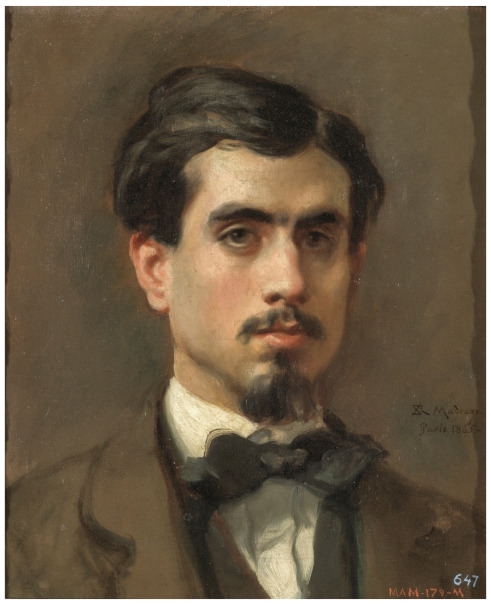
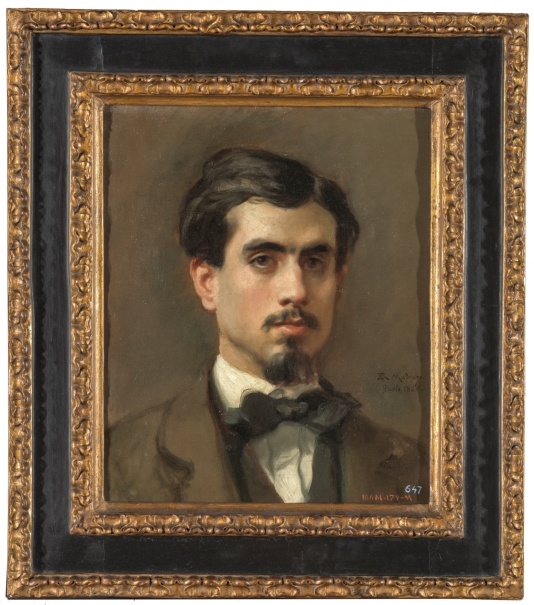
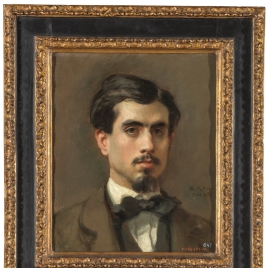
This is a bust portrait of a man whose face looks like that of someone in their early twenties, with strong, angular features. He has full hair, bushy eyebrows, a moustache and a goatee. He wears a frock coat, waistcoat and bow tie, and his gaze is fixed on the viewer.
The name of the artist portrayed in this canvas by Raimundo de Madrazo in Paris had been a mystery ever since the painting was acquired in 1920 by the Museo de Arte Moderno for its artists’ gallery. It was purchased under the ambiguous title of Portrait of the painter Rivas, which has remained in use to the present day, although the Museum´s documentation to date has not shed any light on the matter. However, in the minutes of the Museo de Arte Moderno´s meeting of 6 February 1920, at which the acquisition of the painting was discussed, the sitter is mentioned as the brother of the Minister of Public Instruction, who at the time was Natalio Rivas Santiago (1865–1958). His surname is different since they were brothers only on their father’s side. This is undoubtedly the painter Juan Rivas y Ortiz, who, like the above-mentioned politician, was born in Albuñol (Granada, Spain) and took part in the 1892 International Exhibition once with the works entitled El acechacabras (‘The Goat Stalker’) and Cabeza de gitano (‘Gypsy´s Head’).
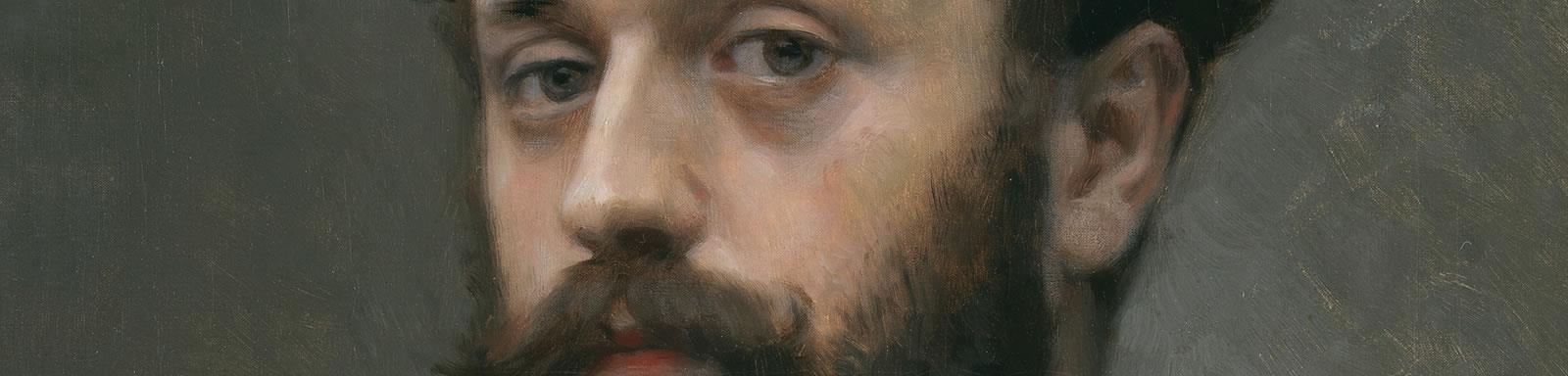
In any case, the portrait is a very interesting piece from Raimundo de Madrazo´s youthful works, in which he approaches the frank and direct realism of the French portrait painting of the time. He employed broad, untied execution, an energetic impasto and great pictorial effect, particularly visible in the design of the clothing. Furthermore, the artist concentrated all his attention on the vigorous modelling of the model´s head, bathed in a violent chiaroscuro that shadows his left side. This artistic trend would change profoundly throughout the painter’s mature production.
The canvas, the stretcher frame of which is French in origin, was acquired by Madrazo from the Vieille house in Paris, its stamp visible on the back.Artistas pintados: retratos de pintores y escultores del siglo XIX en el Museo del Prado, Madrid, Ministerio de Educación y Cultura, Dirección Gener, 1997, p.106