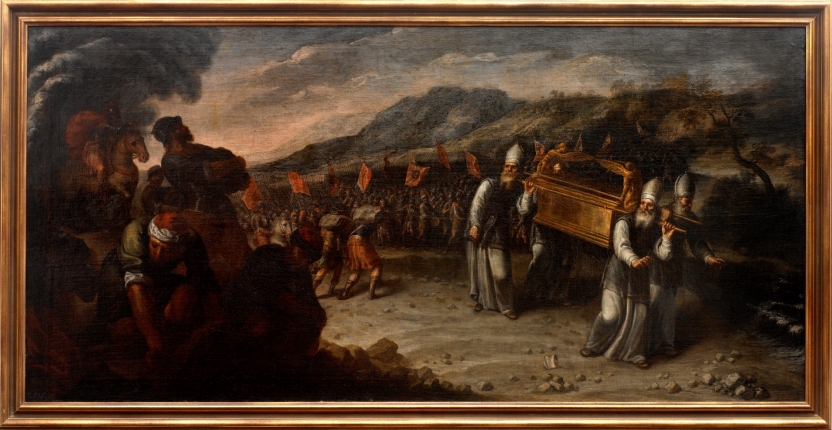
The passage of the Jordan River with the Ark of the Covenant
Ca. 1667. Oil on canvas.On display elsewhere
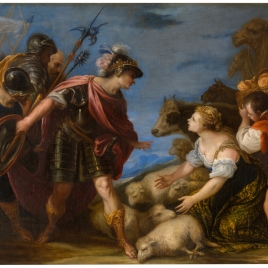
The iconography of this work faithfully depicts the biblical account (Joshua, chap. 3 and 4). For this purpose, the Madrid painter Juan Montero de Rojas opted for a horizontal canvas so that the scene would have a panoramic format. It depicts the passage of the Ark of the Covenant, carried by four Hebrew priests, across the riverbed of the Jordan, dried up by Divine intervention. The figures are elongated, as is typical for the artist. On the left of the composition, there are a number of figures in different poses who appear against the light and occupy almost a third of the work. This use of figures is a resource that adds depth to the representation and was widely used in the Baroque period. The clarity of the rest of the composition contrasts with this scenography resource. The artist has placed the figures on different planes, there is the ark carried by the priests and then the figures collecting and carrying the stones from the riverbed. Finally, between this plane and the mountainous landscape in the background, he has placed the army and people of Israel, ready to follow the Ark of the Covenant, which carried the tablets of the Law that had been received by Moses. Moses, who had died after seeing the Promised Land from Mount Nebo, commissions Joshua to lead his people. The mighty Jordan River stands between their passage and the Promised Land, but will be made to retreat from its course to allow the Israelites to cross behind the Ark. It is Joshua himself, who is perhaps the character depicted on horseback on the left-hand side of the composition, who orders representatives of each of the 12 tribes of Israel to gather 12 stones from the dry riverbed and leave them on the bank to record the miracle that has taken place.
The purpose of this painting is clear, to reveal to all who see it, the intervention and power of the Divine. It was one of a series of seventeen canvases, some of them by Juan Antonio de Frías y Escalante, depicting scenes from the Old Testament. In a way, the Church interpreted these scenes as representations of the Eucharist. The artist executed all of them for the sacristy of the convent of La Merced Calzada in Madrid. This convent, confiscated in 1836 and demolished a year later, occupied what is now the Plaza de Tirso de Molina. It is due to the presence in the convent of Fray Gabriel Téllez, known in the literary world by that name. The paintings that adorned the sacristy were transferred to the Museo de la Trinidad, which was founded precisely to house works from confiscated convents and churches in the provinces of Madrid and the surrounding area. Later, in 1872, it was merged with the then Museo Real de Pintura to create the present-day Museo Nacional del Prado. In the inventory of the Museo de la Trinidad of 1854, it appears erroneously as the ‘Passage of the Red Sea’ and in the 1865 catalogue by Gregorio Cruzada Villaamil it is cited with its true iconography.
Las Edades del Hombre. Toro, Zamora, Aqva, Fundación Las Edades del Hombre, 2016, p.176-177 n.44