The Path of Artistic Glory (sketch)
Ca. 1855. Oil on canvas.Not on display
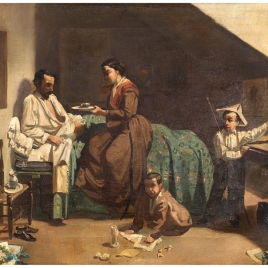
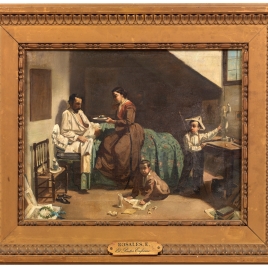
This small painting, entitled The Sick Painter, was acquired by the now defunct Museo de Arte Moderno as a work by Rosales. Now it is part of the Prado´s 19th century collections. The previous attribution was partly due to a misreading of the signature, which was thought to read E. Rosale(s), when it actually reads G. Bande. The letters were somewhat blurred causing the confusion. Indeed, the disputed painting is the work of the painter José González Bande, who also comes from Madrid. He is a practically unknown artist whose artistic activity is barely known.
This small painting is in fact the preparatory sketch for the work entitled The Path of Artistic Glory (P006056). González Bande submitted it to the National Exhibition of Fine Arts of 1856 and, curiously, the State also acquired it for 5.000 reales by Royal Order of 23th of December 1857. Its destination was the Museo Nacional de Pintura y Escultura, which in turn deposited it at the Museo del Ampurdán in Figueras by Royal Order of 26th of May 1887.
The sketch, with its dark, ochre tones, is faithful in all its details to the final painting, except for the logical imprecision of its execution, as is appropriate to its nature as a preparatory work. The study of light is interesting in his composition, as well as the meticulous and faithful description of the modest domestic interior. It is also interesting to note the strand of social criticism that this theme must have implied at the time, as he submitted it to a recently inaugurated official competition, whose pretensions and artistic tendencies could have placed the artist and his work in at least a controversial position (Díez, J. L. in: ‘González Bande and not Rosales. A clarification of the Prado catalogue’, Gazette of the Museo del Prado, volume XI, number 29, 1990, pp. 77–80.)
The large painting was acquired at the exhibition despite not being awarded a prize. Even given the understatement of its artistic quality, the painting palpably reflects the artist´s opinion of the situation of many artists of his time. He interprets his subject with the vision of late Bohemian romanticism, a precedent, in a certain sense, of the thriving realism of the end of the 19th century. The final painting is signed ‘J. Gon.z Bande/Oct.e 1855’ in the lower right corner. Under the sadly ironic title, it depicts a small darkened room, dimly lit by a skylight. Here there is a resigned wife caring for a poor painter, who is lying in bed. Various canvases and tools from his workshop, with which his children play, are scattered around the room. The youngest, at the foot of the bed, is making paper cranes from the pages of a picture book. The eldest son is wearing a cap made of the same material and a maulstick like a rifle as a soldier´s disguise. He takes advantage of his parents´ carelessness to pick up a small plaster model on the table. To the left of the chair that serves as the patient´s bedside table, there is a symbolic laurel wreath resting on some of the painter´s notes. This depicts the testimony of past glories, or the hope of future ones.