The Practice of the Arts
1573 - 1578. Taille douce: etching and engraving on laid paper.Not on display
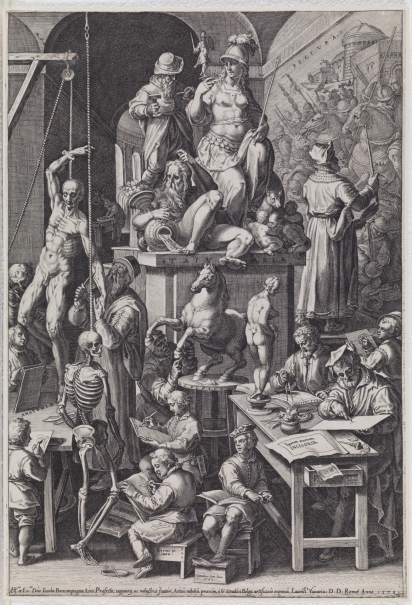
One of the most significant allegorical images of the arts from the end of the Renaissance is this print engraved by Cort after a drawing by Van der Straet, known as Stradanus. The drawing, now at the British Museum, is very detailed and was clearly intended to be engraved. This is clear in the similar size, the reversed composition and the inscription. Dated in 1573, it bears an inscription which clearly indicates that Cort not only engraved the plate but also intended to be its publisher. He made some small changes with regard to the drawing but he succeeded in reproducing the original chiaroscuro through an intensive use of etching, reserving the burin for the final details. The print must have been made immediately afterwards, as it is dedicated to Giacomo Boncompagni, whose position as prefect of Castel Sant’Angelo lasted only until April of that same year. We have no proof, however, that prints were actually pulled in 1573. Indeed, this image was not published until 1578, after Lorenzo Vaccari acquired the plate. It was highly successful, and at least three versions were made. This print can be understood in the context of the efforts of artists since the early Renaissance to elevate the visual arts to the rank of the liberal arts, that is, the intellectual activities that had made up the Trivium and the Quadrivium since the Middle Ages. In that sense, we should point out that all of the figures, both masters and apprentices, wear sumptuous clothing indicative of high social standing. On the other hand, those same fundamentally Italian art circles sought to create institutions such as the academies, where young artists could receive training in theory, surpassing the merely practical instruction offered by guilds and workshops. This scene shows masters and apprentices involved in the practice of the principle artistic activities, which are identified with their corresponding labels. Following the division proposed by Pliny (Natural History, books 34-36) the sculptural arts are split into three categories. The most important is Statvuaria, that is, the carving of hard materials, which takes pride of place in the present scene as a sculptor uses a mallet and chisel to carve a figure of the city of Rome holding, in his hand, a sculpture of Minerva, goddess of the sciences and arts. At her feet, allegorical groups represent the Tiber River and the Capitoline Wolf with Romulus and Remus. A very similar iconography may be found in examples from the following century. Next, we see Scvlptura, that is, modeling, which is represented by another sculptor shaping a rearing horse out of clay. Finally, in the middle ground to the left, we find a representation of Fvsoria, that is, metal casting, which is being carried out by a workman. The other arts appear on the right, beginning with Pictvra, represented by a painter on a scaffold holding a long brush with a cane handle in his right hand and some feathers or pens in his left. With these, he is making a fresco with a battle scene, marking this as a history painting—the highest genre. Architectvra appears at the lower right, where its practitioner is measuring geometric drawings with a compass. Finally, in the foreground on the same table, Incisoria, that is, chalcographic engraving, is very clearly presented, probably due to Stradanus and Cort’s shared interest in this art. Holding a plate in his left hand, the engraver applies a burin with his right. On the table are another burin, some glasses, a case and other engraving and drawing implements. Most of the apprentices (Tyronespicturae) are on the left, separated by a diagonal that runs through the entire composition. They are studying the most important of the sciences associated with the art of drawing: Anatomia. A skeleton hanging by its skull is being copied by four young men while another sharpens his pen—the instrument employed by all of them. The bespectacled master and an aide are busy hanging an ecorché, that is, a cadaver that has been flayed to reveal its musculature and other internal organs as part of the drawing lesson. A single apprentice has separated himself from the group and appears on the right of the composition, about to copy a statue of Venus (text drawn from Docampo, J.: No solo Goya. Adquisiciones para el Gabinete de dibujos y estampas del Museo del Prado 1997-2010, Museo del Prado, 2011, pp. 236-239).