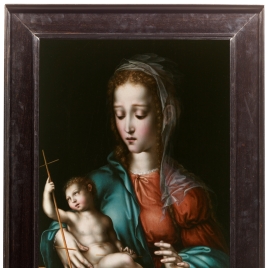
The Virgin and Child with a Spindle
1566. Oil on panel.Room 052C
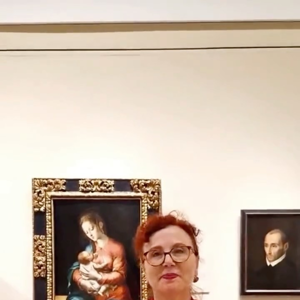
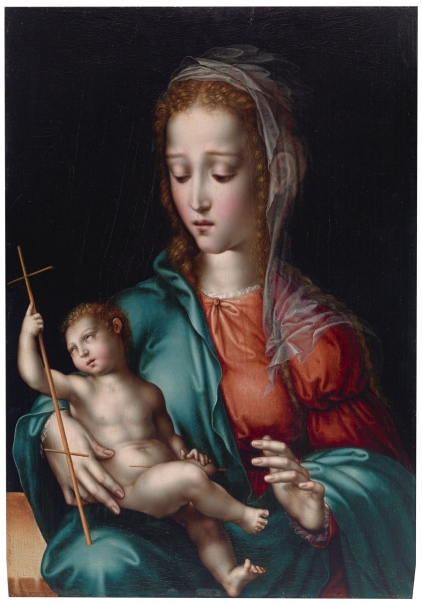
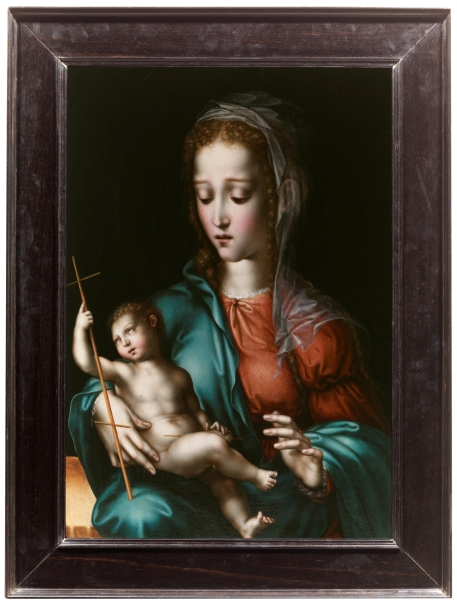
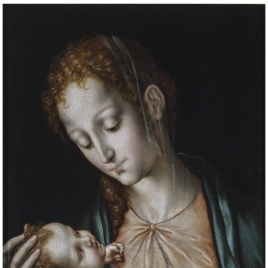
This panel formed part of an altar dedicated to St Anne at Badajoz Cathedral. Commissioned by the bishop at that time, Juan de Ribera (1532-1611), it shows the young Virgin Mary seated half-length against an intensely dark background while the Christ Child, approximately a year old, rests on her lap. Jesus reclines and turns his head to look more intently at a winding frame in the form of a cross, which he grasps with his right hand, while with the other he clutches a small spindle with its ball of thread. The Virgin gently holds the Child back with her right hand, and turns her head with its oval face, serious and tearful, towards her son, while with the left hand, the fingers extended forward, she makes an expressive gesture of sad surprise. This type of representation was a recurrent and popular one within the artist’s devotional work, and four other paintings of his on the same subject are to be found besides this one.
The model for this painting is without doubt the so-called Madonna dei Fusi or Madonna of the Yarnwinder, a work sketched in 1501 by Leonardo da Vinci (1452-1519) and copied with variants by pupils from his workshop, the best examples being the one attributed to Gian Giacomo Caprotti, Salaì (c. 1480-c. 1524), and the one belonging to the Duke of Buccleuch, both dating from 1501-7. In them the Virgin and Child are arranged in a similar way, merely moving from left to right against a landscape background, and both replace the lamb designed by Leonardo, which the Child reaches towards while his mother tries to hold him back, with a domestic object, the winding frame, which also symbolically refers to Jesus’s selfless dedication from his birth until his sacrifice for the redemption of mankind. The allegory envisaged by Leonardo in his sketch was described by the Carmelite friar Pietro Novellara in a letter to Isabella d’Este of 3 April 1501, where he insists that the attitude of the Virgin in holding the Child back in her lap and so preventing his sacrifice symbolised by the lamb, was determined by her maternal instinct, opposed to her son’s firm decision to try to free himself from his mother and hurtle towards the symbol of his sacrifice. The same allegory is perfectly appropriate for interpreting the general sense of the picture by Morales, who, like the Leonardesque painters, has replaced the sacrificial symbol of the lamb with its equivalent, the cross-shaped winding frame.
Elizabeth du Gué Trapier who pointed out the Leonardesque aspect of this picture by Morales, and added that he might not have had to leave Spain to acquaint himself with the model created in Leonardo’s studio, since it was copied by Fernando Yáñez de la Almedina (c. 1475-1540), whose version of the subject was located by the same scholar in the Colección Grether in Buenos Aires. We now know that there were as many as three versions of the Madonna of the Yarnwinder in the Levantine region of Eastern Spain, where Fernando Yáñez de la Almedina and Fernando Llanos (act. c. 1505-1525) both worked. Among them is the one held on long-term loan from the Museo del Prado by the Museo de Bellas Artes in Murcia, which is attributed to Fernando Llanos.
At all events, Morales offers a very personal version of the subject, enveloping it in an air of sombre anguish by making the afflicted mother’s face thinner while she sheds three tears from her beautiful eyes, nearly hidden by the eyelids, and accepts and resigns herself to the divine will. In this, the painter is probably following the text from St Luke’s Gospel (2, 34-36), where the aged Simeon is said to have prophesied to Mary, during her presentation of her new-born son in the temple of Jesusalem, that a sword would pierce her soul. The execution of the panel is minute and delicate, as is clear especially in the subtle veil that covers the Virgin’s head, with her left ear and the strand of hair that hangs down on the shoulder both visible through its transparency. The bluish mantle leaves part of the bust uncovered, revealing a tunic of an intensely contrasted vermilion. The state of conservation is excellent, which allows the painter’s incomparable technical skill to be better appreciated (Text drawn from Rodríguez G. de Ceballos, A. in: The Divine Morales, Museo Nacional del Prado, 2015, pp. 109-110).