Bibliography +
Davies, D., Paintings and Drawings on the Backs of National Gallery Pict..., The Trustees, 1946, pp. lám 13.
Trens, Manuel, María: iconografía de la Virgen en el arte español, Plus-Ultra, Madrid, 1946, pp. 479/ lám.286.
Post, Chandler Rathfon, A History of Spanish Painting T.X The Early Renaissance in Andalusia, X, Harvard University Press, Cambridge, Massachusetts, 1950, pp. 263.
Longhi, R, Comprimari spagnoli della maniera italiana, Paragone, 43, 1953, pp. 3-15.
Gudiol Ricart, José, Pintura gótica, Ars hispaniae: historia universal del arte hispánico IX, Madrid, 1955, pp. 225/ lám.234.
Griseri, Andreina, Perino, Machuca, Campaña, Paragone, 87, 1957, pp. 13-21.
Carlos V y su ambiente: exposición-homenaje en el IV Centenario de su muerte (1558-1958), Ministerio de Educación Nacional, Toledo, 1958, pp. 86.
Griseri, Andreina, Nuove schede di manierismo iberico, Paragone, 113, 1959, pp. 33-70.
Gonçalves, Flavio, Os painéis do Purgatório e as origens das 'alminhas' populares, Boletim da biblioteca pública municipal de Matosinhos, 6, 1959, pp. 1-37.
Griseri, Andreina, Berruguete e Machuca dopo il viaggio italiano, Paragone, 179, 1964, pp. 3-19 [17].
Sricchia Santoro, Fiorella., Classicismo e Manierismo enl Nord. SStoria de la Pittura, Vol.XI., Fratelli Fabbri editori, Milan, 1966.
Longhi, Roberto, Ancora sul Machuca, Paragone, 231, 1969, pp. 34-39.
Post, Chandler Rathfon, A History of Spanish Painting, Harvard University Press, Cambridge. Nueva York, 1970, pp. 263/ lám.97.
Santa Teresa y su tiempo, Ministerio de Educación y Ciencia, Madrid, 1970, pp. 110.
Sánchez Cantón, Francisco Javier, Museo del Prado. Catálogo de las pinturas, Museo del Prado, Madrid, 1972.
Kalby, Luigi G., L' arrivo della maniera a Napoli e Agostino Tesauro, Bollettino di storia dell' arte del centro studi per i nuclei antichi e documenti artistici della Campania meridionale., 1, 1973.
Dacos, Nicole, Le Logge Di Raffaello: Maestro e Bottega Di Fronte All'Antico, Istituto Poligrafico Dello Stato, Roma, 1977, pp. 113.
Buendía, R., 'La pintura española del siglo XVI". En: Historia del Arte Hispánico vol III. El Renacimiento, Alhambra, Madrid, 1978, pp. 197-302 [253].
Previtali, Giovanni, La pittura del Cinquecento a Napoli en el vicereame, Einaudi, Turin, 1978, pp. il.24,25.
Longhi, Roberto, Edizione delle Opere Complete di Roberto Longhi., Sansoni, Florencia, 1979, pp. lám.94.
Gómez-Moreno, Manuel, Las Aguilas del Renacimiento Español. Bartolome Ordoñez, Diego de Siloé, Pedro Machuca, Xarait Ediciones,, 1983, pp. 100.
Dacos, Nicole, 'Pedro Machuca en Italie' En: Scritti di storia dell' arte in onore di Federico Zeri, II, Electa,, Milan, 1984, pp. 332-361 [332-337].
Cannata, R., Aspetti Dell'Arte a Roma Prima e Dopo Raffaello, De Luca Editore, Roma, 1984, pp. 127/ lám.46.
Museo Nacional del Prado, Catálogo de las pinturas, Museo del Prado, Madrid, 1985, pp. 382.
Giusti, Paola, Forastieri e Regnicoli. La Pittura Moderna a Napoli Nel Prim, Elcta, Nápoles, 1985, pp. 43.
Abbate, Francesco, Andrea Sabatini. Trittico. 1519. In, Andrea Da Salerno Nel Rinascimento Meridionale, Centro Di, 1986, pp. 140-141.
Dacos, Nicole, Pedro Machuca. In, Andrea Da Salerno Nel Rinascimento Meridionale, Centro Di, 1986, pp. 248-249.
D' Aniello, Antonia, Agostino Tesauro. Madonna delle Grazie fra Sant' Andrea e Santa Luzia post dicembre 1517. In, Andrea Da Salerno Nel Rinascimento Meridionale, Centro Di, 1986, pp. 140-141.
Giusti, P., Pittura del Cinquecento a Napoli. 1510-1540 Forastieri e Regnicoli, Electa Napoli, Napoles, 1988, pp. 36-37,43 il.31.
Brown, Jonathan, La Edad de Oro de la pintura en España, Nerea, Madrid, 1990, pp. 34/ lám.31.
Scaramella, Pierroberto, Le madonne del Purgatorio: iconografia e religioni in Campania tra rinascimento e controriforma, Marietti, Genoa, 1991.
Cassani, Silvia, Pedro Machuca a Napoli : due nuovi dipinti per il Museo di Capodimonti, Electa Napoli, Napoli, 1992.
Marías, Fernando, El siglo XVI: gótico y renacimiento, Introducción al Arte Español, Madrid, 1992, pp. 104.
Museo Nacional del Prado, Museo del Prado. Inventario general de pinturas (III). Nuevas Adquisiciones. Museo Iconográfico. Tapices., Museo del Prado, Espasa Calpe, Madrid, 1996, pp. nº1677.
Brown, Jonathan, Painting in Spain 1500-1700, Yale University Press, Yale, 1998, pp. 32/ lám.43.
Cali, Maria, La Pittura del Cinquencento, Utet, Torino, 2000, pp. 127.
Leone de Castris, Pierluigi, Polidoro Da Caravaggio :L'Opera Completa, Electa, Nápoles, 2001, pp. 79.
Ruiz Gómez, Leticia, El Greco y la pintura española del Renacimiento: guía, Museo del Prado, Aldeasa, Madrid, 2001, pp. 38.
Goffen, Rona, Signatures: Inscribing identity in italian Renaissance art, Viator, 32, 2001, pp. 303-370.
Boubli, Lizzie, Inventaire général des dessins : école espagnole, XVIe-XVIII, Réunion des musées nationaux, Paris, 2002, pp. nº 12.
Portús Pérez, Javier, La colección de pintura española en el Museo del Prado, Edilupa, Madrid, 2003, pp. 182.
Burg, Tobias, Die signatur. Formen und Funktionen vom Mittelalter bis zum 17. Jahrundert,, Verlag, Berlin, 2007, pp. 321-322.
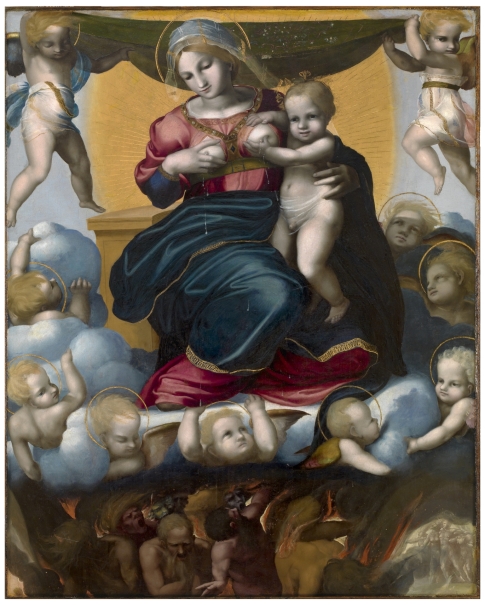
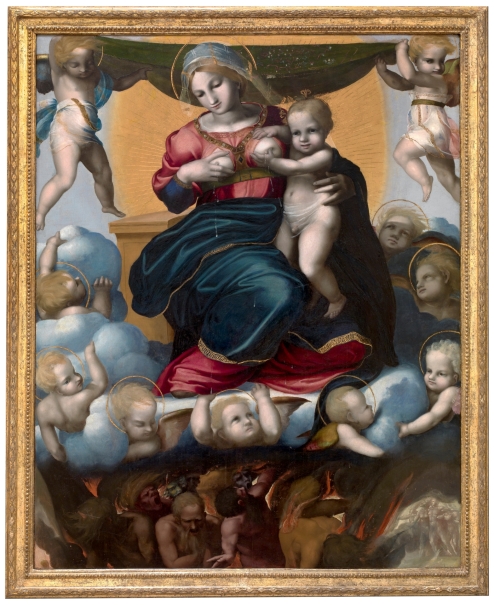
Avila, Ana, La Virgen con el Niño y las almas del Purgatorio de Pedro Machuca y su vinculación italiana., Archivo español de arte, LXXXV, 2012, pp. 125-146.
Bisceglia, Anna, 'Pedro Machuca: Madonna del Suffragio' En:, Norma e capriccio. Spagnoli in Italia agli esordi della 'maniera moderna', Giunti, Firenze musei, Firenze, 2013, pp. 294-295, n. V.2.
Agosti, Barbara, 'Artisti spagnoli e fonti italiane ' En:, Norma e capriccio. Spagnoli in Italia agli esordi della 'maniera moderna', Giunti, Firenze musei, Firenze, 2013, pp. 156-167 [165-166].
Bisceglia, Anna, Roma e gli spagnoli agli inizi del Cinquecento: La Sistina, Raffaello, le logge vaticane, Norma e capriccio. Spagnoli in Italia agli esordi della 'maniera moderna', Giunti, Firenze musei, Firenze, 2013, pp. 106-119 [112-117].
Olszewski, Edward J., Parmigianino's Madonna of the long neck., American Philosophical Society, 2014, pp. 148 fg.4.30.
Leone de Castris, Pierluigi, Andrea Sabatini da Salerno: il Raffaello di Napoli /, Arte'm,, 2017, pp. 113-115.
Leone de Castris, Pierluigi, Su Machuca e Raffaello, tra Roma e l' Italia meridionale, Confronto, 1, 2018, pp. 72-87.
Campos Pallarés, Liliana, Pedro Machuca en Italia y en España: su presencia y huella en la pintura granadina del Quinientos, Editorial Universidad de Jaén,, 2021, pp. 115-118 nº.6.
Molina Figueras, Joan, 'Pedro Machuca. La Virgen de las ánimas del Purgatorio', Otro Renacimiento: artistas españoles en Nápoles a comienzos del Cinquecento, Museo Nacional del Prado, Madrid, 2022, pp. 256-258 nº 44.
Molina Figueras, Joan, 'Pedro Machuca. Madonna delle Grazie con le anime del Purgatorio ( Madonna del Suffragio)', Gli Spagnoli a Napoli: il Rinascimento meridionale, Arte'm,, 2023, pp. 262-264 nº37.