The Virgin Annunciate
1480 - 1500. Oil on walnut panel.Not on display
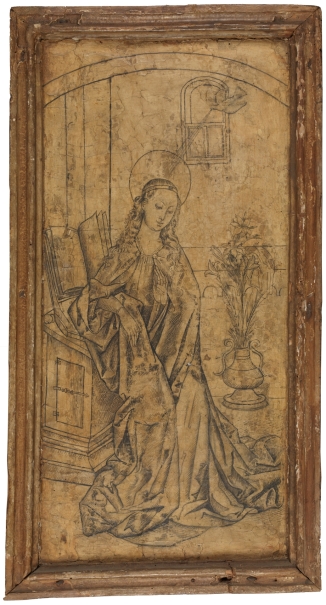
Of unknown origin, this is an unparalleled and distinct work of art amongst those produced by Castilian painters at the end of the 15th century. A priori, this drawing might be considered as the underlying drawing of another work that the painter left unfinished, without applying the pictorial layer. Nevertheless, it looks more like an unfinished monochrome painting – usually known as grisaille – made for the exterior of the two side panels of a triptych, as was the case with The Triptych of the Nativity by Master of Avila, located in the Museo Lázaro Galdiano in Madrid. It is worth noticing how carefully the drawing has been executed in its outline and completed shading, which is not the case for the underlying drawings. However, like underlying drawings, it has certain changes in composition in this case in the Virgin panel, namely in the bench drawn on the right side of the panel that is partially covered by lilies.
Given the way the drawing was finished and the way the modelling was carried out, it has not yet been possible to attribute the work without being able to compare it with the known underlying drawings of the Hispano-Flemish painters. Nonetheless, of all known artists, the closest one is Pedro Berruguete. The chosen human models – not to mention the length of curly hair and how it is made – are not dissimilar to those of the artist from Palencia; this is also noticeable in the Archangel’s chin and nose as well as the inclusion in the scenes of a diaphragm arch – a lowered one, as this painter often depicts – that allows us to see the interior of the scene in which the Annunciation is taking place between Gabriel and Mary.
The composition is indebted to the Flemish models, yet there is no known composition from which it is based. As was typical, the Virgin is placed before a prie-dieu, but oddly enough (although not necessarily unusual) she is displayed with a book – ‘huge’, as only Pedro Berruguete depicts them – leaning on a wall and turning her body to the Archangel, with her right arm resting in the prie-dieu and holding her mantle with her hand. Gabriel’s posture is also far from typical, holding the phylactery with his left hand and the sceptre with his right. In Flemish grisailles, it is not uncommon for the Virgin to appear on the left panel and the Archangel on the right; but the most recurrent arrangements regarding the phylactery are those in which it is twined up the sceptre or unfolded in the painting’s surface without being held by the Archangel, as in Pedro Berruguete’s works.
In taking into account these aspects of the two panels, they are very likely to have been by a Castilian painter working between 1480-1500 and closely linked in some way to Pedro Berruguete, whose style he imitates in the shape of the Virgin’s face as well as in the huge book. So far, there are not enough arguments to assert that this work might have been by him, especially if compared with how he represented this iconographic theme after returning from Italy, with the distinguishing brush of the Italian painting. An exception should be made in his Annunciation in the Miraflores Charterhouse, in which he followed the Flemish models at the request of his commissioner, Queen Isabella the Catholic.
Museo Nacional del Prado, Memoria de actividades 2009, Madrid, Museo Nacional del Prado, 2009, p.16-17