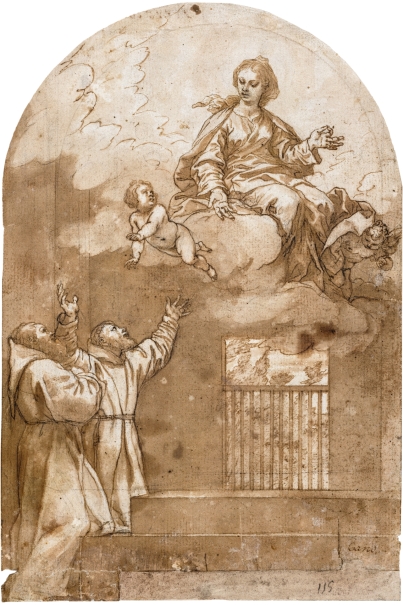
The Virgin Appears to Saint Felix of Cantalice
1653 - 1657. Grey-brown wash, Pencil on laid paper.Not on display
In the upper right register, the Virgin is seated on clouds and the Christ Child moves away from his mother towards Saint Felix, whose open arms await the little one entrusted to his care. In the lower left register, Saint Felix and another Capuchin monk kneel on the steps of a stone platform in a monastic cell. Through the open balcony, the foliage outside can be perceived.
The very well developed technique of this drawing is consistent with that of other finished drawings of this composition produced by Cano in the 1650s and the 1660s. The large dimensions of the sheet are unusual and suggest that it may be a drawing to have been formally presented to the Capuchin community for their approval before executing the painting that is currently held in Cadiz (Museo de Bellas Artes).
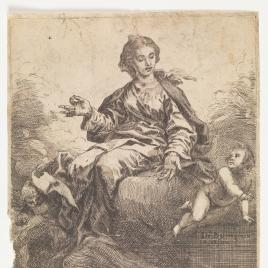
An engraving by Diego de Obregón also exists, in which the inverted figure of the Virgin is used as Saint Apollonia (National Library). Cano is credited with inventing the design ALoCANOINV. The peculiar gesture of the Virgin’s left hand appears more appropriate for Saint Apollonia than for the Virgin, since, at least in the drawing, she does not hold any objects (in the painting in Cadiz, she holds a branch of lilies between her fingers).
This finished drawing shows extraordinary restraint compared to the energy of Cano’s pen sketches. Each element in this composition has been so successfully executed that the formal choreography imagined by Cano is perfectly transferred to the paper without a single brushstroke out of place. This illustrates the perfection and precision with which Cano organised his compositions. This compositional skill is exemplified by the open fingers of the Christ Child centred in an engraved vertical line. It aligns perfectly with the step on which the saint is kneeling. Furthermore, the left foot of the Christ Child aligns perfectly with the central axis of the composition’s main arch. This drawing allows observation of Cano’s method. In this method, he establishes an underlying geometric sequence for the composition before adding the figures and developing the contrast between light and shadows, He also performs a skilful definition of form. This clearly executed composition would have fully satisfied a drawing intended for presentation to the Capuchin clients.
Veliz, Zahira, Alonso Cano (1601-1667): dibujos, Santander, Fundación Marcelino Botín, 2009, p.314-317; nº 59