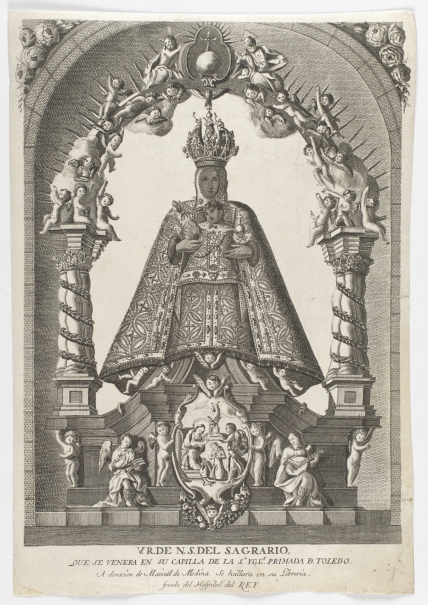
The Virgin of the Sagrario in Toledo Cathedral
Second half of the XVIII century. Taille douce: etching and engraving on wove paper.Not on display
The history of the important Spanish devotion of the miracle of the Virgin of the Sagrario in Toledo, widely disseminated through paintings and prints, highlighted two remarkable events: firstly, that the Virgin, in a miraculous act, had descended from heaven to honour Saint Ildephonsus by presenting him with the chasuble, in a scene reiterated in iconography; and secondly, that she had then embraced her own sculptural representation, endowing the object with divine status, thereby converting it into an active instrument of persuasion. This tradition of the Virgin’s gesture of breathing life into her image was also included in the book published in 1617 to mark the installation of the sculpture in its new chapel, indicating the nature and purpose of the divine embrace: “around which it is said that she threw her arms, when she set her sacred feet in this holy church, embracing it sweetly, to convey to it through contact the virtue of working all the miracles it has done”.
Arias Martínez, Manuel, Darse la mano. Escultura y color en el Siglo de Oro, Madrid, Museo Nacional del Prado, 2024, p.70-71