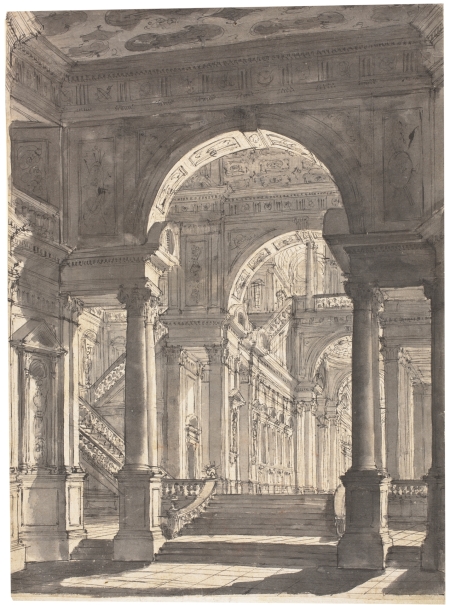
Theatre set
Early XVIII century. Grey wash, Pencil on dark yellow paper.Not on display
The son of painter Giovanni Maria Galli da Bibiena and brother of Ferdinando Galli da Bibiena, Francesco was raised in a family of artists and took an early interest in architecture and set design. He worked in various Italian cities before being appointed architect to the court of Mantua and moving to Vienna, where he took charge of the construction of the new opera theatre. Later trips took him to London and Nancy, but by 1726 he was settled in his native Bologna again, where he became director of the Accademia Clementina.
This drawing is a fine example of the architectural fantasies that characterise Francesco’s oeuvre: highly developed, late-baroque models in the manner of Andrea Pozzo or the quadraturista masters of Bologna. It depicts an imaginary palatial indoor scene in which arches, regal stairways and sculptural niches follow each other in perspective. This fanciful character contrasts with Francesco’s architectural designs for real buildings (for example, his drawings for the Nancy Theatre, now in the Metropolitan Museum of Art, New York, or some of his drawings for the opera in Vienna). Similarly, the sketchy nature of the ornamental details of this drawing contrast markedly with his more rigidly drawn architectural plans. This and the stagelike perspective seen here indicate that this drawing is related to one of his numerous theatre designs, which were also known in his time through prints.
Here, Francesco draws on his experience as an architect, knowledge of mathematics, geometry and perspective to create the impression of depth in his set design, marked by contrasting light and shadows. Its grandiloquent character recalls the later glorification of classical architecture by artists such as Giovanni Battista Piranesi. It is well known that Francesco strongly influenced Piranesi’s work, evident in Etching no. XI of his Imaginary Prisons series, first published 1750. Francesco’s effect on Piranesi is even more apparent in his spectacular drawing Cortile di fortezza (Museo Nacionale de Arte Antiga, Lisbon) (Texto extractado de Carlos Varona, M. C. de,: Italian Masterpieces. From Spain´s Royal Court, Museo del Prado, 2014, p. 254).