Treaty of Cambrai
1871. Oil on canvas.On display elsewhere
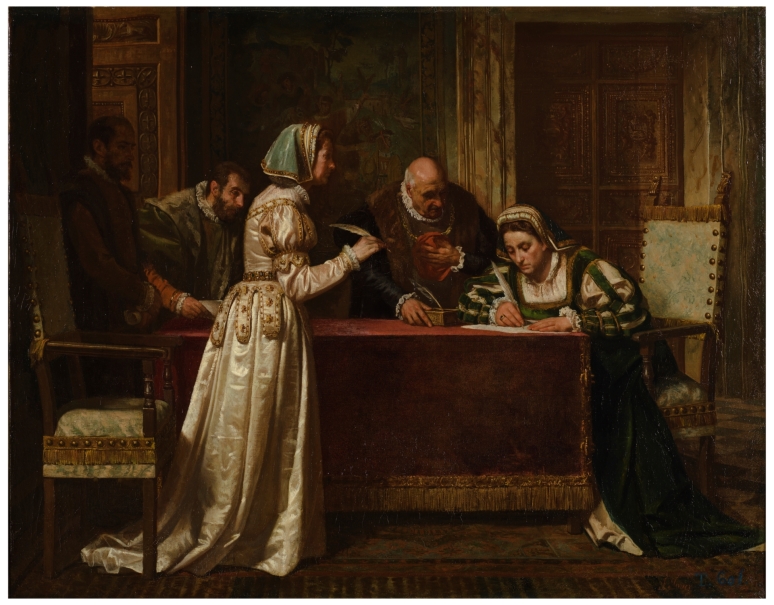
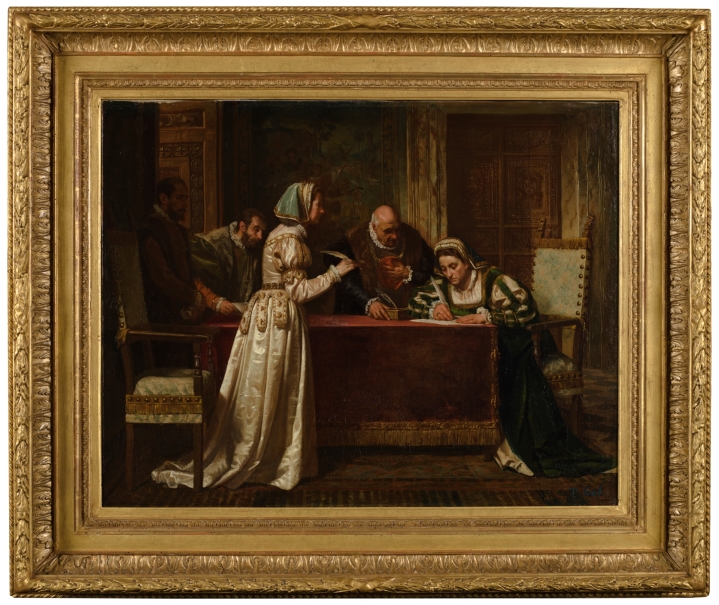
The painting depicts Margaret of Austria and Louise of Savoy at the moment of the signing of the treaty that put an end to the aspirations of the French King Francis I over Italy, among other economic and territorial concessions that the agreement entailed. The Spanish General History (Historia general de España) by Modesto Lafuente relates the signing of the peace treaty in these terms: ‘having agreed to meet in Cambrai, they alone, without intermediaries, without noise, without ceremony or formalities, held their conferences aimed at such a laudable goal. These were Margaret of Austria, widow of Savoy, aunt of the emperor, and Louise of Savoy, mother of Francis I of France [...] Their amicable negotiations resulted in the Peace of Cambrai (5th of August 1529), otherwise known as the Ladies’ Peace.’
The painting was exhibited at the National Exhibition of Fine Arts in 1871. It is an academically correct work in which there is a laudably dramatic treatment of the historical garments and close historical attention paid to accurate reproduction of the objects, while the historical presence of the protagonists is conveyed in the treatment of their physiognomies. This work immediately became a very popular iconography of the event: even the Spanish History (Historia de España) by R. del Castillo, published almost at the same time as the exhibition, used it to illustrate the passage (Barcelona, 1871–1872, vol. III, chap. XXXIV.)
The thematic interest of this episode lies on the one hand, in the benefit for the Emperor Charles V resulting from the clauses of the treaty, which, for Spanish historians, was a symbol of the improvement of Spain´s international interests, and therefore, to its triumphal elevation on the world stage. On the other hand, the notable participation of two women in this process, which was seen both as a picturesque historical exceptionality and as an edifying example of the role that women began to play in the political evolution of the 19th century.
La época de Carlos V y Felipe II en la pintura de historia del siglo XIX [comisario, Carlos Reyero], Madrid, Sociedad Estatal para la Conmemoración de los Centenarios de Felipe II y Carlos V, 1999, p.206-207