Triptych of the Holy Family
1588. Oil on panel.Not on display
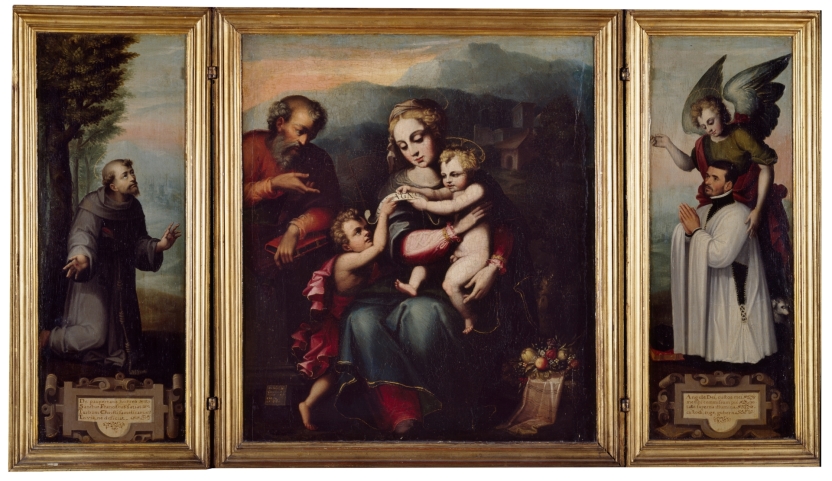
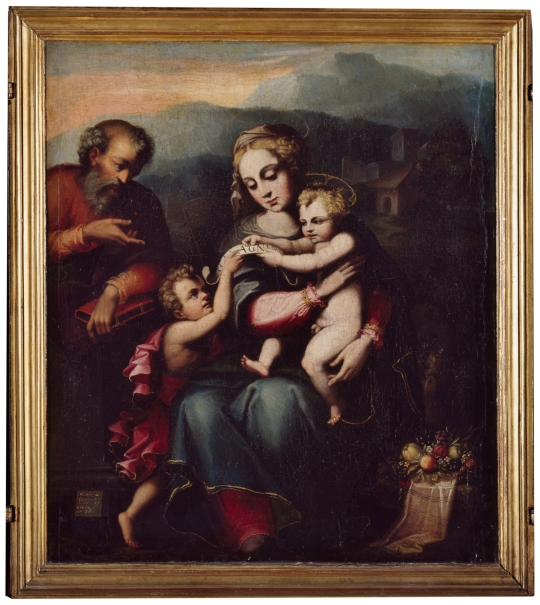
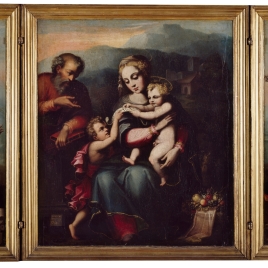
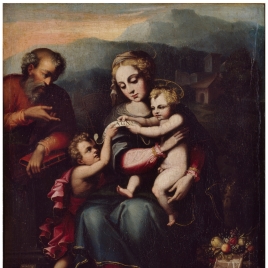
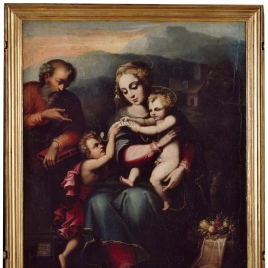
The quality of this triptych of the Holy Family is exceptional among the work of Gabriel de Cárdenas. It was signed in 1588 in no uncertain terms. The findings of Angulo in his study on the artist and the triptych are essential. For the central panel of the Holy Family with the Infant Saint John the Baptist, Cárdenas takes as a source the Madonna of the Rose by Rafael, introducing various but not fundamental modifications: mainly the incorporation of the landscape background and the greater amplitude of the framing, which allows him to make the full-length figures with slightly incomplete legs. In the lower band on the right, Cárdenas includes a small still life with fruit that represents his main contribution and one of the greatest achievements of the panel, which Angulo considers to be a possible sign of a relationship with the Toledo school and particularly with Blas de Prado.
There are some other minor alterations in the hands of the Virgin, in the mantle of the Infant Saint John the Baptist which is very curled, in the mannerist taste, or in the somewhat unusual representation of Joseph with a book as an iconographic attribute. Despite the artist´s inclination towards sfumato, the work still seems rough in comparison with the original. It is worth noting that the artist has chosen a different technique, using shorter, thicker brushstrokes with small luminous hues.
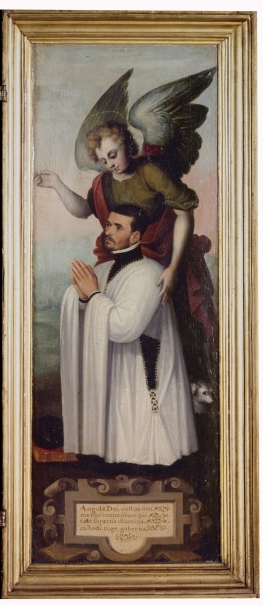
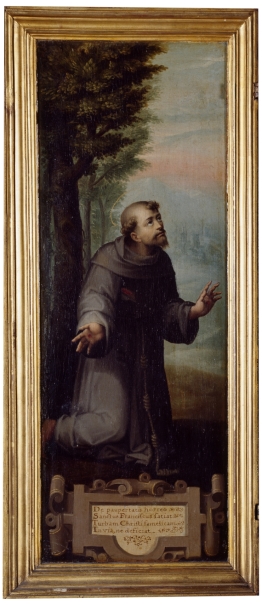
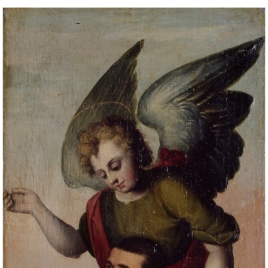
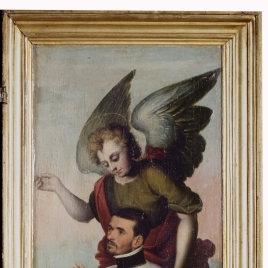
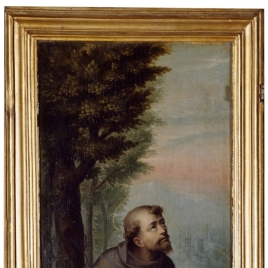
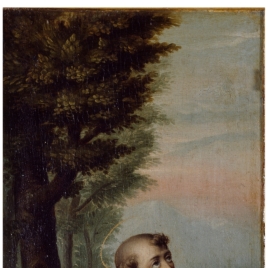
On the side panels appear the Stigmatization of Saint Francis and the Guardian Angel with a donating clergyman. There are compositions of iridescent lights in which greater attention is paid to the landscape backgrounds similar between them as well as Mannerist cartouches with Latin inscriptions on the lower part. The figures are smaller than those on the central panel. The identity of the donor is unknown. He is kneeling, with a book and his bonnet on the ground next to him. A dog, presumably related to demonic symbolism, appears behind him. It should be noted that the painting lacks profundity in some aspects. The features of Saint Francis, kneeling in front of a celestial radiance, are similar to those of Saint Joseph; and the trees, which are directly behind Saint Francis, create the compositional counterpoint to the figure of the Guardian Angel on the opposite panel.