Two Head Studies for an Immaculate
1855. Oil on canvas.Not on display
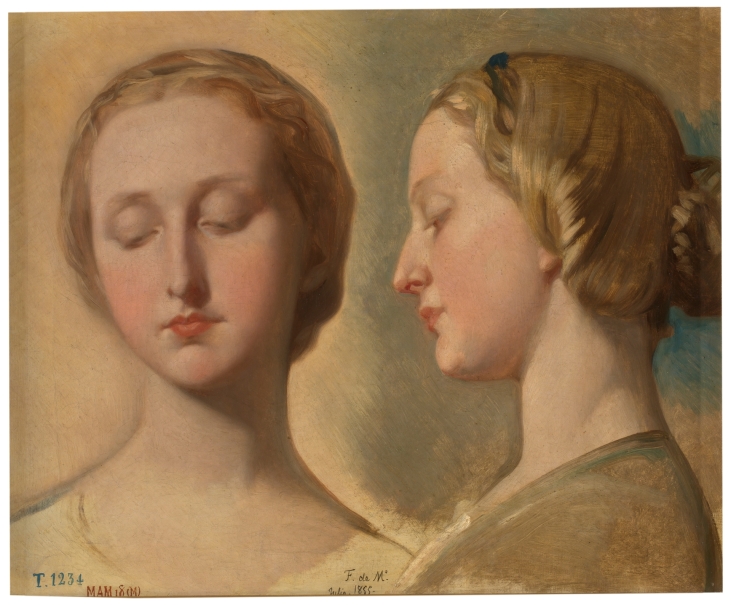
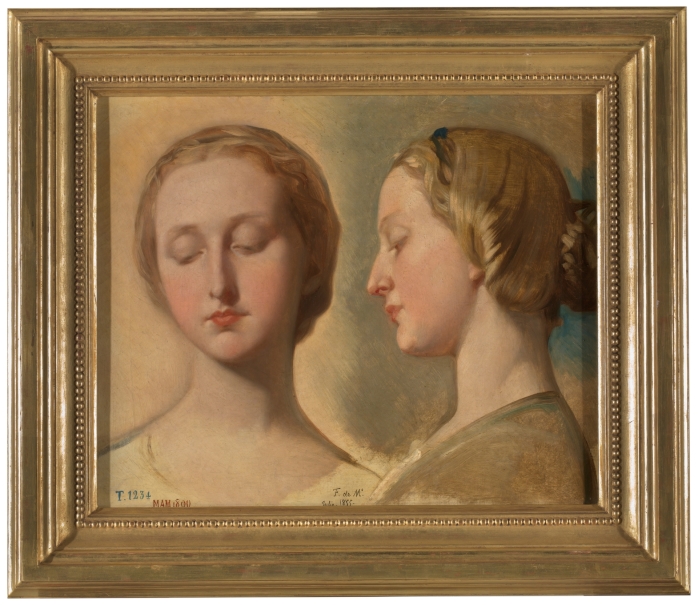
These are two short-length bust studies of a female head, one of them is facing the front and the other in strict profile. She has an almond-shaped face, large eyelids, long nose and very short mouth. Her blonde hair is tied up in a bun and adorned with a blue ribbon.
The model is traditionally identified with Federico de Madrazo´s eldest daughter, Luisa, who was then nineteen years old and whom he portrayed in a painting of 1866. However, there are sufficient differences in the physiognomy of her face, considerably broader and rounder, to suggest that Madrazo may in fact have wished to capture his prototype of feminine beauty in these pleasing studies. The artist resolves his portrait in a logical idealisation in view of the subject’s destiny, displaying in this important traces of the Nazarene heritage in which the artist was trained and which marks his entire religious output.
The nature of these studies has always been specified as preparatory for an Immaculate Conception, but the work for which they were painted was unknown. They were executed for an Immaculate Conception of 1855 –which is kept in a private collection– and it was not until 1994 that the preparatory sketch of the painting became known. It broadly repeats the compositional scheme of the other large Immaculate painted in 1856. It may even be a preparatory sketch of this, as mentioned in the Inventory of Assets drawn up on the death of Federico de Madrazo. However, the model of the Virgin is different, with a face similar to that of the present studies but with a change in the appearance of her hair, which is darker and very long, falling down her back.
The execution of this study is extremely fluid, achieved thanks to a clear preparation and a very thin material. The artist tries to capture the supernatural luminosity of the cloud of glory that outlines the silhouette of the Virgin in the sketch of the overall composition. On the other hand, these studies bear witness to Madrazo´s special mastery in the handling of light. He executed the frontal sketch of the head against a very light background. This way, he modelled its volume by means of lighting, which comes from the left. This produces a strong chiaroscuro, while the profile drawing shows the opposite effect.
Díez, José Luis, Federico de Madrazo y Kuntz (1815-1894), Madrid, Museo Nacional del Prado, 1994, p.256 nº47