View of the city of Seville
Late XVI century. Oil on canvas.On display elsewhere
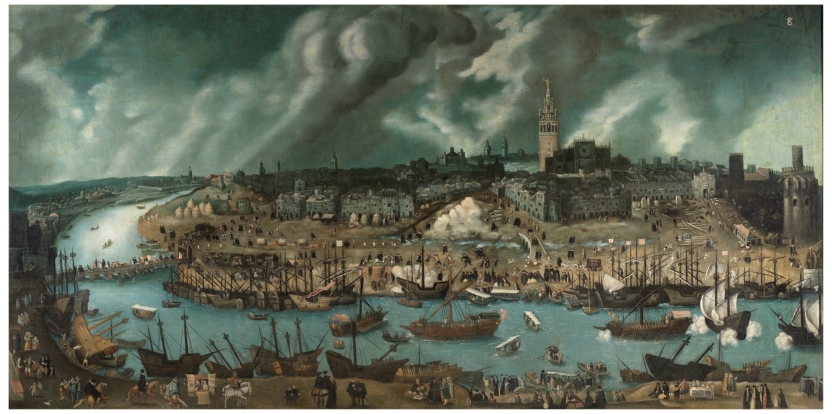
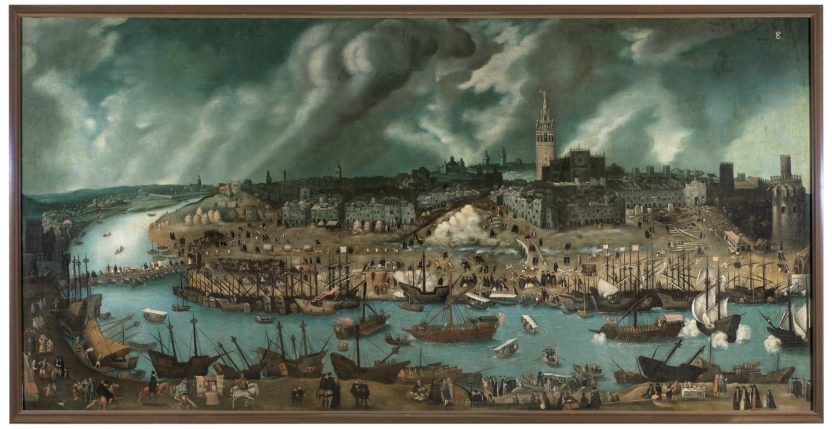
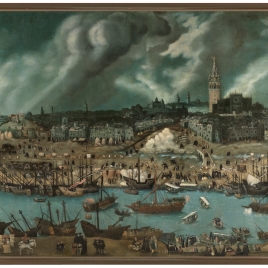
The painter depicts the city from a high viewpoint to capture a better planimetric perspective of its urban and environmental setting. The Giralda, which dominates the vertical axis of the scene, forces the viewer to look upwards, where a disturbing grey sky, with diagonally projecting clouds, dominates the pictorial space. The river bends its course in perspective towards the background, forcing the viewer´s attention to the left side, where the city is growing. Nonetheless, the horizontal dominates in this panoramic view of Seville. In addition to its artistic value as a landscape, the documentary importance of the painting is also of considerable worth. The realism of the painter´s view guarantees a journey through time with connotations that go beyond the literary sources.
All the feverish activity of Seville, which at this time is both an emporium of wealth and power and the meeting of two worlds, surrounds the construction of the cathedral to compete with the richest in Christendom. The structure dominates, against the light, with its mass of stone beneath The Giralda, whose facade stands out brilliantly against the greyish tones of the canvas. The various ships, the activity of the shipyards, the utensils on the quay and the bustle of the people are all examples of the city´s everyday life. In addition to this historical and documentary value, this painting is an example of what we understand as genre painting, in which the acts and events of everyday life enliven the architectural setting. There are no perceptible prophetic visions of the Church, nor any militant and dynastic propaganda. It is difficult to see in this city a reflection of sadness for the oppression of Castile, as was mentioned in a previous description of the painting, when all the wealth of royal power was transferred to this city imprinted by Islam. For the anonymous painter, the city is not an ordinary topographical layout but a peculiar space that bears witness to customs, a flourishing economy and the irrepressible vitality of its openness to the river.
The buildings can be clearly identified, which demonstrates the painter´s objectivity and powers of observation. Such costumbrist paintings are not common in Spain and the sketches derive from contemporary Flemish engravings where this type of painting is widespread. Many engravings and paintings of this type were imported from Flanders. It is important to remember that there were houses in Seville devoted to the trade in paintings from the Netherlands. The clashes between swordsmen and soldiers suggest a festive entertainment that is also repeated in the engravings, but which does not exude dramatic tension. There are various types of boats, particularly the galleys with many oars, decorated with pennants. Gunpowder salutes greet the arrival of the ships and lighten the mood. In the central plain there is a bridge with two openings to ford the riverbed of a stream of the Guadalquivir. The stacked logs and storage huts on the quayside are evidence of port activity. We have identified, through contemporary engravings, Wyngaerden´s views of Seville from the end of the century and, more interestingly for us, Joannes Janssonius´s view of Seville from the Triana suburb in 1617. We have also consulted the versions from the British Museum in London and the Museo Naval in Madrid. On the left of the canvas, against the light, we can see the building of the Holy Inquisition, the Triana bridge with its gate rebuilt in 1558 and, on the right, the Arenal gate, rebuilt by Hernán Ruiz in 1566. Next, there is one of the entrances to the Atarazanas, perhaps the Aceite gateway, which is followed by another with the royal coat of arms. The latter stands out due to the light that falls on the facade in contrast with the gloom of the neighbourhood that extends inside the walls. Between this gate and the Torre de la Plata is the Postigo del Carbón, known as the Póstigo de los Azacanes del Oro, built by Alfonso X at the same time as the Atarazanas and rebuilt in 1667. The walls are enclosed by the towers of La Plata and El Oro. To the left of the cathedral, we can distinguish the towers of San Agustín and San Francisco, and two others that could, according to their location, be the churches of El Salvador and Santa Catalina. The Casa Profesa de los Jesuitas appears even clearer throughout the city. Its ostentatious dome dominates the space in the area that Alonso Morgado considers ‘the most privileged in the city’ (History of Seville containing its antiquities, greatness and memorable things that have taken place there since its foundation up to the present day, Seville, 1587, p. 145). The Monastery of San Pedro is remarkable for its 14th century tower, rebuilt in the 16th and 17th centuries, and the walls of the monastic rectangle. The church of San Salvador is a 9th century Moorish building that was converted into a Christian temple which, destroyed at the end of the 17th century, was later rebuilt. The Monastery of San Pablo, in the district of La Magdalena, the largest of the four monasteries of this order in Seville, was founded in the 13th century and enlarged in the following centuries. It collapsed in 1691 and was rebuilt in the 18th century and ‘does not exist today in the name of progress’. To the left of the Casa de los Jesuitas, the towers of these buildings are silhouetted against the sky. Finally, it is fascinating to distinguish, in the labyrinth of private buildings, the Columbus mansion. In Joris Hoefnagel´s intaglio engraving of 1565, Civitates orbis terrarum by G. Braun and F. Hogenberg (Cologne, 1572), it already appears as a prominent building. In Janssonius´s print, the house of Ferdinand Columbus, son of the admiral, is indicated as one of the most important in Seville in the 16th century. It is recognisable by its gallery of five high arches in the interior of the walled city, near the Guadalquivir and opposite the Monastery of las Cuevas. In the engraving, it is confused between the trees and is more visible and frontal in the painting we are discussing. On the far right of the city, the crenellated towers of the walled belt line up. Behind the cathedral and on the other bank of the river, in Triana, the silhouette of the horizontal monastery of the Cuchos, with its vertical spire, is outlined in the background.