Portrait of an Unknown Young Woman
1567 - 1570. Oil on panel.On display elsewhere
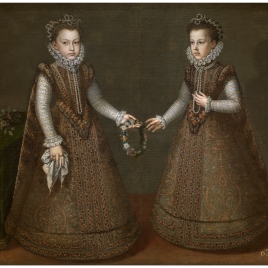
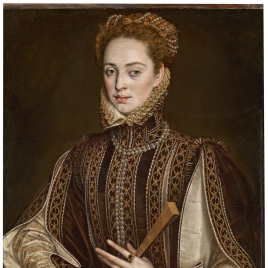
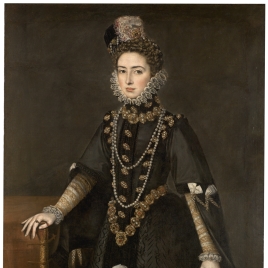
Nothing is known about the identity of this young lady who is aged barely more than fifteen or sixteen and dressed in a travelling outfit (ropa de camino), as suggested by the hoodless cloak lined in fur (probably lynx) and the muff adorned with brown fur (possibly sable). In 1858, when it was included in the catalogue of the Museo del Prado, Pedro de Madrazo suggested it might represent ‘one of Philip II’s daughters’. This proposal has not been widely accepted, though the portrait is comparable to those painted of the king’s daughters during that period. The sitter, with her sumptuous clothing, is no doubt a young woman of the court, whose features conform to the ideal of female beauty of the time: large, almond-shaped eyes; a small, delicately drawn mouth subtly raised at the corners; snow-white skin; rosy cheeks; and a carefully groomed hairstyle characteristic of the late 1560s which, together with the high collar around the back of her neck, enhances the oval of her jaw.
The first technical study of the work was carried out in 1990 in connection with the exhibition staged by the Prado on Alonso Sánchez Coello. On that occasion Stephanie Breuer-Hermann backed the attribution to the Spanish portraitist and proposed an execution date (1567) which I believe can be widened slightly in view of the formal similarities this scholar found with the portraits of Anne of Austria.
Breuer-Hermann suggested that this portrait could be identified as the one described in the inventory of paintings belonging to Charles II’s estate, mistakenly stating that the dimensions were not given. Gloria Fernández Bayton’s transcription refers to ‘Another [painting] a vara and a half high and a vara wide, a portrait of a foreign woman in a robe or over-gown, an original by Alonso Sánchez with a gilt and black frame, appraised at five doubloons’; therefore, neither the description (there is no mention of the muff and nothing in the sitter’s face suggests she is foreign) nor the excessively large size (126 x 84 cm) corresponds to this work, even though this portrait was originally larger. The dimensions of the bust – the head measures approximately 15 cm – the small background area around it, the position and cropped appearance of the muff, and the manner in which the support was reinforced suggest that the original composition may have been half or even three-quarter length.
In 2007 Maria Kusche added four portraits to Sofonisba Anguissola’s corpus, including this one. She identified the sitter as Ana de Mendoza, Princess of Éboli (1540-1592), on the basis of the similarity with other portraits of the princess which, in my opinion, are merely idealised representations that conform to the canons of the period. Nor do I agree with the attribution of this group of portraits to Sofonisba. In the case of this small canvas in the Prado, I believe that Breuer-Hermann is more to the point in her observations when she draws attention to the private nature of the composition, the originality of the sitter’s expression – which lacks the aloofness of court portraits – and the position of the muff, held at chest height as opposed to between her hands and at the waist. She accurately described the key aspects that link the portrait to Sánchez Coello: a balanced use of loose brushstrokes in the cloak, the tonal transition in the face, and careful attention to detail but not to the extent of Flemish artists. Nor does the painting display – and this observation is mine – the minute brushwork characteristic of Sofonisba, as can be seen in the hair and the clothing.
In my opinion, the nature of this painting, which draws on formulas of court portraiture but shows a concern with conveying a certain familiarity and emphasising the young woman’s beauty, points to one of the ladies of the court who shared part of their lives with Sofonisba Anguissola while they waited for a suitable marriage candidate to appear. A portrait like this one would have provided an attractive means of introduction, though I do not believe that it was painted by Sofonisba.
Ruiz Gómez, Leticia, 'Alonso Sánchez Coello. An unknown young woman'. In: A tale of two women painters: Sofonisba Anguissola and Lavinia Fontana, Madrid, Museo Nacional del Prado, 2019, p.164 nº.34