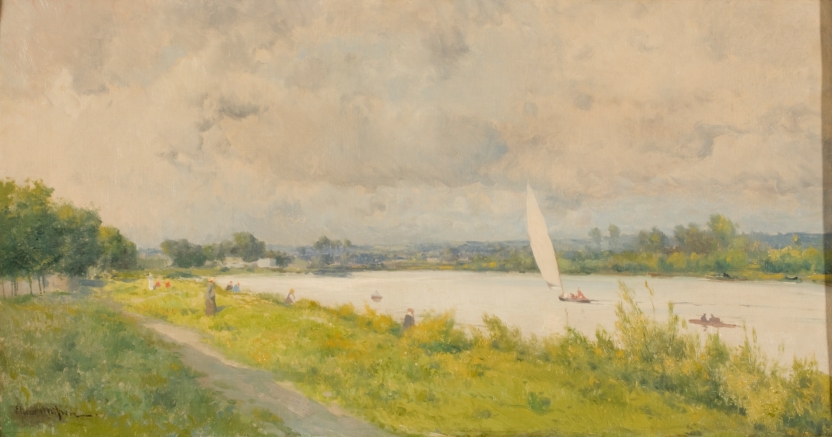
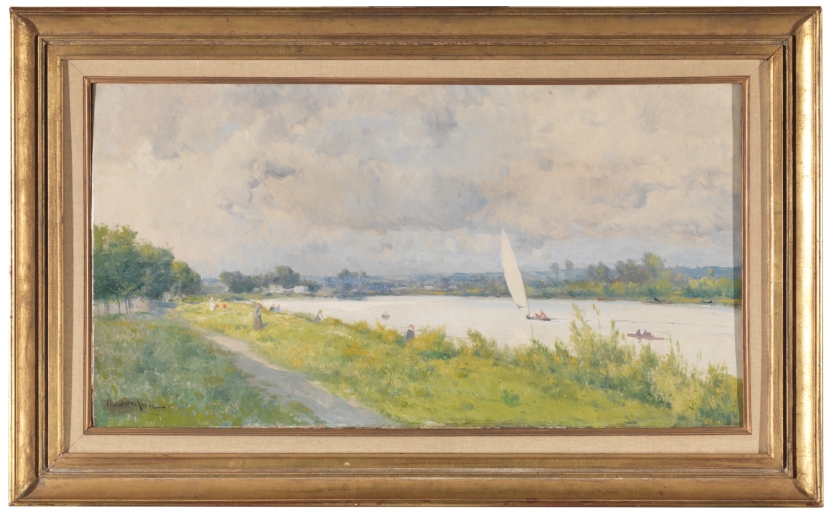
View over the Seine
Ca. 1890. Oil on canvas.Not on display
Eliseo Meifrén, one of the most prolific and emblematic Catalan landscape painters of the Restoration generation, is represented in ten paintings in the Prado’s collections. In this group of works, we see diverse facets of his artistic production, including large panoramic landscapes, maritime scenes, river motifs, and gardens. The different periods of his work are also visible, starting from his still early paintings from the 1880s, spanning through his mature works – painted in Pontevedra and Palma de Mallorca between 1900-10 – until his later pieces well into the 20th century.
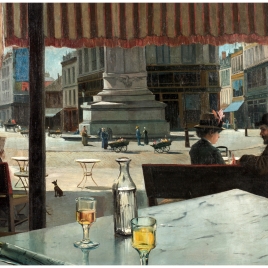
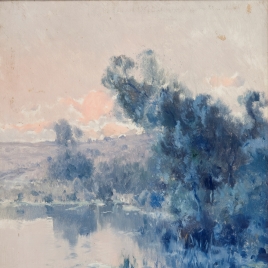
The last two paintings incorporated into this group show the influence that his different sojourns in Paris, since 1879 and during the last two decades of the 19th century, had on his production. In 2004, the Museo del Prado acquired A Square in Paris (P007862), an urban view from a café in the Place de Clichy that was a meeting place for artists, dated 1887. However, given his status as a landscape painter, he mainly painted in the outskirts of Paris, at the banks of rivers Seine and Marne, thus keeping a usual routine among French and Spanish artists who worked there. Therefore, this view from the Seine shows his predilection for landscape format during the final years of the 1880s and throughout the 1890s. In those works, he draws the horizon slightly lower than half the height of the canvas, in which the lower strip is divided into two triangles, as was typical of his work during those years. In this painting, one of the triangles is occupied by the river, the current of which goes towards the background and highlights the boats’ wake, as well as the arrangement of the high sail in one of them, thereby animating the inherent quiescence of the landscape composition. The slanted disposition of a parallel road to the sun and to the river – where the shaded areas are decisively split – as well as the sloping of the shrubbery on the riverbank and the top of the trees towards the left, following the wind’s flow, make it even more quiescent. Likewise, the voluminous clouds provide movement in the background area of the painting.
As is usual in French landscape painting derived from the Barbizon school, the horizon is enclosed by lumps of trees, whose diminishing size accentuates the remoteness of the background. The painter also makes use of this perspectival strategy in the disposition of the figures. Similarly, the French naturalistic landscape is related to the direct nature of observation and to the grey colour palette in the river. This painting and its frame need to be restored. Both its loose execution and its light colour scheme – lighter than in his first period – are indicative of a not-so-early date, which would be in any event later than 1890.
Museo Nacional del Prado, Memoria de Actividades 2008, Madrid, Museo Nacional del Prado, 2009, p.30-31