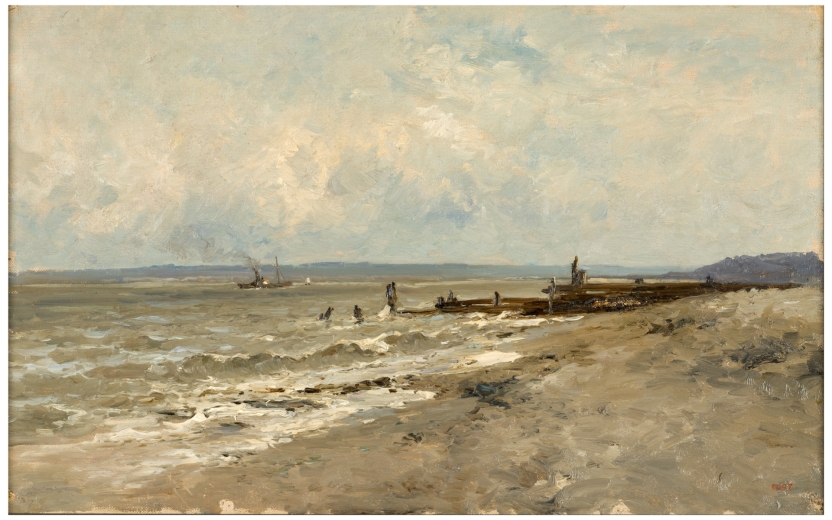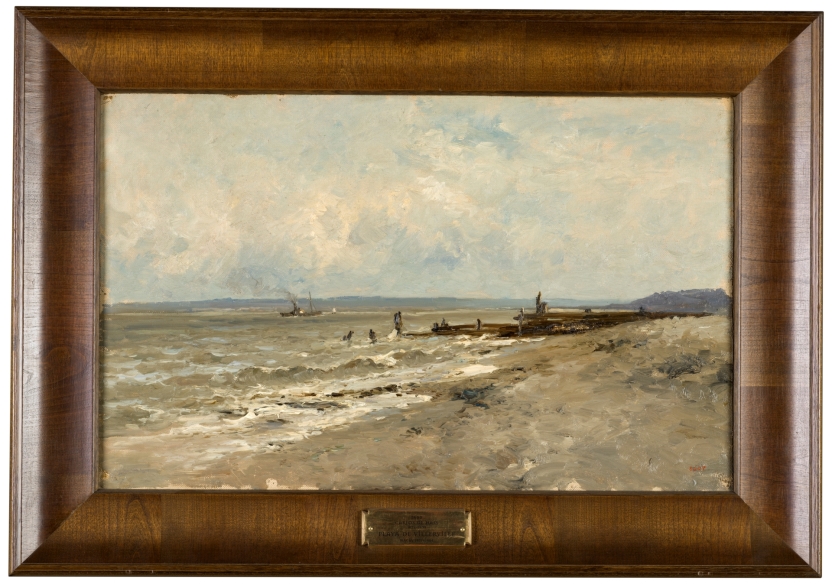
Villerville Beach
1877 - 1884. Oil on canvas attached to canvas.Not on display
On the left of the painting is a small surf break beats the sand and land that closes the foreground. The ebb and flow of the high tide produces irregular, moving crests in which the foam of the sea is reflected in luminous white. To the right, the dilapidated remains of a palisade from a demolished pier extend into the sea where a small fishing steamer and a sailboat sail, whose masts surpass the line of the coast´s profile, giving way to a turbulent sky, dividing the composition into two fairly equal parts.
Haes was drawn by an artistic rationale to the motif of old, ruined wharf stockades. Given the inevitably featureless horizontal expanse of a seascape, these rustic aligned formations were commonly employed by the painter to break the monotony of the composition, often constructing a play of volumes with perpendiculars, diagonals or even parallels. It effectively fragmented the uniformity of an extensive surface which, in the distance, increases its paradoxical immobility.
Gutiérrez Márquez, Ana, Carlos de Haes en el Museo del Prado, 1826-1898: catálogo razonado, Madrid, Museo Nacional del Prado, 2002, p.282