formularioRDF
The itinerary <em>TITULORECORRIDO</em> has been successfully created. Now you can add in works from the Collection browser
<em>TITULOOBRA</em> added to <em>TITULORECORRIDO</em> itinerary

Close Continuar a ficha de la obra Continuar a ficha de la obra
17-07-2026

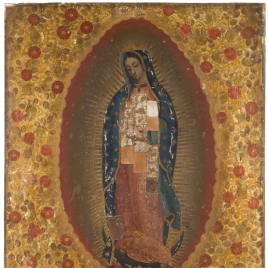
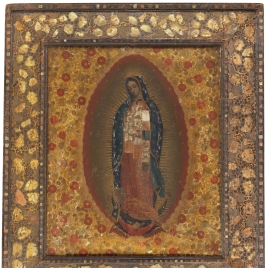
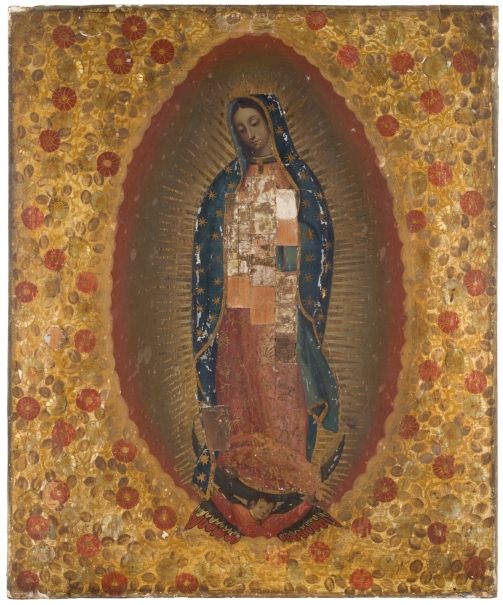
Virgin of Guadalupe of Mexico

XVIII century. Shell work on panel.
Not on display

Guadalupe of Mexico was the first globalised Marian image. The dispatch of her “true likenesses” from New Spain to the metropolis bears witness to the intense relations between families and personalities on both sides of the Atlantic who shared desires, aspirations and sentiments. Through them, dense interpersonal, cultural, political, social and economic webs were woven that have now been lost, and which this exhibition seeks to restore.

The Virgin of Guadalupe had a devotional legend, but it was above all a revealed icon whose imprint made by roses on the unprecedented support of a cape of coarse cloth led theologians to compare the phenomenon with the Eucharist itself. For copies of the Holy Original to partake of its miraculous nature, they had to be extremely exact, obliging artists to apply all their skill.

The image of Our Lady of Guadalupe belongs to a family of late Gothic Madonnas (though already more Renaissance in their proportions) of Northern European origin that show her in a state of pregnancy, her hands joined in prayer, surrounded by a radial solar mandorla and positioned over the waning moon and an angelic plinth or footstool. The iconography also shares the signs of identity of the most popular Marian advocations of the first half of the 16th century, the Tota Pulchra and the Apocalyptic woman adorned with the sun, and it finally merged into the representations of the mystery of the Immaculate Conception.

The proof of the sacred nature of the Virgin of Guadalupe lay not only in the miraculous reproduction of her image on Juan Diego’s rustic cape but also in the fact that the cloak was preserved intact despite adverse environmental conditions. The veil of Veronica was also considered a trace or relic of the divine because the face of Jesus had been left imprinted on it through contact with his sweat and blood. The image of La Guadalupana was meanwhile explained in different ways, either as an impression produced by the sun or as a painting mysteriously executed by God or his angels.
Technical data

Imagen del carrusel
Imagen del carrusel
Inventory number
P005381
Author
Anonymous
Title
Virgin of Guadalupe of Mexico
Date
XVIII century
Technique
Shell work
Support
Panel
Dimension
Height: 75 cm; Width: 62 cm
Provenance
¿Oratorio portátil de María Luisa de Toledo y Carreto, hija del virrey marqués de Mancera; convento de Santa María de Constantinopla, Madrid?; Museo de la Trinidad, 1835-1872
Entry date
1872

Bibliography +

Museo Nacional del Prado, Museo del Prado: inventario general de pinturas (II). Museo de la Trinidad, Museo del Prado, Espasa Calpe, Madrid, 1991, pp. 493.

El "Prado disperso". Cuadros depositados en Palma de Mallorca, en Mahón y en Pamplona, Boletín del Museo del Prado, XIV (32), 1993, pp. 79.

Gutiérrez Usillos, Andrés, Historia del retrato de doña María Luisa de Toledo, la mujer chichimeca y el ajuar, en: La hija del virrey: El mundo femenino novohispano en el siglo XVII [cat. exp. Madrid, Museo de América], Madrid, 2019, pp. 212-217.

Rendón Soto, Natalia, El enconchado de la Virgen de Guadalupe del Museo del Prado. relevancia del marco para una propuesta de autoria, Boletín del Museo del Prado, XL, 2024, pp. 96-106 fg.1, fg.4.

Mues Orts, Paloma; Bruquetas Galán, Rocío, "Que no hay quein pueda copiarla': La Virgen de Guadalupe de México y de cómo los pintores novohispanos intentaron retratarla', Tan lejos, tan cerca: Guadalupe de México en España, Museo Nacional del Prado, Madrid, 2025, pp. 141-201.

Cuadriello, Jaime, 'Tipología figural, construcción visual y articulación devocional: travesía atlántica de la imagen de Guadalupe, 1550-1680', Tan lejos, tan cerca: Guadalupe de México en España, Museo Nacional del Prado, Madrid, 2025, pp. 55-115 [O.R].

Other inventories +

Inv. Museo de la Trinidad, Pintura, 1854. Núm. 1723.
1723. / Tabla. Ntra. Señora de Guadalupe de méjico. Figª como de tres cuartas y cuerpo entº / Autor / Alto 0,76 Ancho 0,62 / [Al margen izdo.] Galofre 3ª / N 34 cuadº [Debajo, en letras rojas] Sotanillo patio [Al margen dcho] Sin Embar. ni Rar. Con marco antiguo in / crustado de nacar á si como las figs del cuadro

Update date: 17-07-2026 | Registry created on 14-11-2019

Visor 360

Drag with the cursor to rotate the piece

Print on demand

Print artworks available in our catalogue in high quality and your preferred size and finish.

Image archive

Request artworks available in our catalogue in digital format.

Up