Saint Francis of Assisi in Ecstasy
XVII century. Oil on canvas.On display elsewhere
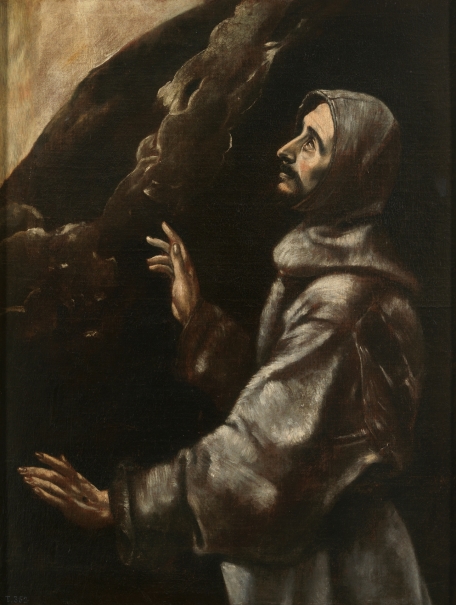
We see the upper body of a figure, in profile, with his head raised to the sky. His arms and hands are stretched out in admiration and surprise. The saint is wearing a humble grey habit and a narrow hood covering his head. An intense light from the upper left corner illuminates the saint’s turned body, and his face appears excited at what we imagine is a heavenly vision. In contrast, the background surrounding the figure is painted in dark tones devoid of chromatic nuance.
The painting depicts the moment Saint Francis receives Christian stigmata as a result of the supernatural vision he experienced in September 1224 during his retreat at Mount La Verna in the Italian valley of Casentino. The Feast of the Cross was being commemorated while the Saint of Assisi was meditating on the Passion of Christ. A seraphic apparition provoked in Saint Francis the infliction of the wounds that Christ suffered during his crucifixion.
From this event, El Greco devised different compositions that vary in small details. Included among them is Saint Francis of Assisi in Ecstasy in the Abelló collection, made around 1589. This work is considered to be where other later variants would come from. All of these works were widely accepted by Toledo’s society at the time, which explains the abundance of variations, both from the master’s workshop as well as from followers and copyists. The Prado canvas is a copy of one of these variants and is specifically named ‘type III’ or ‘El Escorial type’ as an allusion to the composition from the late eighties found in the royal monastery of the same name. This version lacks a depiction of Christ crucified in the corner that emanates light because a contemporary viewer would have already understood it to have been a heavenly vision, as he or she was well aware of the significance of this type of composition disseminated by El Greco’s workshop and, as this canvas reveals, by other anonymous artists who generated such compositions until well into the 17th century. One of them, held at the Fundación Lázaro Galdiano (Madrid), represents the vision in the same way through a luminous arch.
Ruiz Gómez, Leticia, El Greco en el Museo Nacional del Prado: catálogo razonado, Madrid, Museo Nacional del Prado, 2007, p.242-244 n.41