Wedding fan
Ca. 1790. Ivory.Room 101
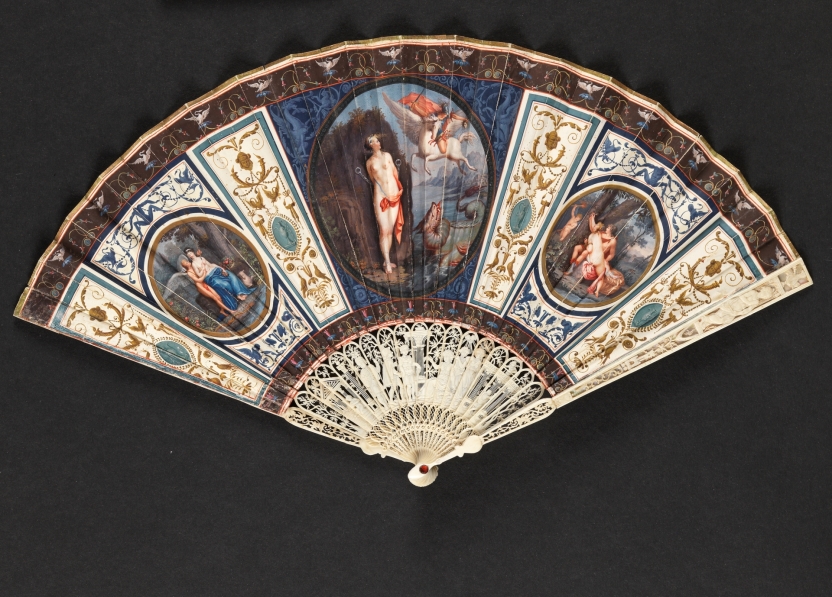
The face of the fan is made from vellum and painted with watercolours. The reverse is plain with a double red line around the edge. In the centre, the initials IGS appear, possibly referring to owner’s initials. The rigid strips are made of carved and engraved ivory with applications of nacre slices on the guard sticks. In the upper part of the fan, there is a trimming with a blue background, dotted with small bluebells on which what are perhaps cranes, perch with spread wings. In the lower part, there is also a trimming with small bluebells, whose fine stems are intertwined. They create a composition in the Pompeian style, which is typical of the last decade of the 19th century. The theme is developed on three medallions, which Eusebi painted and signed, depicting scenes of love. The centre and left ones are inspired by Ovid’ s Metamorphoses, showing Eros winning Psyche’s love and Perseus riding Pegasus with the Gorgon´s head in his left hand and a sword in his right to free Andromeda from the sea monster. The scene on the right is not taken from classical mythology but rather from Ariosto´s epic poem Orlando Furioso (The Frenzy of Orlando). It depicts the moment when Angelica intertwines Medoro’s name with her own on a tree. Stylised blue and gold grotesques framed and separated the scenes. On the sticks, the artist carved a garden scene with classical porticoes and figures dressed in Roman costume, which may refer to the famous love affairs of Mark Antony and Cleopatra. On the guard sticks, there is a female figure on the right one and a warrior on the left one. The fan is in line with the fashion that prevailed in the last quarter of the 18th century in France for brides’ dowries. They distributed them to their bridesmaids or gave them as gifts, decorated with scenes of love, as in this case. In addition to his work as a miniaturist, Eusebi continued to produce leaves designs and also worked for the Prince of the Peace and the Countess Duchess of Benavente.
Museo Nacional del Prado, Memoria de Actividades 2006, Madrid, Ministerio de Cultura, 2007, p.84-86