Young
100 a.C. - 75 a.C.. White marble.Room 033
The history of the sculptures that graced the great galleries of European collectors is a living, moving chronicle. Objects unearthed by archaeologists – originally intended for some specific purpose, which they presumably fulfilled – tended to be mostly incomplete fragments. This was by no means a disadvantage: fragments were prized as proof of an antiquity that invested them with dignity and unquestionable prestige. The frontispiece to François Perrier’s indispensable collection of engravings of great Roman sculptures, published in 1638, shows Saturn devouring the Belvedere Torso in an explicit and highly-revealing allegory of the inexorable passage of time.
Moreover, at a time when restoration criteria differed from those in force today, the reconstruction of these works was regarded as both permissible and wholly natural. The great sculptors of sixteenth and seventeenth-century Rome, from Giovanni Angelo Montorsoli (1507–1563) to Gian Lorenzo Bernini (1598–1680), took part in the restoration of antique pieces which in some cases sought to challenge the teachings of the ancient masters. The well-known anecdote regarding the legs made by Guglielmo della Porta (c. 1500–1577) for the Farnese Hercules, which Michelangelo (1475–1564) considered better than the originals discovered later, is further evidence that this concept was widespread.
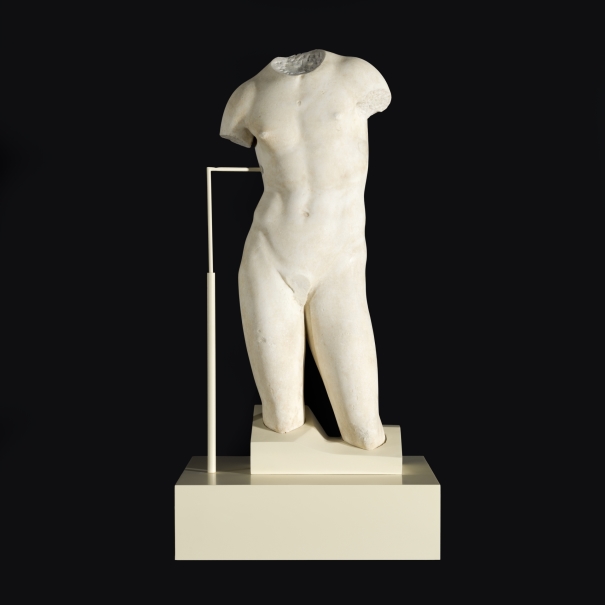
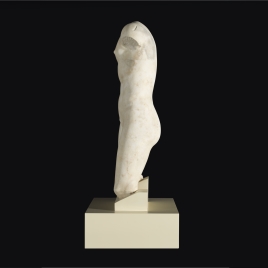
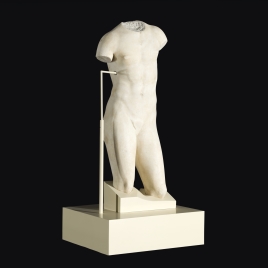
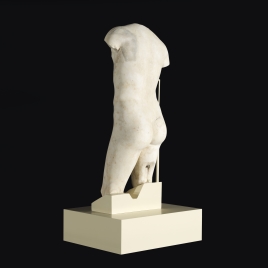
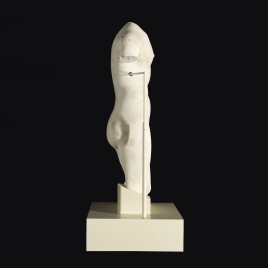
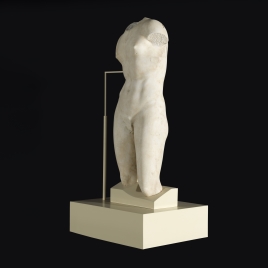
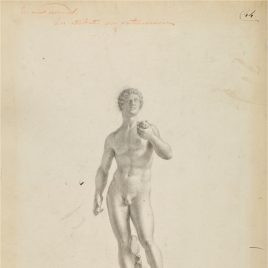
As a result, these sculptures went on to enjoy a second life, different from that for which they were first produced; henceforth, they were simply objects to be contemplated and enjoyed in their owners’ galleries. This marble fragment of a young male body is a perfect example of the successive lives of ancient sculptures put to fresh uses. Like other pieces in the Spanish royal collection, there is little certainty as to its provenance or when it was acquired. It is exhibited today stripped of certain earlier additions, which enabled it – at least in the eighteenth century – to be identified as Paris or Adonis, regardless of its original identity. The restored version was reproduced in the Ajello Notebook as an example of those reconstructions based on historical fragments, often reusing old pieces that fitted the new design. At some point in the past – probably in the latter half of the nineteenth century, prompted by a more purist approach to restoration – these additions were removed, leaving the piece as it is today.
Stephan Schröder, noting its resemblance to a small winged youth from the island of Cos thought to represent Eros, suggested that this might be the identity of the Prado sculpture. If so, it would be a version of the Eros of Parium, one of the finest creations of the Athenian sculptor Praxiteles (c. 400–c. 330 BC), and just as important as his Aphrodite of Cnidus, to the extent that both – according to literary sources – were the victims of agalmatophilia: Pliny the Elder assures us that this Eros "was a work that matches the Venus of Cnidus in its renown, as well as in the outrageous treatment which it suffered. For Alcetas, a man from Rhodes, fell in love with it and left upon it a similar mark of his passion".
The Eros of Parium, notable for the characteristically languid treatment of the human anatomy – the well-known "Praxitelean curve" – was widely reproduced, even featuring on coins. In Rome, sculptors sought (some more faithfully than others) to duplicate the lost Greek original; a good example is the socalled Borghese Genius now in the Louvre. Indeed, the composition proved so successful that in Roman times it was reused to represent the figure of the young Dionysus. Given the fragmentary nature of the Prado sculpture, and the resulting lack of attributes, it could be read in iconographic terms as either Eros or Dionysus; we cannot be absolutely sure which.
Arias Martínez, Manuel, 'Taller jónico. Joven efebo'. En: Guido Reni, Madrid, Museo Nacional del Prado, 2023, p.403-404 nº 95