Master of the Legend of Saint Catherine
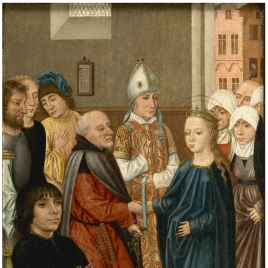
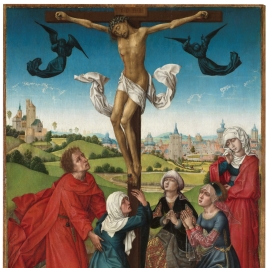
Max Friedländer established this conventional name in 1926 to designate a considerable group of Works derived from the style of Rogier van der Weyden but of inferior quality, enlarging the initial group compiled by Friedrich Winkler under the name of Master of the Multiplication of the Loaves. The final appellation stems from the panel of the Scenes from the Legend of Saint Catherine now in Brussels (Koninklijke Musea voor Schone Kunsten, inv. 12102) and generally agreed to be the basis for gauging the master’s style. Other works unanimously considered to be by his hand are the Cologne “Triptych of the Descent” (Wallraf-Richartz-Museum, inv. 0029) and the Prado Crucifixion. This artist’s stylistic characteristics were defined by Friedländer, who spoke of an ‘almost caricature-like’emulation of Rogier’s style. The figures have large, high-set ears and black, half-open eyes which, together with the eyelids and the forehead, are positioned parallel to the picture plane as opposed to in a more logical arched shape, resulting in a similar perspective for both sides of the face.
Nearly all his works have been dated to the final decades of the fifteenth century, after the death of Van der Weyden. For years this led this master to be identified as Rogier’s son, Pieter van der Weyden (1437–after 1514), even though there are no documentary or stylistic grounds for such a connection. Many of his pictures attest to close collaboration with other artists, such as the Melbourne Triptych with the Miracles of Christ (National Gallery of Victoria, inv. 1247-3), currently held to have been executed in conjunction with the Master of the Portraits of Princes and Aert van den Bossche, painters whose style is very similar to his (J.J. Pérez Preciado, "Fifteenth-century netherlandish painting at the Museo Nacional del Prado. Catalogue raisonné", Museo del Prado, 2024, p. 225).