The Betrothal of the Virgin / Cristo Patiens
1470 - 1500. Oil on oak panel.Room 057
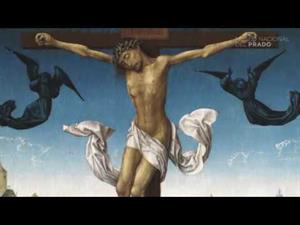
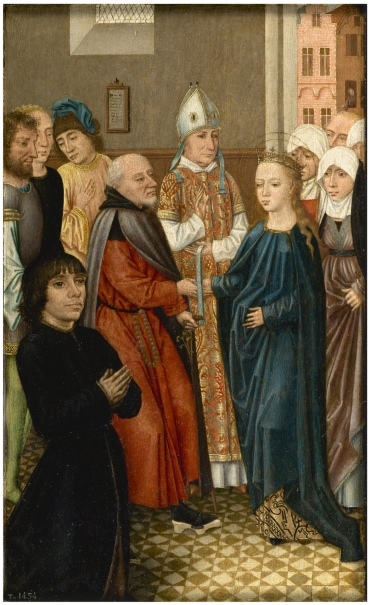
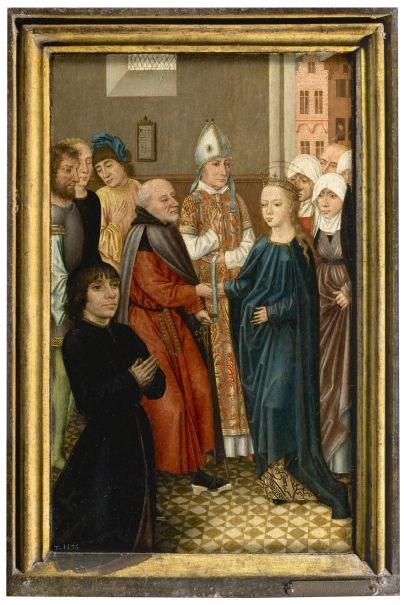
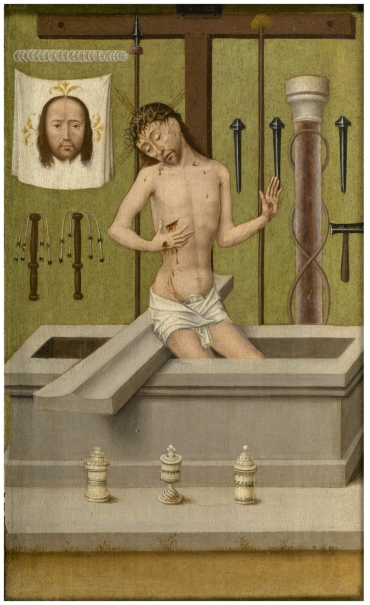
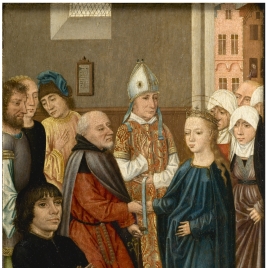
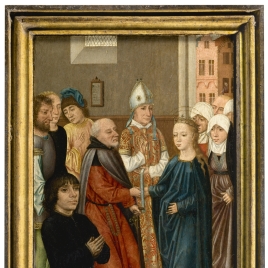
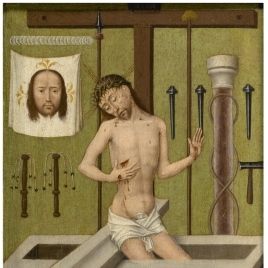
The Betrothal of Mary and Joseph is depicted on the recto. However, a donor portrayed in the foreground, whose identity is unknown, shares the same prominence as the holy figures. Mary, crowned and haloed, is dressed in a blue cloak over a brocade tunic, whereas Joseph, in a red robe and brownish cloak, leans on the flowering staff which, according to the scriptures, identified him as the man who would marry Mary. The ceremony is depicted in traditional fashion, with the celebrant in the centre joining the spouses’ hands with a ribbon, as was common practice and can be seen in other Flemish paintings of the period, such as the Betrothal of the Virgin by the Master of Flémalle. Behind this trio are the people attending the event. The men stand behind Saint Joseph in a group that extends into the church’s interior, where there is a window and beneath it an illegible prayer tablet nailed to the wall. The women are positioned behind Mary in a vanishing line that stretches towards the entrance to the temple. The verso displays the iconographic theme of Cristo Patiens or Christ resigned to his suffering, portrayed with the elements alluding to his martyrdom.
The link between the painting and the Master of the Legend of Saint Catherine can be justified by comparison of a few details with works attributed to this artist. The women in the Prado panel, however, are far removed from the artist’s more prototypical female figures found in his main works. This unique evidence of formal and stylistic connections between the Prado panel and other works linked to the master’s circle offers new perspectives. For example, it is interesting to note the presence of background details such as the figure watching the scene from a balcony, not only because of the anecdotal factor. Witnesses to the main event are also found in a side panel of the Melbourne triptych depicting the Wedding at Cana, which has been attributed to the Master of the Portraits of Princes. The fact that the portraits in the foreground of this work in turn bear a certain resemblance to the heads in the Betrothal of the Virgin allows us not to rule out the involvement of this other master in the Prado work.
It is difficult to establish a direct relationship between the Cristo Patiens on the verso and the painter of the recto. Nor are there many similarities with other works on the same subject that have sometimes been attributed to the Master of the Legend of Saint Catherine, except for their shared iconography.
Pérez Preciado, José Juan, Fifteenth-century netherlandish painting at the Museo Nacional del Prado. Catalogue raisonné, Madrid, Museo Nacional del Prado, 2024, p.231-237 nº.26