formularioRDF
The itinerary <em>TITULORECORRIDO</em> has been successfully created. Now you can add in works from the Collection browser
<em>TITULOOBRA</em> added to <em>TITULORECORRIDO</em> itinerary

Exhibition Museo del Prado - Fundación AXA

On the Reverse

Museo Nacional del Prado. Madrid 11/7/2023 - 3/3/2024

Until 3 March 2024 the Museo Nacional del Prado and Fundación AXA are undertaking a journey that moves beyond the surface of artistic masterpieces to allow for the contemplation of a fascinating reality: the hidden side of the work of art, its reverse.

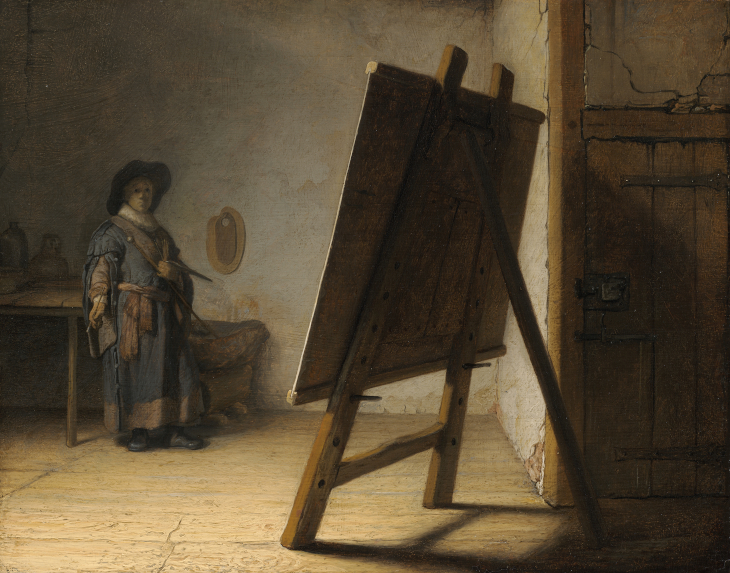
Alongside works from the Prado’s own collection, which have been the subject of a lengthy process of research on their other sides that is now presented in the exhibition, On the Reverse also includes generous loans from other national and international institutions. They include Assemblage with Graffiti by Antoni Tàpies from Fundación Telefónica, Cosimo I de’Medici by Bronzino from the Abelló Collection, Self-portrait as a Painter by Van Gogh from the Van Gogh Museum, Amsterdam, Artist in his Studio by Rembrandt from the Museum of Fine Arts, Boston, and The empty Mask by Magritte from the Kunstsammlung Nordrhein-Westfalen, Düsseldorf, giving a total of around 100 works on display.

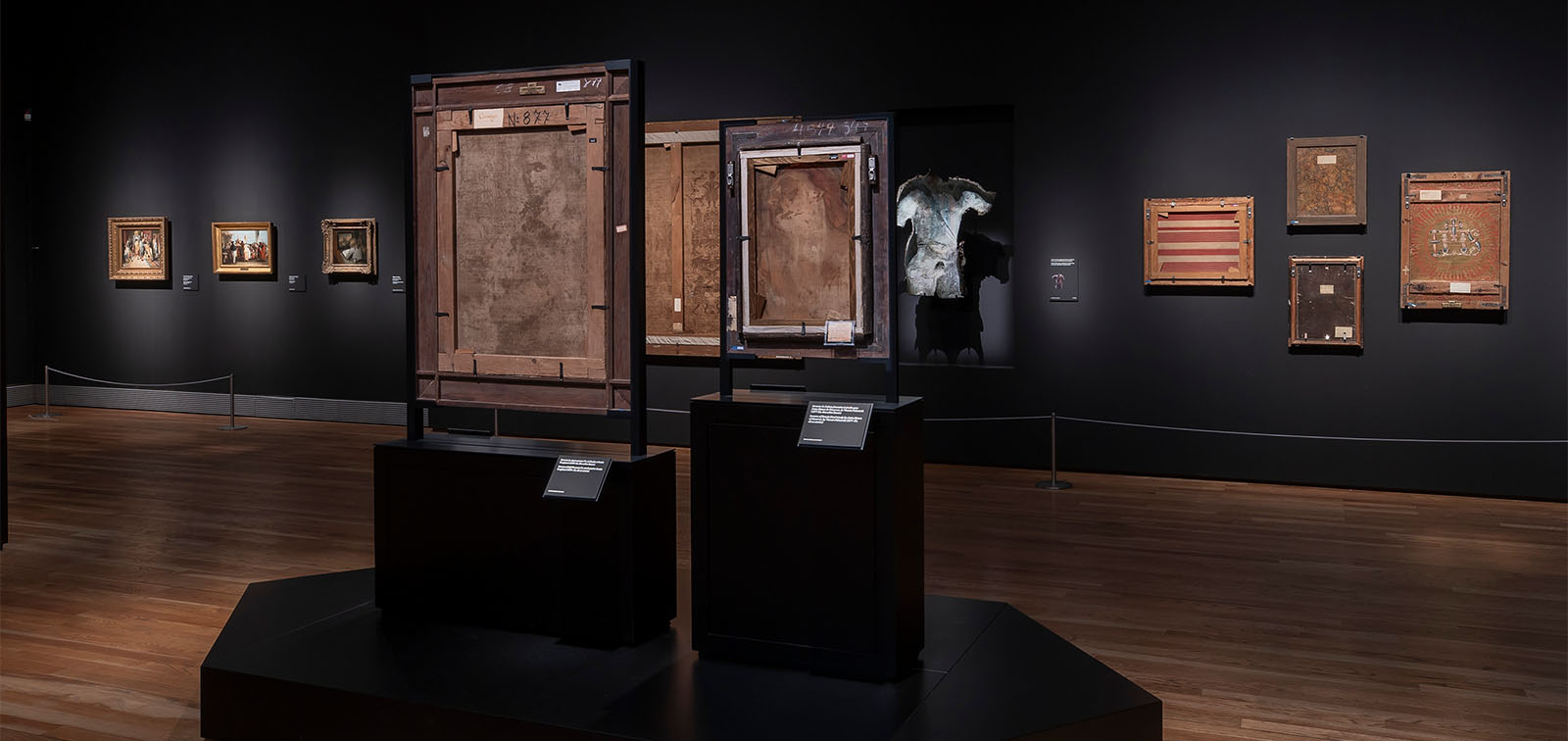
Curated by artist Miguel Ángel Blanco, for the installation of the exhibition Rooms A and B of the Jerónimos Building have been painted black for the first time. On the Reverse takes the form of an open survey which gives maximum freedom to the spatial relationship between the works, devoid of any hierarchy or chronological ordering and including the presence of creations by contemporary artists such as Vik Muniz, Sophie Calle and Miguel Ángel Blanco himself, represented by three of his box-books from the “Library of the Forest”.
Taking his starting point from a contemplation of Las Meninas, in which the reverse of the vast canvas on which Velázquez is working occupies a large portion of the pictorial surface, the exhibition’s curator, contemporary artist Miguel Ángel Blanco, proposes an unusual approach to painting by turning the works around in order to encourage visitors to establish a new and more complete relationship with the artists who created the approximately 100 works on display.

Numerous studies have been undertaken to date on individual works which have interesting backs for different reasons and some museums have explored this aspect in a partial manner through small exhibitions focused on the reverse of works in their collections. However, with the collaboration of Fundación AXA it is the Museo Nacional del Prado that is now approaching this subject with the necessary ambition. In addition to undertaking a complete reassessment of the backs of works in its collections, the Museum has also located examples in some of the world’s leading museums which reveal how an appreciation of works of art is enriched when their contemplation is not limited to the front.

The exhibition, which is structured into sections that focus on different aspects relating to the reverse of works, includes artists never previously seen at the Prado, among them Van Gogh (1853-1890), René Magritte (1898-1967), Lucio Fontana (1899-1968), Pablo Palazuelo (1915-2007), Antoni Tàpies (1923-2012), Sophie Calle (1953), Vik Muniz (1961), Michelangelo Pistoletto (1933), José María Sicilia (1954), Wolfgang Beurer (active 1480-1504), Louis-Léopold Boilly (1761-1845), Carl Gustav Carus (1789-1869), Vilhelm Hammershøi (1864-1916), Martin van Meytens (1695-1770), Wallerant Vaillant (1623-1677), Ernst Ludwig Kirchner (1880-1938), and Max Liebermann (1847-1935).

The exhibition opens with The artist behind the canvas, crossing that dimensional threshold to which Velázquez draws our attention with the enigmatic reverse of the canvas he is painting in Las Meninas, with a section devoted to depictions of backs of paintings in artists’ studios. They frequently portrayed themselves located behind one, but even when these backs are not so directly associated with the artist’s activity they acquire a prominent presence in the setting as objects of special significance in painters’ studios.

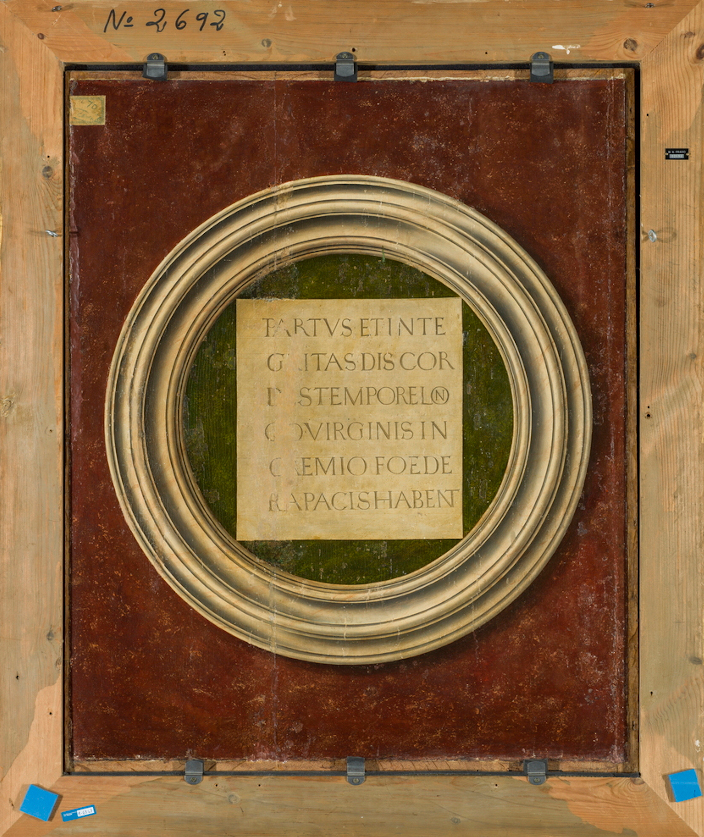
The depiction of the back returns in This is not a reverse, a section which paraphrases Magritte in order to bring together various trompe l’oeils that represent backs of paintings. This meta-artistic subject reveals the enormous significance that the hidden side of works could acquire for artists, leading them to imitate the annotations, inscriptions, drawings, etc, habitually found on picture backs.

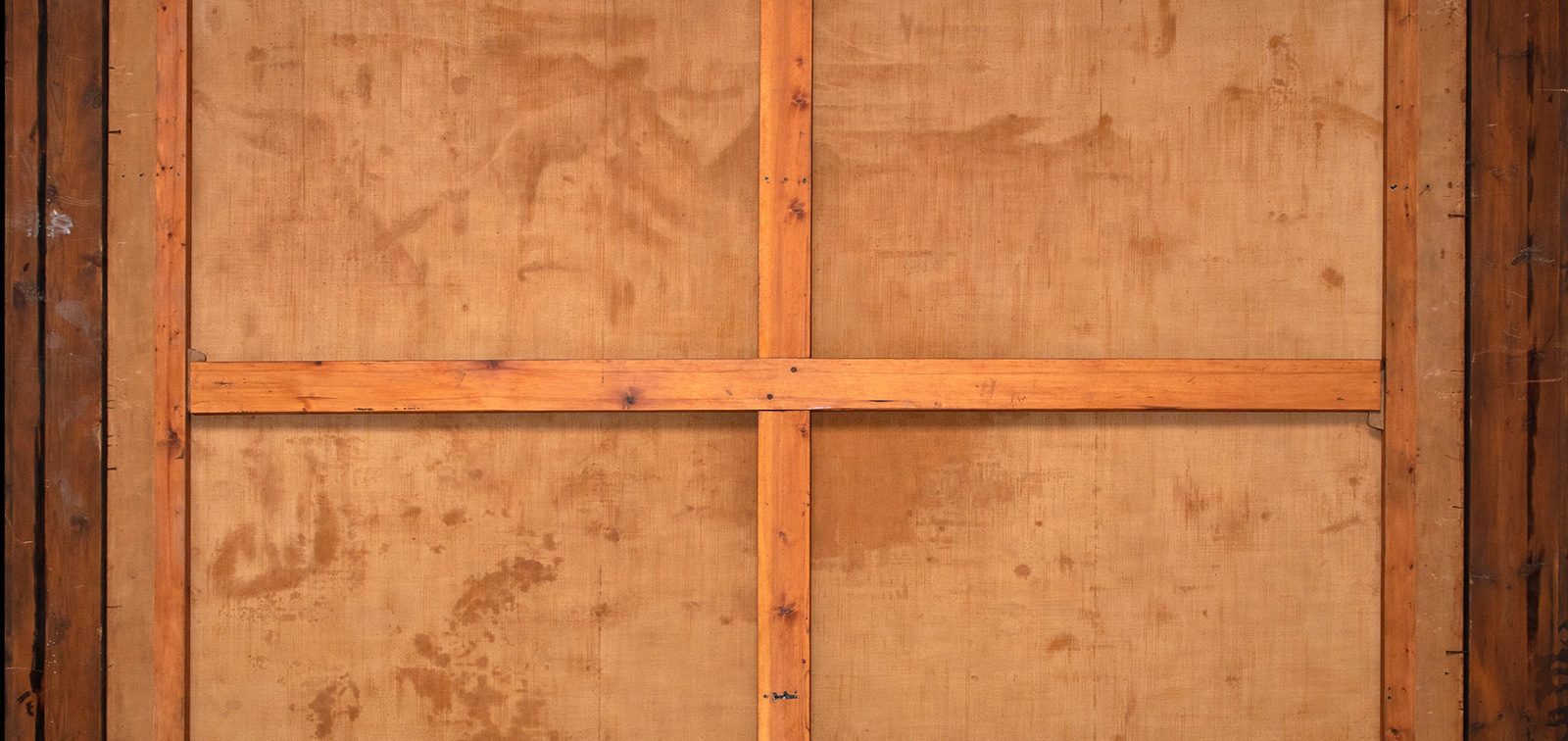
One of the elements that makes up the pictorial support is the subject of The stretcher as cross, the exhibition’s third section. This concealed structural element normally takes the form of a wooden cross which can be used to carry the painting from one place to another. When, in a habitual, everyday action that also emphasises the three-dimensional status of the work which this exhibition analyses, an artist picks up the cross of the stretcher in order to move the work in the studio or take it outside for the purpose of painting outdoors he/she is performing a type of “Via Crucis” which symbolises the effort and difficulties of artistic endeavour.

The exhibition’s central section, B-sides, focuses on works that can be termed “two-sided”. Here the back has its own artistic status and complements the principal image in various ways. It may feature the back of a figure seen from the front on the other side, a landscape or allegorical scene that modifies the meaning of the principal representation, heraldic information, associated religious themes, portraits, and more. Continuing this theme, the section The hidden side includes various works in which the back reveals traces of the creative process in the form of drawings, geometrical designs or expressive whimsies.

More information on the back looks at a classic problem in painting. Although word and image coexisted relatively easily until the Middle Ages, a moment arrived when artists entrusted all the weight of the narrative to the latter. Furthermore, when they needed to convey information, identify subjects or individuals or include additional information or commentaries on the execution of the work they almost invariably wrote on the back.

In some cases information has been added to backs at a later date in the form of labels and stamps or seals that help us to trace the history of the works: the collections they belonged to, the palaces they adorned, their changes of location and any restoration undertaken on them.

In other cases, as seen in Ornaments and ghosts, the backs reveal stories contained in the works’ actual materials: textiles that had domestic uses or patterned weaves that contain unintentional ghosts which appear when oil soaks into the cloth. In addition, the section Folds, cuts and cutouts shows how old restorations and alterations made to adapt paintings to new locations or functions are visible on reverses that include repairs, cuts and folds which result in part of the image being relegated to facing the wall.

It is easy to simplify the experience of “facing” a painting to a question of fronts: the work’s and the viewer’s. Looking at a painting implies locating ourselves before it with our “front side”, where our eyes are located. However, for some time now the experience of art has been understood as something more physical; our entire body in all its dimensions participates in it. In fact, in both depictions of artists working in their studios and in images of the public looking at art in museums and exhibitions these figures are often seen From behind, in front of the painting.

Finally, Nature in the background investigates the unusual or less common materials that have been used over the centuries as the supports for paintings in the Museum’s collection. This research has identified copper, tin, slate, alabaster, cork, brick, porcelain and ivory. Furthermore, dust is always present. Regular cleaning is of course undertaken at the Museum but the largest and heaviest works are less frequently moved. A short time ago the Museo del Prado removed The Transfiguration by Giovanni Francesco Penni from the wall, allowing Miguel Ángel Blanco to collect some of the dust accumulated on its reverse, which he has used to make three box-books for his “Library of the Forest”.
Curator:
Miguel Ángel Blanco
Access

Room A and B . Jerónimos

RDF

RDF

Sponsored by:
Fundación AXA

Multimedia

Exhibition

The exhibition

In Las Meninas Velázquez looks out at us from behind a large canvas of which we can only see the reverse and which occupies a considerable proportion of the pictorial surface. Through this canvas nailed to a wooden stretcher the painter refers to the image as artifice, opening a door for us onto a secret dimension.

This exhibition goes beyond the simple action of turning paintings around. Rather, the Museo del Prado is undertaking a complete reassessment of the backs of works in its collections while also identifying relevant examples in other major museums which reveal how appreciation of works of art is enhanced when we do more than just look at the front. The exhibition addresses issues that have never previously been brought together and in which there is also space for imaginative interpretations: the emergence of the reverse as a pictorial motif in two sub-genres: the self-portrait of the artist behind the canvas and the depiction of the picture back in trompe l’oeil; the poetic reading of the stretcher as a cross; two-sided paintings; the back as a field for experimentation and subjective expression; aesthetic appreciation of the material nature of the works, and the issue of the viewer seen from behind, which makes us aware of the particular spatial relationships that are generated by human interaction with art.

By turning works around to pervert their conventional frontality and by obliging us to walk round them and take on a more active role as viewers, we introduce contemporary creative attitudes and contemplative experiences into the museum which celebrate the side of the painting on which the light never falls.

The artist behind the canvas

The artist behind the canvas

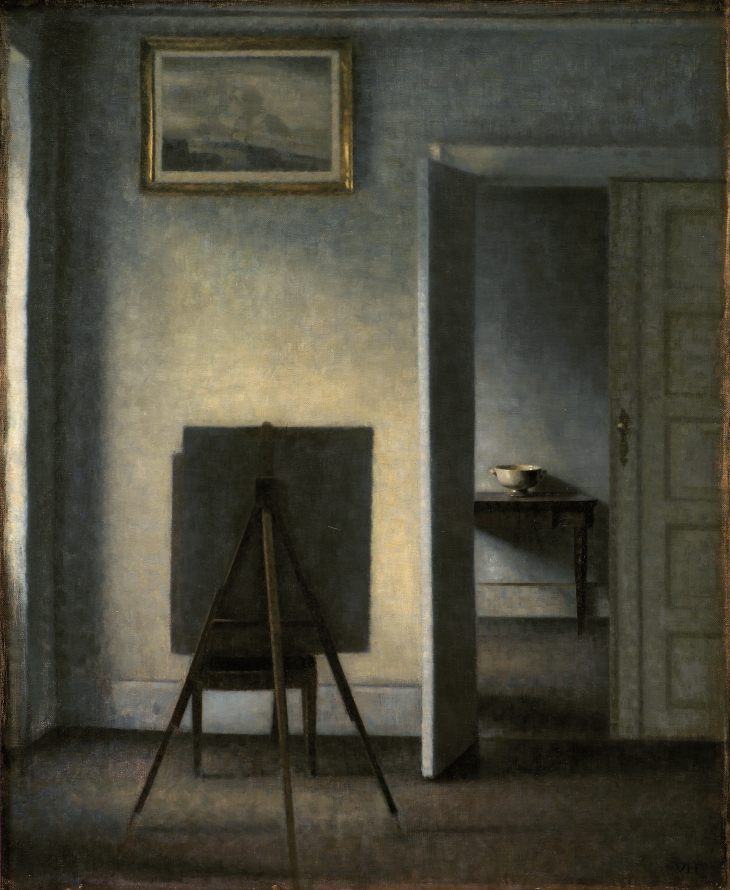
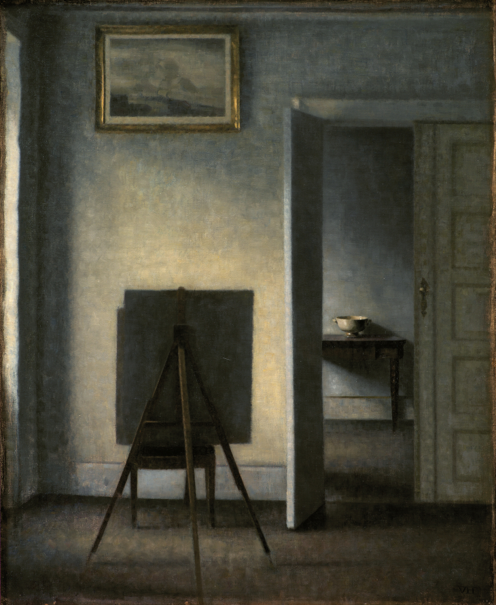
Vilhelm Hammershøi. Interior with the Artist’s Easel, 1910. Oil on canvas. Copenhagen, SMK, National Gallery of Denmark

The central decades of the 17th century saw the consolidation of a type of self-portrait that still survives today: the painter seen in his studio behind a painting on which he is working and of which we only see the back. Opening the exhibition, Vik Muniz’s faithful reproduction of the reverse of Las Meninas encourages us to make a physical and conceptual turn while establishing a connection with the unprecedented sculptural presence of the reverse of the canvas on an easel in the paintings by Rembrandt and Barent Fabritius. Those images also include items habitually found in an artist’s studio such as a mahlstick, a palette hanging from a nail and canvases turned to the wall, the latter the subject of particular attention here.

Although an eloquent element, the picture back can also remain on the margins: Francisco de Goya, Vincent van Gogh, Ignacio Pinazo and José Villegas located themselves next to it in simple half-length formats. Inspired by Las Meninas, Max Liebermann proposed more complex spatial games. On its own, however, and resting on an easel, the canvas seen from behind can even stand in for the image of the artist—so much is it associated with it—as an alter ego. This is the case with works on display here by Carl Gustav Carus, Vilhelm Hammershøi and Michelangelo Pistoletto.

The Stretcher as a Cross

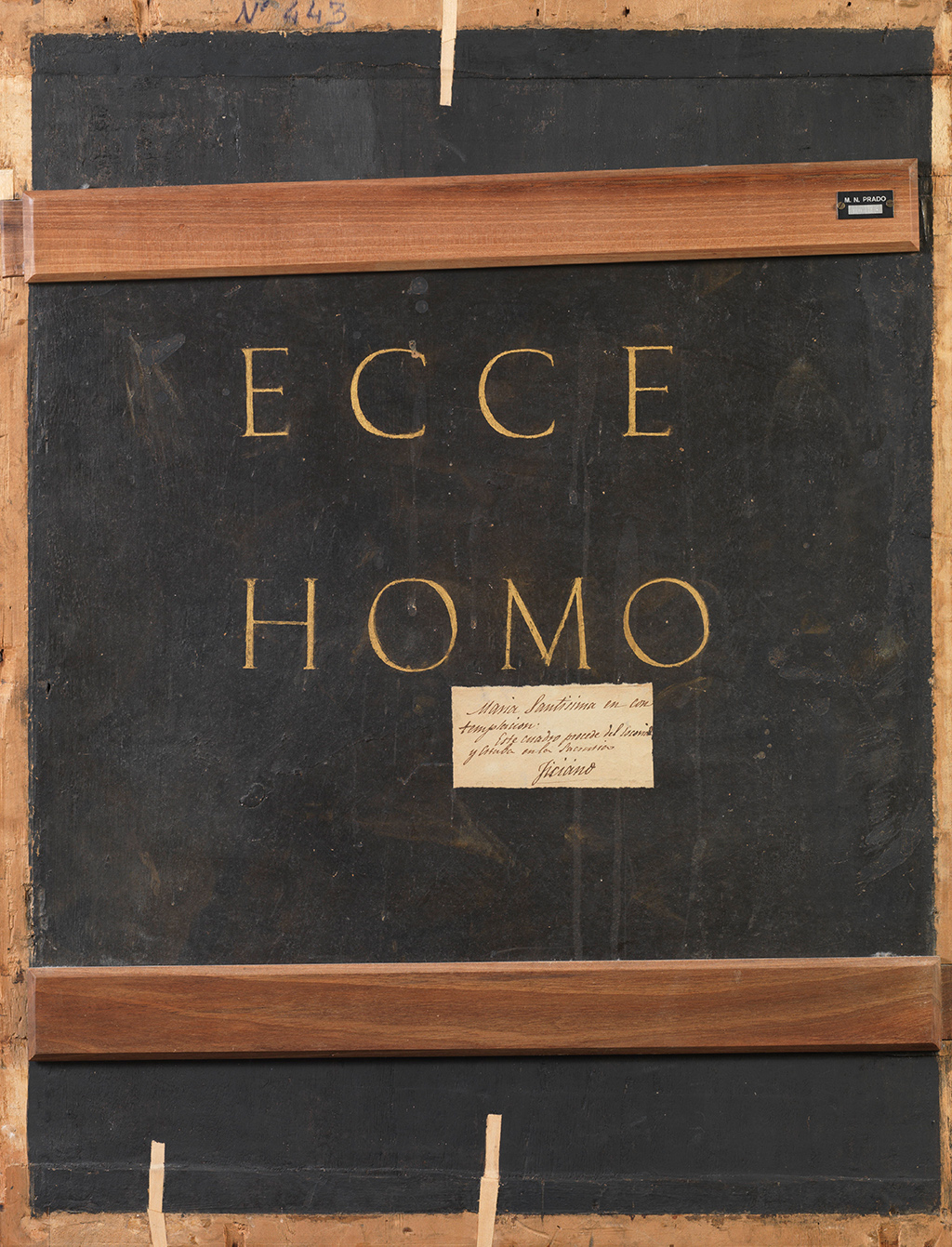
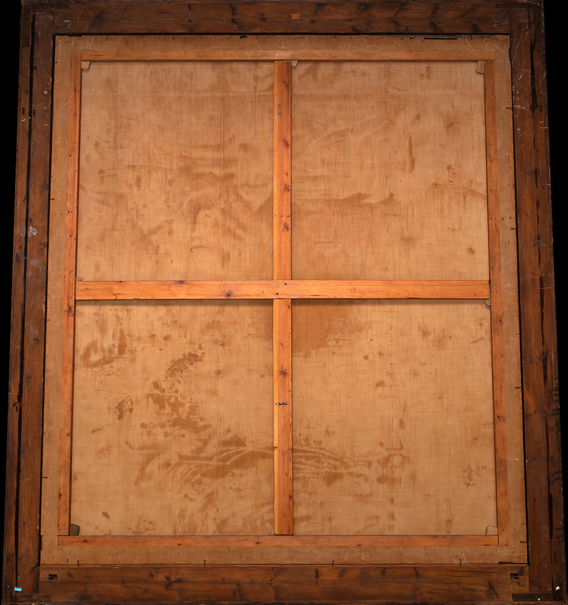
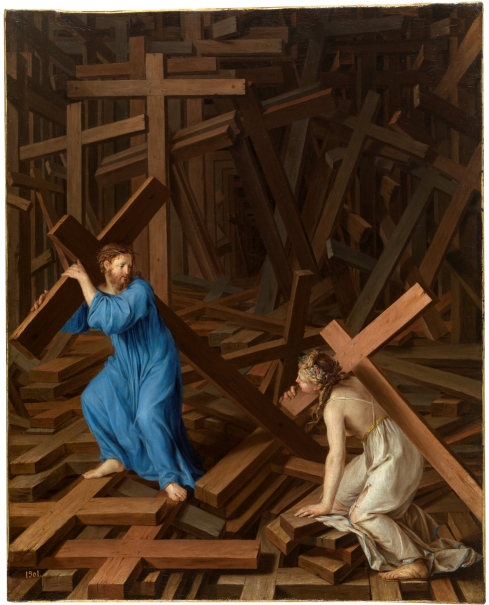
Stretchers are one of the essential components of picture backs, both real and represented. For small-format works they are rectangular and reinforced at the corners, while larger ones require a cross-bar for extra strength. In that case the cross supports the pictorial image in a figurative sense. The canvas is fixed to the stretcher with nails, crucified, while in order to carry paintings we hold them by the stretcher, bearing the cross. François Bunel the Younger, Georgia O’Keeffe and Mark Rothko perform this type of secular and artistic Via crucis, sharing the penitential status of the anonymous French painting The Christian Soul accepts its Cross. The accumulation of wooden crosses in that work is repeated in David Douglas Duncan’s photograph of Picasso’s studio, from whose Guernica—a sacrificial scene—the Prado is exhibiting part of the original stretcher, possibly the most well-worn in history: a veritable Ecce Homo.

As the photographs of the protection and safeguarding of works of art in the collections of the Louvre and the Prado reveal, wars and conflicts lead to the movement and turning round of paintings, revealing their cross-bearing souls. This was also emphasised by Antoni Tàpies, who often perverted the concept and use of stretchers and crosses, and by Joan Miró, whose “burnt canvases” exposed the painting’s hidden structure.

This is not a Reverse

This is not a Reverse

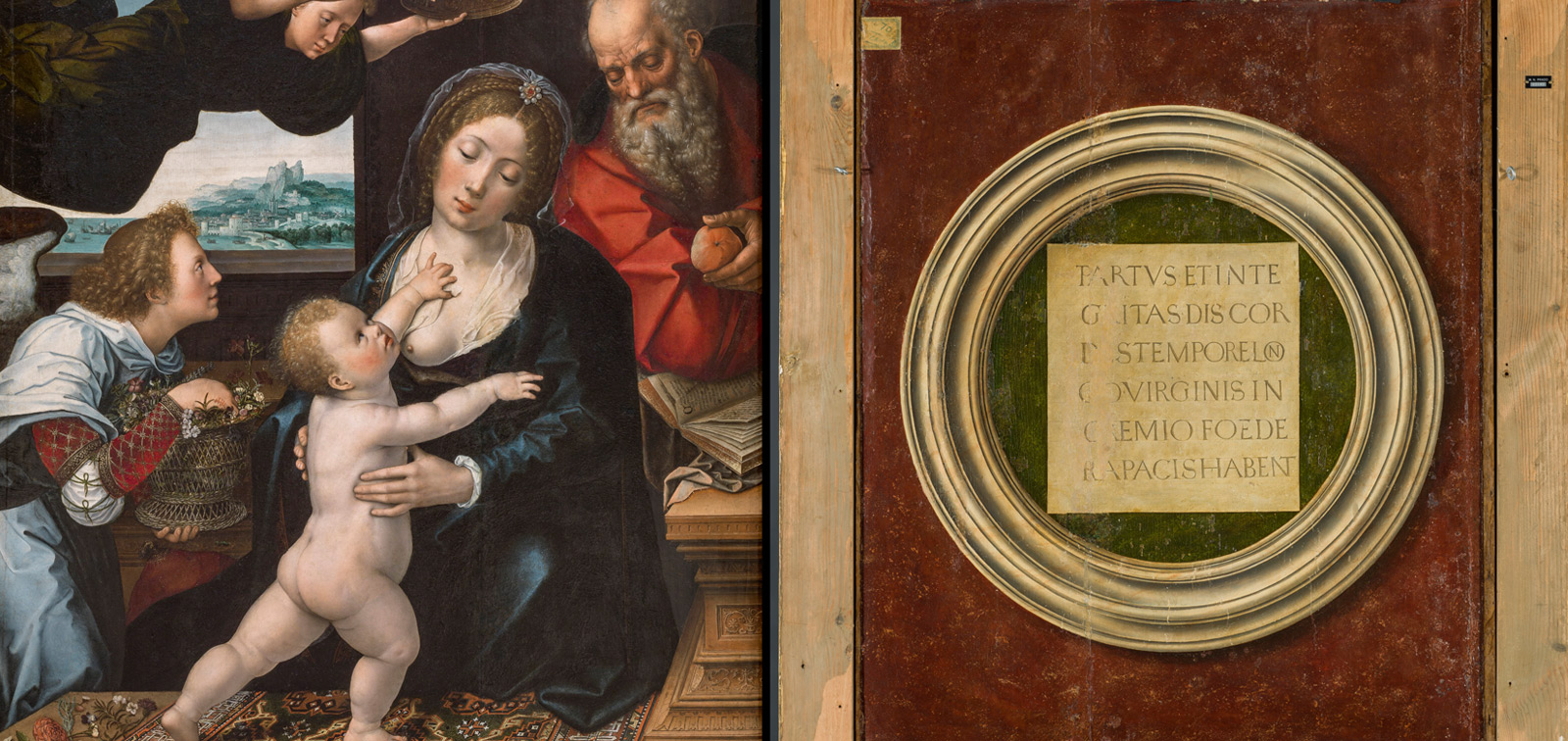
Bernard van Orley. The Holy Family (reverse), 1522. Oil on panel. Madrid, Museo Nacional del Prado

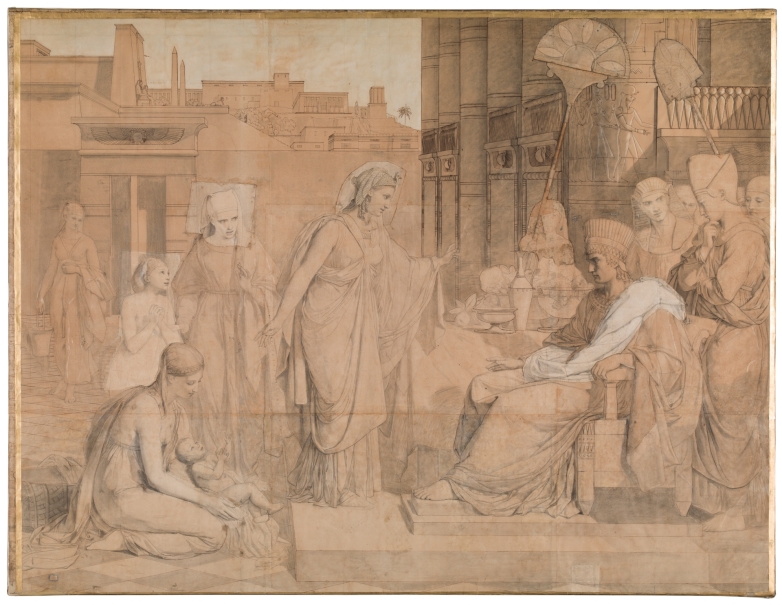
Another 17th-century innovation was the depiction of the reverse of a work in trompe l’oeil, no longer as the attribute of the painter but now the key motif in the composition. This typology was soon adopted by Francisco Gallardo with his metaartistic deceptions within the sub-genre of the “corner of the studio”, showing parts of the backs of prints or canvases pinned or nailed to wooden boards through their lifted edges or tears. The latter device was also employed by Louis-Léopold Boilly, who introduced a humorous and irreverent tone into a serious exercise of fiction through the hungry cat and the log of wood that has pierced the fictive canvas. Equally surprising is the fact that when André-Jacques-Victor Orsel drew the preparatory cartoon for his most successful painting he took the trouble to depict the stretcher to which the intended pieces of canvas would be affixed, detailing the veins of the wood and the nails, perhaps as part of the planning stage prior to the execution of the work.

The title of this section pays homage to René Magritte, an essential presence here. Words replace images in an enigmatic work that can be interpreted as a picture back (on an irregularly shaped stretcher) resting on the ground, as in so many images of artists’ studios.

B-Sides

B-Sides

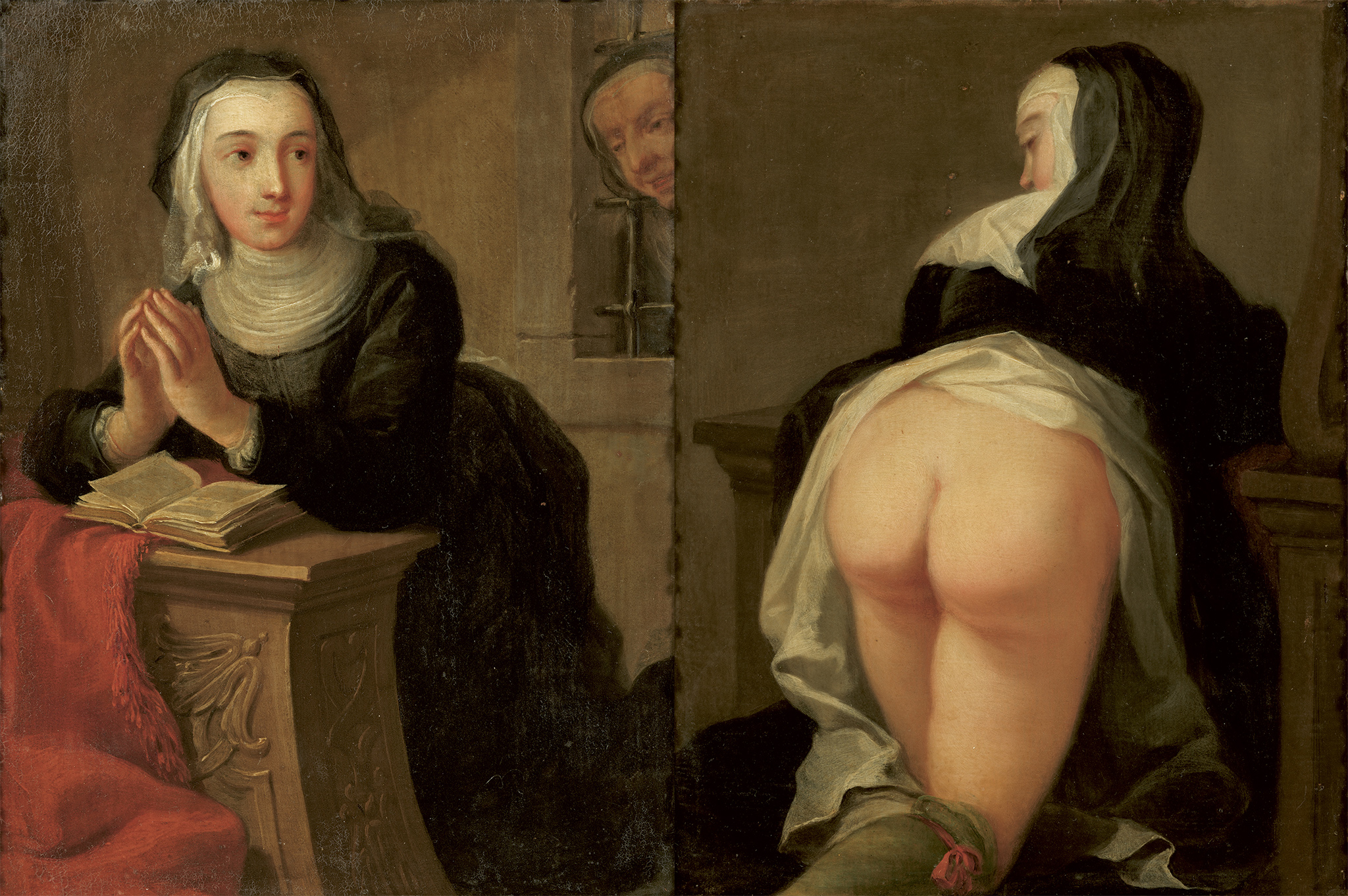
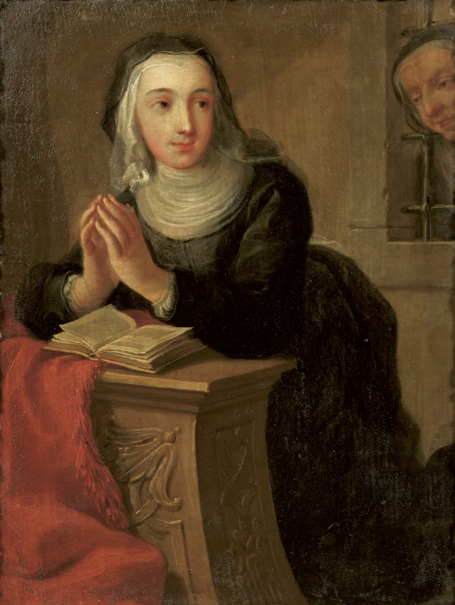
Martin van Meytens. Kneeling Nun (obverse and reverse), c. 1731. Oil on copper. Stockholm, Nationalmuseum

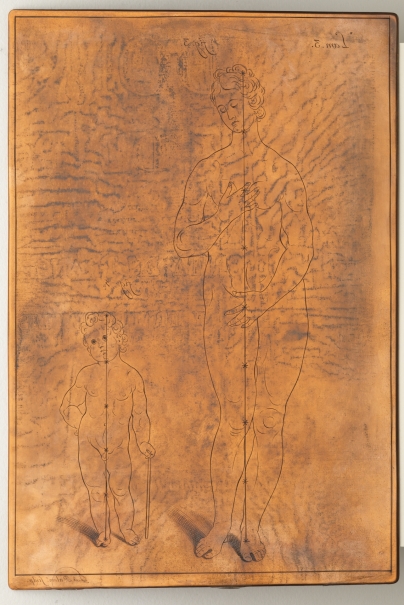
The paragone or Renaissance debate on the relative merits of painting and sculpture inspired the production of two-sided paintings with one or more figures depicted from the front and back. Late echoes of that formula are found in Martin van Meytens the Younger’s licentious work, but also in the life studies associated with the teaching of anatomy by Juan Bernabé Palomino and José López Enguídanos, the latter “synthesising” that dual viewpoint into a single image.

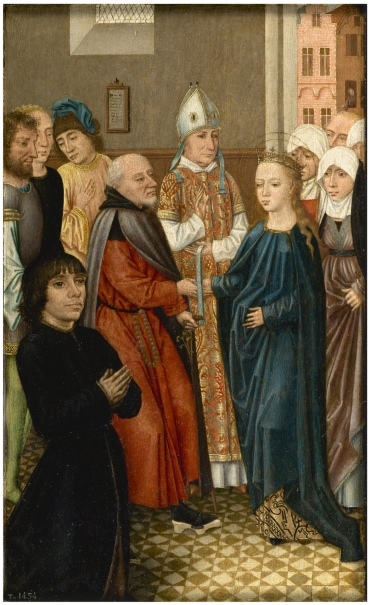
A considerable number of the earliest two-sided works were portable devotional panels or part of folding diptychs. Notably successful was a type of portrait with a reverse that “characterised” the sitter through figures or religious or symbolic scenes, illustrated here with examples by Wolfgang Beurer, an anonymous Venetian artist and the Master of the Magdalen Legend. With regard to two-sided devotional images, examples by Adriaen Isenbrandt, the Master of the Legend of Saint Catherine, an anonymous, possibly Spanish artist and a Mexican enconchado workshop reveal how depictions employing different codes (conventional pictorial figuration and fictive sculpture), languages (narrative and icon) and genres (religious or historical and landscape) could go “back to back”, establishing sometimes enigmatic relationships between the two sides.

The Hidden Side

The Hidden Side

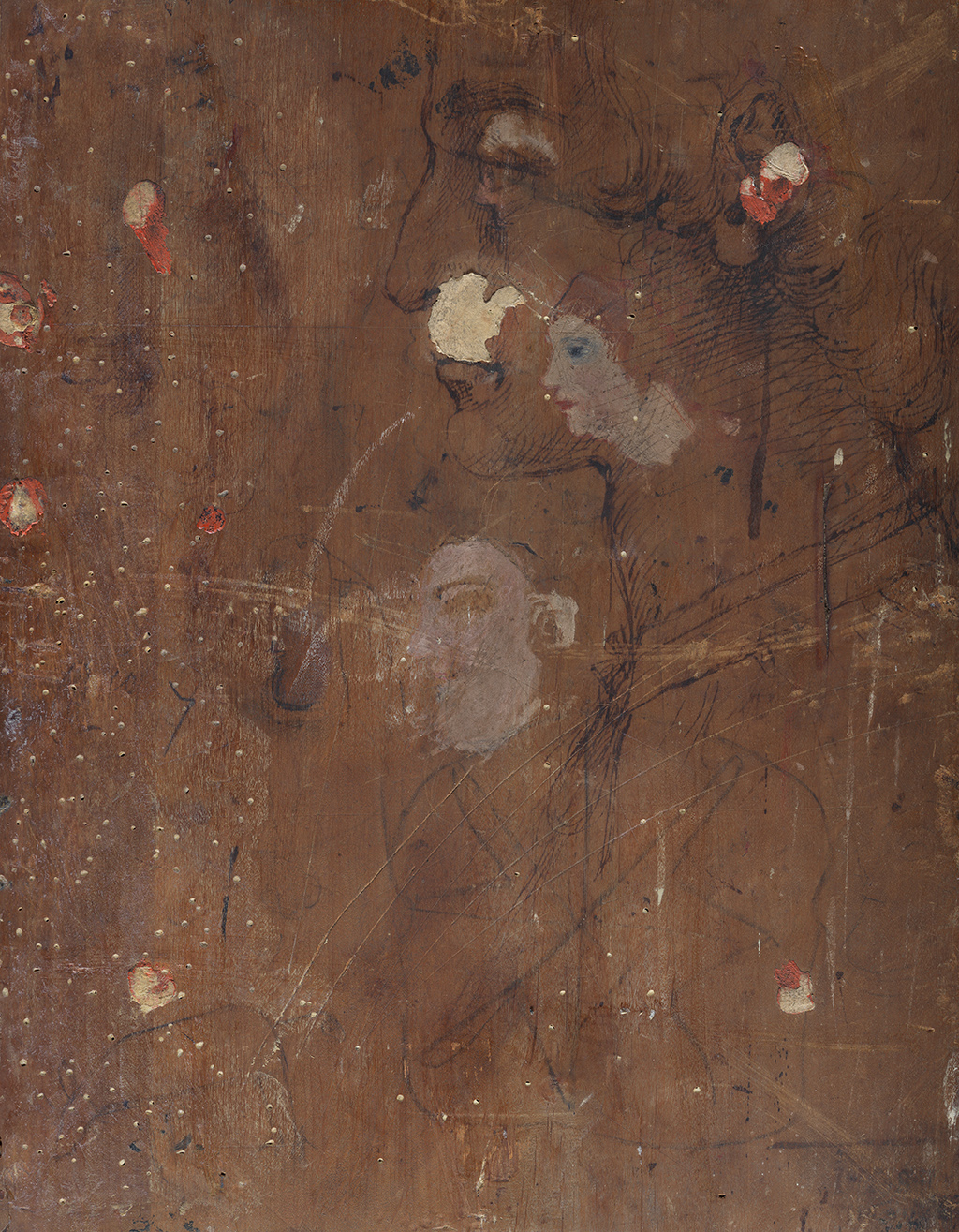
Annibale Carracci and students. The Ecstasy of Mary Magdalen / Sketches of figures (reverse), 1585–1600 / Before 1585. Oil on panel / Black chalk, charcoal, sepia ink and oil on panel. La Coruña, Museo de Belas Artes da Coruña, depósito del Museo Nacional del Prado

Many images that remained hidden on the backs of works as they were part of the creative process and thus lacked relevance for the interpretation of the front nonetheless provide information on the artist’s methods and personality. In some cases these are finished or almost completed compositions which were abandoned for one reason or another, after which the artist used the other side of the canvas. By chance, the four examples selected here—by Gregorio Fosman and an unknown artist, Fernando Álvarez de Sotomayor, Ernst Ludwig Kirchner and Darío de Regoyos—have one element in common: of rectangular format, the orientation of the principal image is different to the secondary one, and with the exception of the work by Kirchner the two sides correspond to a different pictorial genre.

Another group of works exemplifies the use of the reverse to try out ideas or add annotations of different types. In two of them—by an anonymous Italian artist and Rafael Hidalgo de Caviedes—the front image is also present on the back in the form of a drawing, possibly to test the composition. Normally, however, the front and back images are different and even dissonant: Annibale Carracci concealed a veritable palimpsest of caricatural drawings behind his painting; Vicente Palmaroli located landscape and figure studies on the two sides; and Juan Antonio Benlliure reused a canvas with a preliminary study of a ferociously painted-out female body on the back in order to paint his self-portrait on the front.

More Information on the Back: Inscriptions

More Information on the Back: Inscriptions

Tiziano. The Mater Dolorosa with clasped Hands, 1554. Oil on panel. Madrid, Museo Nacional del Prado

This section has involved a radical exercise: turning most of the pictures to face the wall. The result has been to emphasise the aesthetic qualities of the unpremeditated compositions created by the frames, stretchers, labels, handwriting, etc., and the frustration provoked in the viewer by the concealment of the image, anticipated in Las Meninas.

The most “pictorial” inscriptions comment on the images on the front, as with The Holy Family by Bernard van Orley, with Titian and with an anonymous 17th-century copyist, whose work, like Van Orley’s Virgin of Louvain, reveals the importance of preserving the written part in some cases, for example when a copy was made or restoration undertaken. The latter included relining the canvases and on occasions the annotations made by the person who undertook that task have helped to trace the work’s provenance, as with Orazio Gentileschi’s painting.

We also encounter simple testaments to friendship between Anton Raphael Mengs and Nicolás de Azara or Alejandro Ferrant and Francisco Pradilla, or more extensive biographical information on artists, models and benefactors present on the works by Vicente López, Francisco Javier de Urrutia and Ricardo Balaca. Finally, Eugenio Lucas Velázquez’s mordant comments reveal that he did more than simply imitate Goya’s pictorial style.

More Information on the Back: Stamps and Seals

More Information on the Back: Stamps and Seals

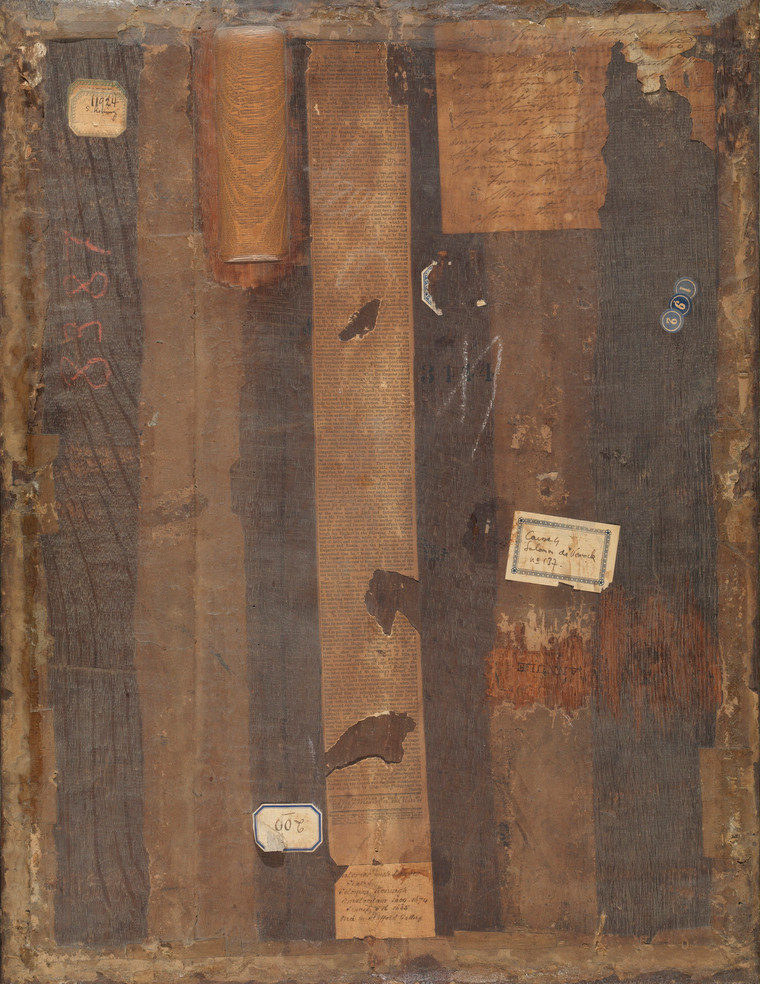
Salomon Koninck. A Philosopher, 1635. Oil on panel. Madrid, Museo Nacional del Prado

Almost all the backs of works in this exhibition feature stamps and seals and this section aims to draw particular attention to them. Even a work as small as Fra Angelico’s bears inscriptions, sealing wax seals of the Alba family, various inventory labels and the Civil War requisition stamp. The latter is also present on the anonymous portrait of Alonso Cano, which also has labels of old exhibitions that allow the history of the work’s attribution to be traced.

The most ambitious collectors marked their possessions and we see stamps or initials of Isabella Farnese on the copy of the work by Bernardino Luini; of the Prince of Asturias (the future Charles IV) on the work by Francisco Bayeu (with indications of the work’s travels); and of Gaspar de Haro on the painting by El Greco, which also retains signs of its progress through the art market. The labels that testify to the most dramatic histories are, however, those on the back of Salomon Koninck’s painting—a press cutting of an obituary and indications of the work’s presence in the famous Stafford Gallery in London and its subsequent ownership by a Jewish art dealer whose collection was seized by the Nazis—and those which reveal the fire damage to Andries van Eertvelt’s seascape when in the home of a Francoist government minister.

Folds, Cuts and Cutouts

Folds, Cuts and Cutouts

Zacarías González Velázquez. Reverse of Two Fishermen, one with a Rod and the other seated, 1785. Oil on canvas. Madrid, Cuartel General del Ejército, depósito del Museo Nacional del Prado

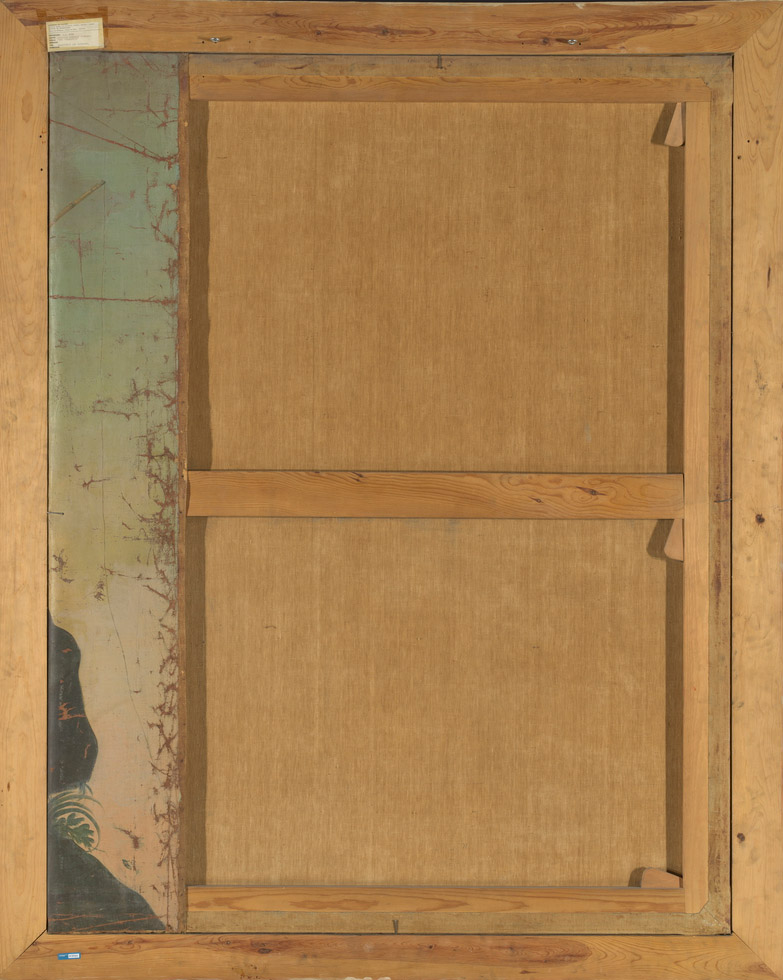
Cuts and folds concealed on the backs of paintings provide evidence of conservation work or of the adaptation of paintings to new locations. The wooden planks of panels that have separated are “sewn” together, as we see with Andrea del Sarto’s, using crossbeams and dovetail joints that now create unforeseen compositions. The same is true—and is emphasised by the visual resonance of Pablo Palazuelo’s painting—of the cut-off pieces retained on the backs of Francesco Albani’s frescoes for the pendentives in the Roman church of San Giacomo degli Spagnoli. Fragments from the rectangular canvases to which the compositions were transferred after removal from the wall, they are the result of the reinstatement of the works’ original oval format.

Turning around a tapestry cartoon by Zacarías González Velázquez reveals a strip of painting that was folded over the stretcher at some date in order to fit the work into a narrower space. The opposite was the case with another design for a tapestry, this time by Rubens, when an addition on all sides in the form of a cradle painted with architectural motifs was recently removed and now frames the absence of the image. With regard to monochrome, another absence of representation, Lucio Fontana slashed his painting to open up a crack onto the tenebrous space behind it.

From Behind, in Front of the Painting

From Behind, in Front of the Painting

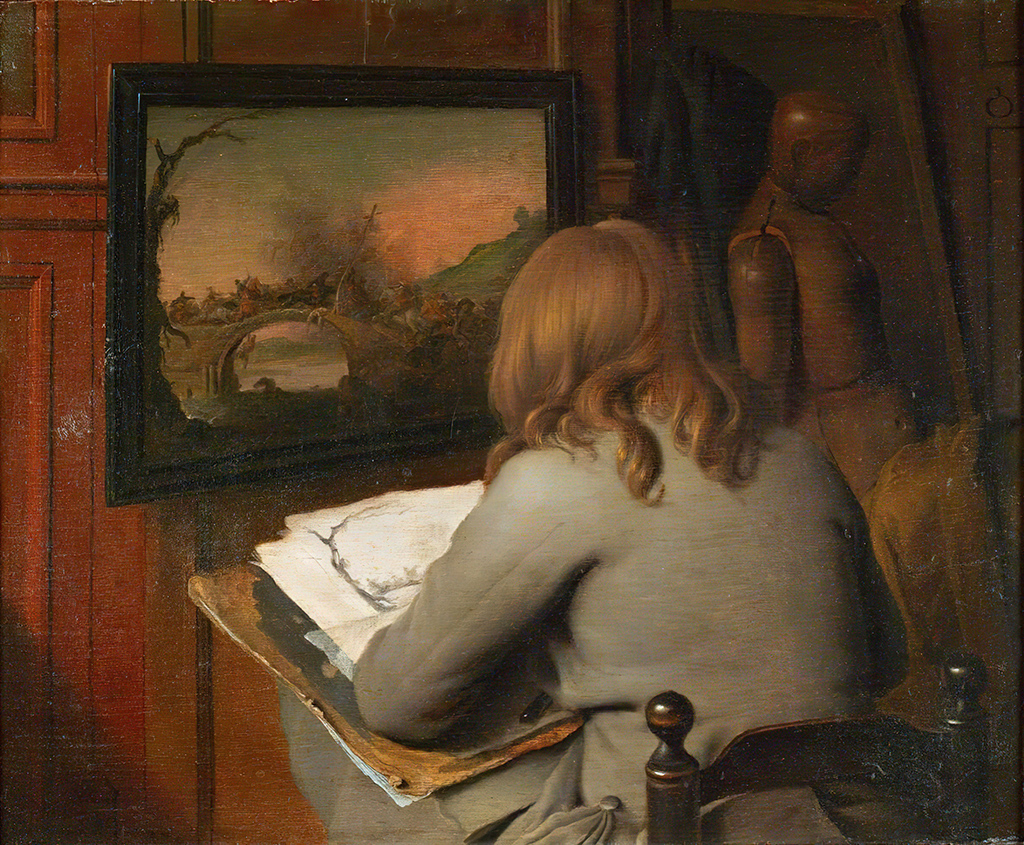
Wallerant Vaillant. A Young Boy copying a Painting, c. 1670. Oil on panel. London, Guildhall Art Gallery, City of London

When viewers (or artists) locate themselves in front of a painting they forget the surrounding reality or turn their backs on it to display their own. This was the case in artists’ studios from an early date, as recorded by Wallerant Vaillant when he spied on a young apprentice copying a painting, or Manuel Fernández Carpio, who observed art dealers participating in an estate sale in the studio of an 18th-century painter. The protagonist of this section is, however, the public, now transformed into an artistic subject in itself; seen not from the front but looking into the pictorial space, immersed in the contemplation of works.

The Mondo nuovo or portable peepshow allowed Giandomenico Tiepolo to convey the faceless, modern urban crowd’s desire for spectacle. Nor do we see that of the visitor to the Isabella Stewart Gardner Museum who, at Sophie Calle’s request, located herself in front of the frame of one of the paintings stolen from that museum in order to describe what she saw in the empty space. Similarly invisible are the faces of visitors to Versailles and to the Prado itself, which Elliott Erwitt photographed in a humorous tone, revealing the spatial dynamics and poses that we typically adopt in museums.

Ornaments and Ghosts

Ornaments and Ghosts

Attributed to Orazio Borgianni. Self-Portrait (?), 1600–10. Oil on canvas. Madrid, Museo Nacional del Prado

Some backs have significant decoration on them. One type imitates other materials, as in Quinten Massys’ panel with its beautiful fictive marbling and the one by Alejo Fernández with a more unusual simulation of an animal skin. Others complement the image on the front, such as the tabernacle door by Juan de Juanes on which the Christogram that now faces the wall was originally the side always visible to the faithful.

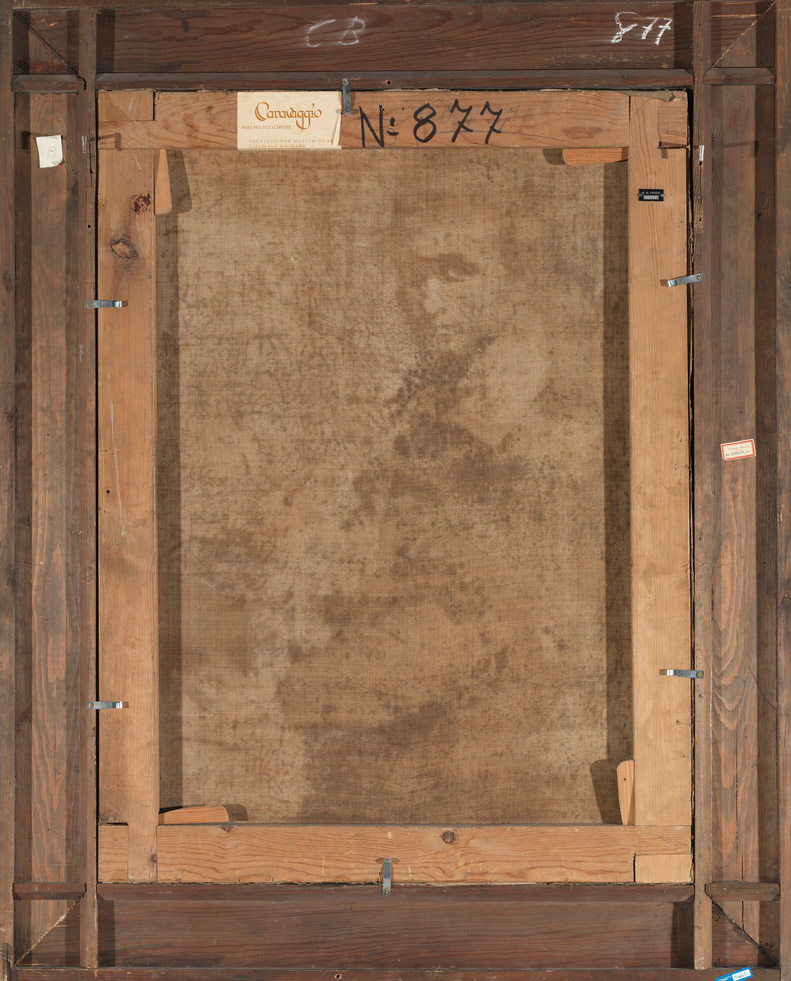
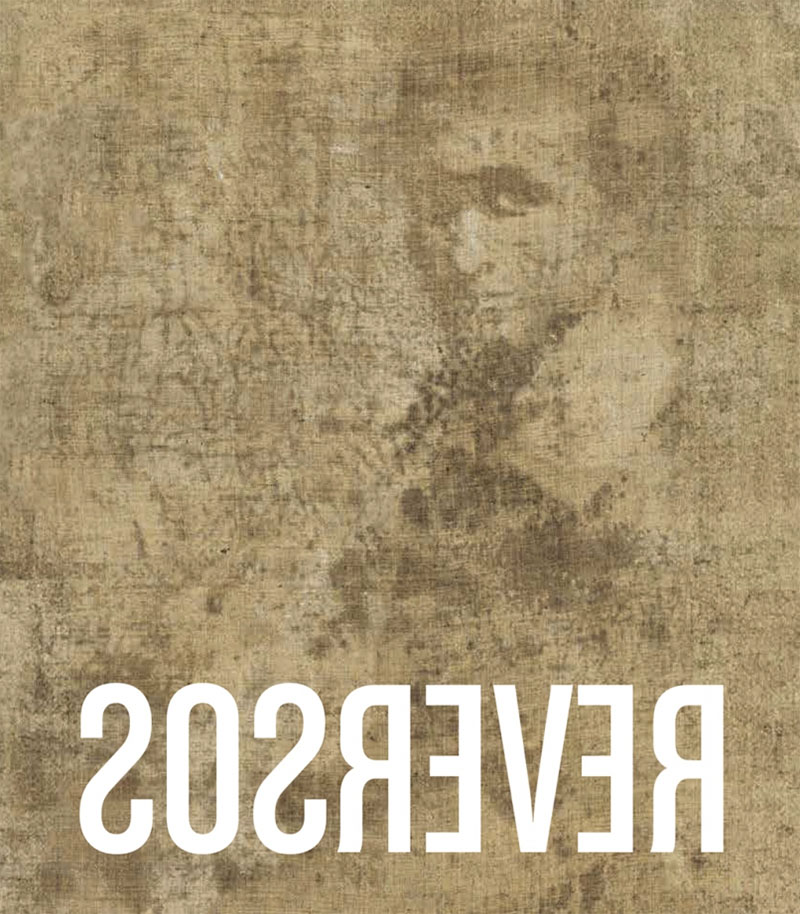
The canvas itself could possess aesthetic qualities. One example is the “mantelillo veneciano” with figural motifs used by Eugenio Cajés or, in a geometrical mode, the ticking employed as a support by José María Estrada. Depending on the materials and the state of conservation, thinner fabrics make beautiful ghosts appear. Oils in particular penetrate the canvas via the ground and create the soft-edged forms that we see on the backs. The most striking case of ghostliness is the work attributed to Orazio Borgianni, closely followed by Vicente Palmaroli’s. Backs of sculptures can also be spectral: inside Charles V’s armour cast by Leone Leoni a dripping, igneous body takes shape.

Nature in the Background

The backs of works reveal the museum’s ecosystem—wood, vegetable fibres, iron, oils, resins, bio-deterioration wherever we look—but also unusual materials (all from the natural world) which painters often used to increase their interaction with the image. Examples include the glass or stone supports employed by Ciro Ferri (aventurine), Agnolo Bronzino (red porphyry) and Francesco Pieri (slate), which are left visible on the back and function as the backgrounds of the paintings or of the latter’s wax reliefs.

Again, the most transparent supports add light to Karl August Müller’s miniatures on porcelain and Francisca Ifigenia Meléndez and Heinrich Friedrich Füger’s on ivory, the latter two embellished with human hair. Another biological material, one of the rarest in the museum, is cork, used as a support by Alonso Sánchez Coello. One of the most common is copper, as in the small plates which Jan van Kessel painted on the front and also in some cases with preliminary sketches on the back, on which oxidisation also charts a spectral geography. Spectral is also an appropriate term for José María Sicilia’s specular “door”, a homage to Goya that concludes this survey, which started with another opening in space: the back of Las Meninas.

Miguel Ángel Blanco adds his own signature as an artist to the exhibition with three works that transmute the element found in greatest abundance on the backs of paintings: dust. When the Museo del Prado took down its extremely large copy of Raphael’s Transfiguration Miguel Ángel collected some of the dust accumulated on the cross-beams of its stretcher during decades of darkness with the aim—and echoing the painting’s subject—of transforming it into light.

Artworks

Verso (Las Meninas)
1
Verso (Las Meninas)

Vik Muniz

Mixed media, 367.5 x 324 x 13 cm

2018

Courtesy of the artista and the Elba Benítez Gallery

Artist in his Studio
2
Artist in his Studio

Rembrandt Harmensz. van Rijn

Oil on panel, 24.8 x 31.7 cm

c. 1628

Boston, Museum of Fine Arts. Zoe Oliver Sherman Collection given in memory of Lillie Oliver Poor

3
Painter in his Studio

Barent Fabritius       

Oil on panel, 72 x 54 cm

1655–60

Paris, Musée du Louvre, département des Peintures

Interior with the Artist’s Easel
4
Interior with the Artist’s Easel

Vilhelm Hammershøi                          

Oil on canvas, 84 x 69 cm

1910

Copenhagen, SMK, National Gallery of Denmark

5
Easel with Canvas

Michelangelo Pistoletto                      

Silkscreen on stainless steel. 250 x 125 cm

1962–75

Madrid, Museo Nacional Centro de Arte Reina Sofía

6
The Studio Window

Carl Gustav Carus

Oil on canvas, 29.2 x 23 cm       

1823–24

Lübeck, die Lübecker Museen. Museum Behnhaus Drägerhaus

7
The Artist’s Studio by the Brandenburg Gate, Berlin

Max Liebermann

Oil on canvas, 68.5 x 82 cm

1902

San Galo, Kunstmuseum St. Gallen, Ernst Schürpf-Stiftung, acquired 1951

8
Self-Portrait as a Painter

Vincent van Gogh     

Oil on canvas, 46.5 x 38.5 cm

1886

Amsterdam, Van Gogh Museum (Vincent Van Gogh Foundation)

10

Madrid, Museo Nacional del Prado

12
The Empty Mask

René Magritte

Oil on canvas, 73 x 92.5 cm

1928

Düsseldorf, Kunstsammlung Nordrhein-Westfalen

13
Greedy Cat piercing the Canvas to eat the Herrings

Louis-Léopold Boilly             

Oil on canvas, 85 x 96 cm

c. 1800

Paris, Collection Farida et Henri Seydoux

14
Literary Trompe l’Oeil

Francisco Gallardo                 

Oil on canvas, 64.2 x 85.2 cm

c. 1764

Madrid, Museo Nacional del Prado

15
Trampantojo de la castidad

Francisco Gallardo                 

Óleo sobre lienzo, 64.4 x 85.4 cm

h. 1764

Madrid, Museo Nacional del Prado

17
The Confiscation of the Contents of an Art Dealer’s Gallery

Attributed to François Bunel the Younger             

Oil on panel, 28.1 x 47 cm

1590

The Hague, Mauritshuis

18
Rothko carrying a canvas in his studio

Alexander Liberman                            

c. 1964–68 (exhibition print)

Los Angeles, Getty Research Institute (2000.R.19), © J. Paul Getty Trust

19
Evacuation of works from the Louvre at the beginning of World War II

Pierre Jahan               

1939 (exhibition print)

Paris, Archives des Musées Nationaux, © Pierre Jahan/Roger-Viollet

20
One of the galleries of the Museo del Prado used as stores for works during the Civil War

Gelatin print on paper, 228 x 304 mm

c. 1939

Madrid, Museo Nacional del Prado

21
Picasso with Jacqueline Roque, signing his works at La Californie

David Douglas Duncan

1960 (exhibition print)

Paris, photo © RMN-Grand Palais (Musée national Picasso-Paris) / image RMN-GP/ © David Douglas Duncan, Harry Ransom Center, The University of Texas at Austin; © Succession Picasso–Gestion droits d’auteur

22
Georgia O’Keeffe (carrying two canvases)

Alfred Stieglitz                         

c. 1921 (exhibition print)

Santa Fe, N. M., Photo Georgia O’Keeffe Museum, Santa Fe/Art Resource/Scala, Florence

23
Cross beams from the original stretcher of Guernica by Picasso

Wood

1937

Madrid, Museo Nacional Centro de Arte Reina Sofía

24
Assemblage with Graffiti

Antoni Tàpies                            

Mixed media, iron and tow on wood, 208 x 190 cm

1972

Courtesy of the Fundación Telefónica

25
Burned Canvas 4

Joan Miró      

Acrylic on cut and burnt canvas, 130 x 195 cm

1973

Barcelona, Fundació Joan Miró. Donación de Pilar Juncosa de Miró

Kneeling Nun
26
Kneeling Nun

Martin van Meytens               

Oil on copper, 28 x 21 cm

c. 1731

Stockholm, Nationalmuseum

28
Family of Skeletons

José López Enguídanos       

Oil on canvas, 101 x 70 cm

c. 1800

Madrid, Museo de la Real Academia de Bellas Artes de San Fernando

29
Johann von Rückingen (?) / Figure with Coat of Arms

Wolfgang Beurer      

Oil on panel, 37.3 x 27.5 cm

1487

Madrid, Museo Nacional Thyssen-Bornemisza

30
Portrait of a Man as Saint Andrew / Saint Sebastian

Attributed to the Master of the Magdalen Legend

Oil on panel, 28.2 x 19.7 cm

c. 1480

Madrid, Museo Nacional Thyssen-Bornemisza

31
The Virgin seated on a Marble Throne / Skull in a Niche

Adriaen Isenbrandt               

Oil on panel, 28 x 21 cm

1501–25

Madrid, Museo Lázaro Galdiano

32
Portrait of a Man (Giulio Mellini?) / Landscape with an Orange Tree and Coats of Arms

Anonymous Venetian artist (previously attributed to Marco Marziale)

Oil on panel, 36 x 25 cm

1493–1507

Paris, Musée du Louvre, département des Peintures

36
The Battle of Cholula / Birds in a Wetland

Juan y Miguel González

Oil, tempera and mother of pearl on panel, 116 x 49.3 cm

c. 1698–1701

Private collection

37
Christ bearing the Cross

Anonymous Italian artist

Marble, 69 x 52 x 6 cm

1501–25

Madrid, Museo Lázaro Galdiano

The Ecstasy of Mary Magdalen / Sketches of figures
38
The Ecstasy of Mary Magdalen / Sketches of figures

Annibale Carracci and students

Oil on panel / Black chalk, charcoal, sepia ink and oil on panel, 37.5 x 29.5 cm

1585–1600 / Before 1585

La Coruña, Museo de Belas Artes da Coruña, depósito del Museo Nacional del Prado

41
Satyr and Nymphs / Portrait of a Woman

Fernando Álvarez de Sotomayor                  

Oil on panel, 54.5 x 63 cm

1924 / before 1924

La Coruña, Museo de Belas Artes da Coruña, depósito del Museo Nacional del Prado

42
Eternal Walkers

Rafael Hidalgo

Charcoal on canvas, 180 x 245 cm

c. 1915

Granada, Museo de Bellas Artes de Granada, depósito del Museo Nacional del Prado

43
Valmaseda / Self-Portrait

Darío de Regoyos

Oil on panel, 46.1 x 37.9 cm

1895 / c. 1901–5

Oviedo, Museo de Bellas Artes de Asturias

44
Landscape / Oil sketch of a seated girl reading

Vicente Palmaroli    

Oil on panel, 41.8 x 24.3 cm

c. 1884

Jaén, Museo de Jaén, depósito del Museo Nacional del Prado

45
Kneeling Nude in front of a Red Screen / Seated Nude with Bent Leg

Ernst Ludwig Kirchner        

Oil on canvas, 75.5 x 56.7 cm

1911–12 / 1921–23

Madrid, Museo Nacional Thyssen-Bornemisza

48
Reverse of Executioner with the Head of Saint John the Baptist by Orazio Gentileschi

(1612–13, oil on panel transferred to canvas, 82 x 61 cm.)

Madrid, Museo Nacional del Prado

52
José Robles. Sapper in the Murcia Regiment

Francisco Javier de Urrutia              

Oil on canvas, 72 x 62.5 cm

1841

Madrid, Museo Nacional del Romanticismo

60
63
67
Untitled II

Pablo Palazuelo

Oil, 124 x 88 cm

c. 2004

Madrid, Fundación Pablo Palazuelo

68
18th-century addition removed from The Defenders of the Eucharist by Peter Paul Rubens

(c. 1625, oil on canvas, 86.8 x 91 cm)

Madrid, Museo Nacional del Prado

69
Spatial Concept. Expectation

Lucio Fontana

Acrylic on canvas, 116 x 89 cm

1960

Madrid, Museo Nacional Centro de Arte Reina Sofía

77
Inside of the amour of Charles V and the Fury by Leone Leoni

(1551–55, cast bronze, 91.5 x 75 x 26.5 cm)

Madrid, Museo Nacional del Prado

78

Madrid, Museo Nacional del Prado

79
A Young Boy copying a Painting
80
A Young Boy copying a Painting

Wallerant Vaillant

Oil on panel, 31.6 x 39.5 cm

c. 1670

London, Guildhall Art Gallery, City of London

81
What do you see? The Storm on the Sea of Galilee. Rembrandt

Sophie Calle                

Colour photograph, text, frames (plexiglass and metal frames), 68 x 101 (x2) cm

2013

Courtesy of the artista and Perrotin

82
Versailles, France

Elliott Erwitt               

Photograph (exhibition print)

1975

Austin, TX., Harry Ransom Center, University of Texas, © Elliott Erwitt/Magnum Photos/Contacto

83
Madrid, Museo del Prado

Elliott Erwitt               

Silver gelatin print on paper, 37.7 x 55.8 cm

1995 (this print 2002)

Madrid, Museo Nacional Centro de Arte Reina Sofía

86
Cosimo I de’Medici

Agnolo di Cosimo, il Bronzino

Oil on red porphyry, 16.6 x 13.5 cm

c. 1560

Colección Abelló

87
Charity, Christ and the Canaanite Woman (reverse), Saint Sebastian and the Holy Women, The Holy Family

Francesco Pieri

Modelled, tinted wax on slate, 23.5 x 19 cm (each)

1734–66

Madrid, Museo Nacional de Artes Decorativas

90
Hardstone specimens

18th century, 28 x 48 x 3 cm

Madrid, Museo Nacional de Artes Decorativas

93
Portrait of a Woman wearing a feather-trimmed Turban (box)

Francisca Ifigenia Meléndez

Gouache on ivory, tortoiseshell, metal, glass and hair, 82 mm. diameter; 29 mm h.

1800

Madrid, Museo Nacional del Romanticismo

94
The Four Parts of the World, selection of scenes and painted reverses

Jan van Kessel el Viejo

Oil on copperplate, 17 x 23 cm (each)

1660–66

Madrid, Museo Nacional del Prado

95
Echo. Devour me

José María Sicilia     

Bronze, 200 x 100 x 2.5 cm

2009

Colección Barón Guillaume Kervyn de Volkaersbeke

96
Box-book 1204 from The Library of the Forest. Dust from The Transfiguration I. Dawn

Miguel Ángel Blanco

8 pages of plant fibre paper and Lokte bark paper soaked in linseed oil with rubbings from the reverse of the panel.

Box: dust accumulated on the reverse of The Transfiguration by Giovanni Francesco Penni and Giulio Romano (Museo del Prado), fragments of poplar wood with woodworm from the original panel and drops of wild pine resin on gold leaf.

11 July 2020. 30 x 30 x 3,3 cm.

Miguel Ángel Blanco, Biblioteca del Bosque

97
Box-book 1205 from The Library of the Forest. Dust from The Transfiguration II. Dusk

Miguel Ángel Blanco

6 pages of Fabriano laid paper and thin copy paper with rubbings from the reverse of the panel.

Box: dust accumulated on the reverse of The Transfiguration by Giovanni Francesco Penni and Giulio Romano (Museo del Prado), fragments of old poplar wood used in the restoration of the support, drops of araucaria and wild pine resin on gold leaf and rosin.

12 July 2020, 11,15 x 22 x 3 cm.

Miguel Ángel Blanco, Biblioteca del Bosque

98
Box-book 1206 from The Library of the Forest. Dust from The Transfiguration III. Night

Miguel Ángel Blanco

6 pages of black rag paper and thin copy paper with rubbings from the reverse of the panel.

Box: dust accumulated on the reverse of The Transfiguration by Giovanni Francesco Penni and Giulio Romano (Museo del Prado) on black oil 13 July 2020, 15 x 22 x 4 cm.

Miguel Ángel Blanco, Biblioteca del Bosque

Resources for the visit

Digital brochure

On the Reverse

Audio Guide

Spanish and English. 5€ (includes the temporary exhibitions On the Reverse, The Lost Mirror and the Collection). On sale online and at the ticket office when you buy your ticket to the Museum.

Print on demand

Print artworks available in our catalogue in high quality and your preferred size and finish.

Image archive

Request artworks available in our catalogue in digital format.

Up