Seascape
1766 - 1800. Hardstone.Room 086
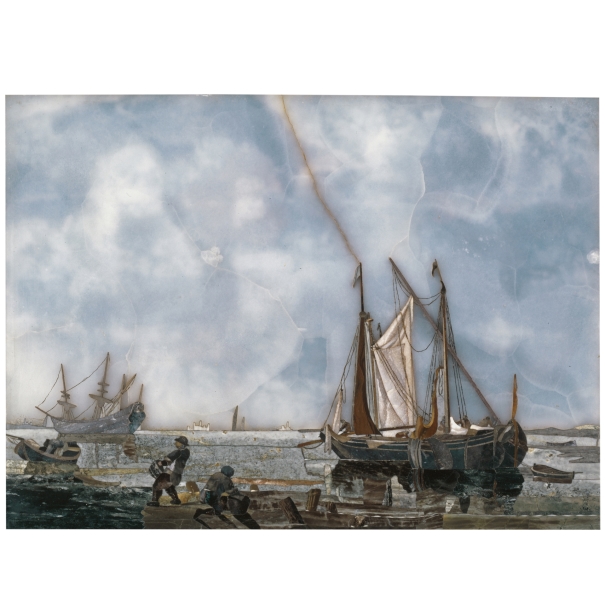
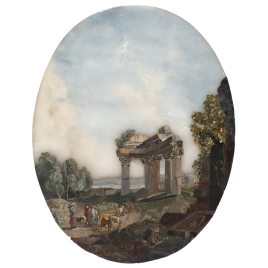
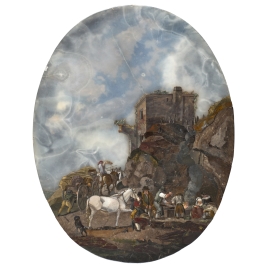
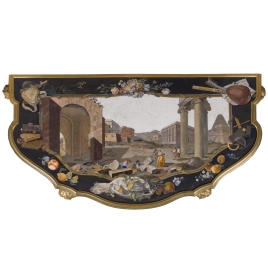
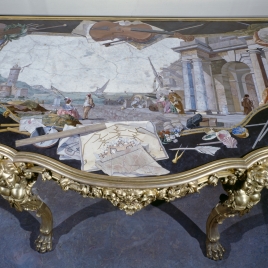
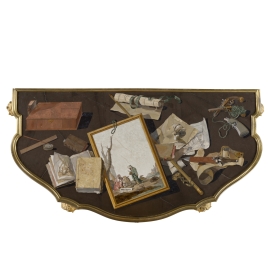
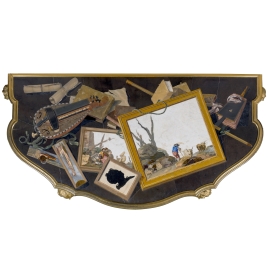
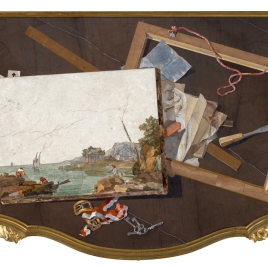
The Seascape made at the Royal Buen Retiro Hardstone Laboratory also has the appearance of being the translation of a painting to another material, possibly a work by Willem van der Velde the Younger who was active in the second half of the 17th century, or one of his followers. Although Ferdinand VI had taken some initial steps to promote the craft of hardstone inlay, the Royal Laboratory was also the initiative of Charles III, a great lover of the natural sciences. He had founded a similar enterprise in Naples, based on the Opificie delle Pietre Dure in Florence with which the Medici had officialized their obsession with porphyry and other sumptuous minerals. Charles then summoned the Italian experts Domenico Stecchi and Francesco Poggetti to Madrid to develop the project. They initially brought the stones from Florence, France, England and Smyrna but soon organised expeditions to locate geological sites in Spain. While relatively few works from the Laboratory have survived, up to 35 craftsmen were employed there and it was active for almost half a century (1762–1808), so its output must have been extensive. Landscape “mosaics” of this type are beautiful objects and now quite rare. In this example the blueish marble of the sky has atmospheric gradations and the reflection of the ship on the water makes us believe in the reflective properties of stones.
Blanco, Miguel Ángel (comisario), Reversos, Museo Nacional del Prado, 2023, p.267-268, 322