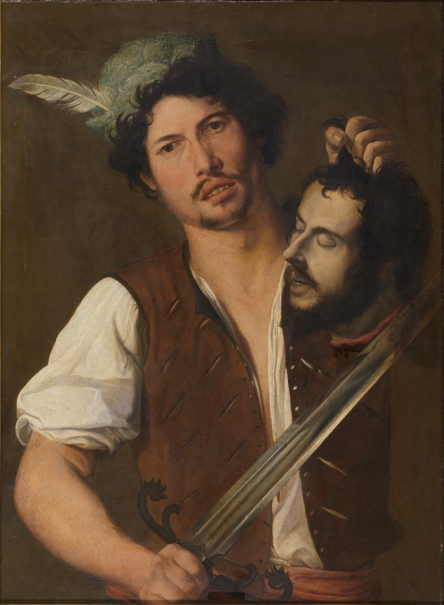
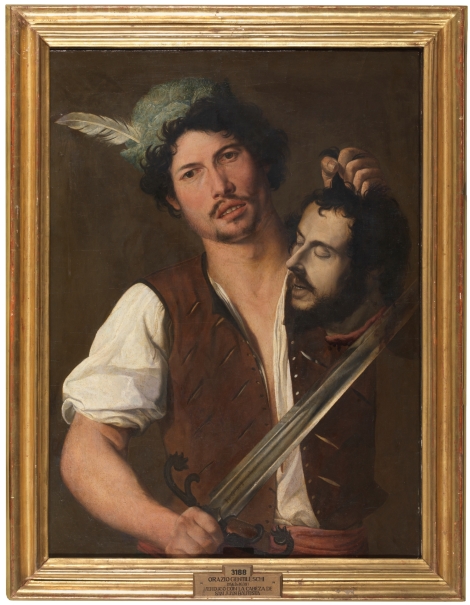
Executioner with the Head of Saint John the Baptist
1612 - 1613. Oil on panel transferred to canvas.Not on display
On the reverse of Executioner with the Head of Saint John the Baptist by Orazio Gentileschi one of the royal museum’s picture liners, Antonio Trillo, proudly states that he had “transposed” this work, which had been in the “select gallery of Sr. don Francisco García Chico”, from panel to canvas in 1849. However, when trying to find out who this Sr. García Chico was, I came across a story that could provide the plot for a novel. He was in fact a well known chief of police in Madrid referred to by Baroja and Galdós. Working on the orders of Ferdinand VII, he climbed up the ranks and became a “terrifying henchman who remorselessly pursued those denounced for their political ideas”, according to Pedro de Répide, a chronicler of events in the capital. This policeman, “despite being a depraved individual, had refined artistic tastes and in his sumptuously decorated house on the Plaza de los Mostenses he had assembled one of the finest private collections of paintings to be found in Madrid.” Among the nearly 700 paintings it is recounted that there were works by Michelangelo, Velázquez, Zurbarán, Rubens, Dürer, Mazo, Claudio Coello, Murillo, Rubens and Bosch and up to fifty by Goya.
Blanco, Miguel Ángel (comisario), Reversos, Museo Nacional del Prado, 2023, p.202-203, 317