Master of the Virgo inter Virgines
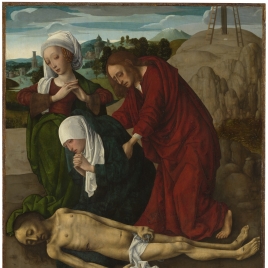
Delft, act. 1480 - Delft, act. 1510Master of the Virgo inter Virgines is the conventional name given by Max Friedländer in 1902 to an artist he considered halfway between Geertgen tot Sint Jans (c. 1460/65–after 1490) and Cornelis Engebrechtsz. (c. 1460–1527) on the basis of a work with this iconography, the “Virgin and Child between four Virgins”, now in Amsterdam (Rijksmuseum, inv. SK-A-501). By 1910 the author had assembled a corpus that totalled fifteen works. The fact that this artist’s figures are relatively easy to identify by their long necks, high cheekbones, straight noses, prominent foreheads and slit-like mouths with fleshier lower lips led scholars to readily recognise the hand of the Master of the Virgo inter Virgines, and his corpus progressively grew with new works such as the “Lamentation over the Dead Christ” in the Museo del Prado. Knowledge of his sources also increased: his paintings were found to be greatly influenced by Hugo van der Goes and other artists active in Ghent in the second half of the fifteenth century, though they also display evidente similarities with northern painters, especially Geertgen tot Sint Jans and even Dirk Bouts, from whose eloquent gesticulating figures he likewise drew. In addition, he produced many engravings for publications between 1483 and the end of the century. These prints have been identified as produced in Delft, suggesting that the artist hailed from that city. Although it has been attempted to equate him with documented painters such as Pieter die Maelre or Dirk Jansz. (act. 1474–95), his identity remains unknown (J.J. Pérez Preciado, "Fifteenth-century netherlandish painting at the Museo Nacional del Prado. Catalogue raisonné", Museo del Prado, 2024, p. 284).