Lamentation over the Dead Christ
Ca. 1490. Oil on panel.Room 058A
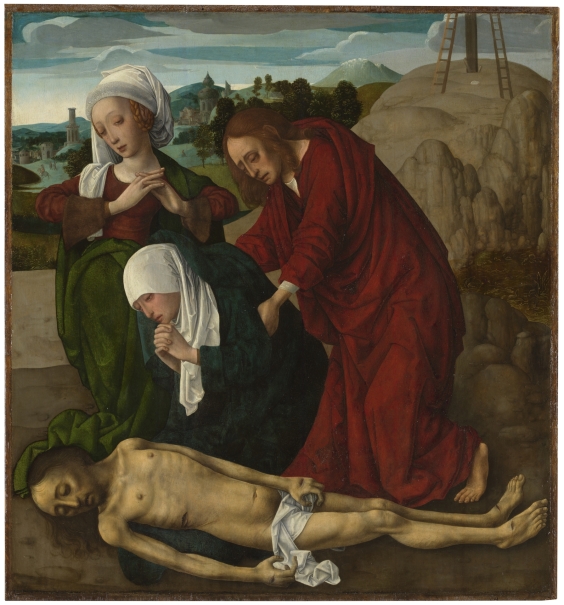
The work represents the Lamentation over the dead Christ. Jesus has been taken down from the cross and his body, in the foreground, lies partly on Mary’s mantle and partly on the bare ground. He is a very expressive figure, gripped by rigor mortis, his hands stiff and extremely thin, his ribs very noticeable and his face cadaverous. The signs of his martyrdom – the spear wound in his side and the nail holes in his hands and feet – are evident, and cuts are even perceptible on his knees, though there is no sign of blood in them. There is, however, no trace of the injuries inflicted during the flagellation and nor is the Crown of thorns depicted. In the mid-ground Mary, kneeling and held up by Saint John, mourns the loss of her son.
The sorrowful figure beside her might not be the Magdalen as is customary, since she does not display any of the characteristic elements that identify her, such as the pot of ointment or luxurious objects like jewellery, but simply appears with her head covered with a veil. Driven into the ground in the background on the right, on a hillock that represents Golgotha, is the lower part of the cross flanked by a ladder on each side. Further behind, towards the left, lies the city of Jerusalem, whose imaginative buildings spring up among tres and mountains. One of these structures, a characteristic semi-circular tower, is found in other works by the artista such as the eponymous Virgin and Child between four Virgins in Amsterdam (Rijksmuseum, inv. SK-A-501).
The lamentation episode was fully illustrated in a triptych of which the central panel was the Prado painting and the wings the pictures now in the Suermondt- Ludwig-Museum in Aachen. Despite entering the Museum’s holdings as a work by the Hispano-Flemish school, the panel was son attributed to the Master of the Virgo inter Virgines. Many stylistic characteristics of the Prado work justify its attribution to the Master of the Virgo inter Virgines. The salient feature is the heightened expressionism and pathos of its figures, common in his output and evidente here in Christ. Equally distinctive traits are the bulging shape of the female figures’ heads, and, in particular, the presence of an unusual building in the landscape with a semi-circular ground plan and conical roof. This construction, which appears in most of the paintings linked to him as a sort of signature feature is visible here just above Saint John’s head.
Elements of the Prado Lamentation by the Master of the Virgo inter Virgines are executed with considerable technical expertise. The artist’s handling of the wounds is striking: a brushstroke to create a dark underlayer, red in the case of the bloody wounds, over which he applies a lighter stroke in white or deep blue. There are highlights in Christ’s fingernails and toenails and in some of the figures’ tears. Subtle pale strokes are visible in Christ’s hair and that of Saint John, which is dark orange with dashes of ochre as an underlayer.
Pérez Preciado, José Juan, Fifteenth-century netherlandish painting at the Museo Nacional del Prado. Catalogue raisonné, Madrid, Museo Nacional del Prado, 2024, p.284-290 nº.37