Hans Memling
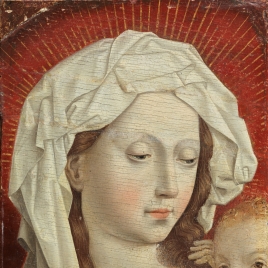
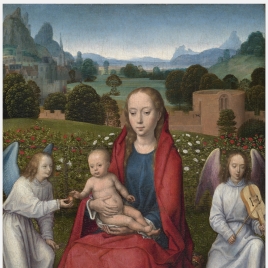
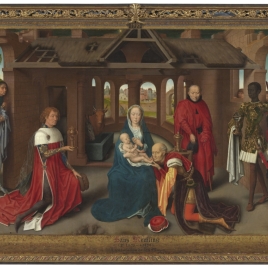
Seligenstadt (Germany), ca 1433 - Bruges (Belgium), 1494Born in Seligenstadt, near Frankfurt, around 1440 but based in Bruges from 1465 onwards, Hans Memling is assumed to have previously spent a period in Cologne, possibly in the workshop of Stefan Lochner (c. 1400–1451). The many similarities with Rogier van der Weyden’s oeuvre suggest he may have served in this artist’s workshop too. His painting also reveals a sound knowledge of the work of Hugo van der Goes, and while Memling’s style is a continuation of the tradition of Jan van Eyck with respect to the rendering of light and the material properties of objects, his images are more human and his figures and works are imbued with less symbolic majesty.
Memling’s documented paintings are confined to the city of Bruges, such as the so-called "Triptych of the Saints John" and the "Triptych of Jan Floreins", both in the Oud Sint-Janshospitaal. Their original inscriptions date them to 1479 and show them to have been executed by him (Oud Sint-Janshospitaal, inv. O-SJ175.I and O-SJ173, respectively). Other paintings recorded in documentary sources can be ascribed to him fairly securely, such as the "Scenes from the Passion of Christ" in Turin (Galleria Sabauda, inv. 8), mentioned by Giorgio Vasari, and the "Martyrdom of Saint Ursula" in the reliquary of the saint in Bruges (Oud Sint-Janshospitaal, inv. O-SJ176.I), referred to by Karel van Mander in his biography of the artist. This group of works has been used as a basis for constructing a very large corpus of paintings on whose stylistic evolution scholars do not fully agree.
Some of Memling’s many patrons hailed from the local patriarchy of Bruges; others were important dignitaries and prominent foreigners, including a few Spaniards and a considerable number of Italians such as Angelo Tani, for whom he produced the "Last Judgement" now in Gdansk (Muzeum Narodowe w Gdansku, inv. SD/413/M). Many of his clients turned to him to have their portraits painted. Indeed, Memling established what could be described as the stereotypical Bruges portrait. Until his death in 1494 he ran a large workshop that was highly active, as may be inferred above all from the large number of paintings executed in his characteristic style. Even so, only two pupils of his are documented: Hannekin Verhanneman and Passchier van der Mersch (J. J. Péez Preciado,"Fifteenth-century netherlandish painting at the Museo Nacional del Prado. Catalogue raisonné", Museo del Prado, 2024, p. 291).