The Virgin and Child between two Angels
1485 - 1490. Oil on baltic oak planks.Room 058A
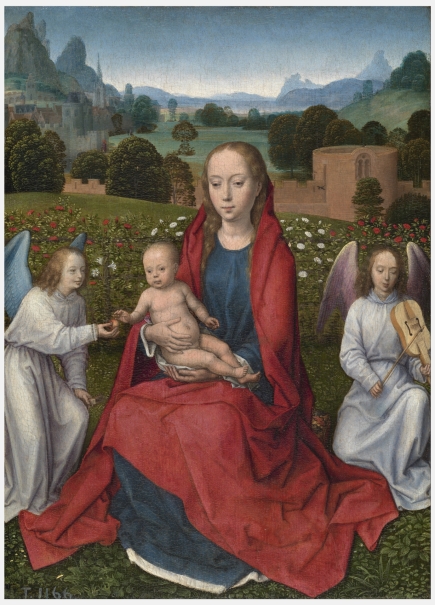
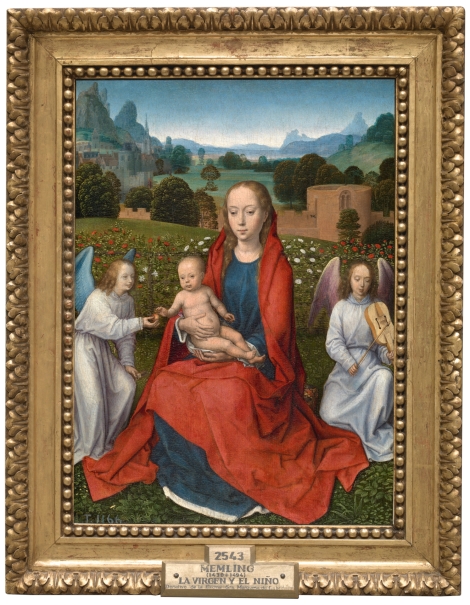
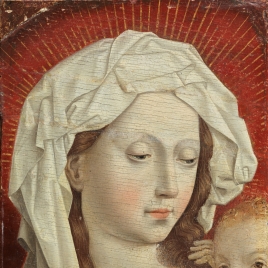
The Virgin, with the child on her lap, is located in an enclosed garden, an allusion to the hortus conclusus mentioned in the Song of Songs (4:12). The Child, naked on a white cloth, is about to grasp with his right hand the apple offered to him by a musical angel with blue wings dressed in a white or mauve tunic, whose other hand holds a lute by the neck. On the other side a second angel is playing a fiddle. Mary is seated on a bench, one end of which, covered in a rich cloth of attractive ochres and yellows, can just be glimpsed beside the angel on the right. Behind the figures is a hedge with bushes of red and white roses. The lower part of the foreground is filled with other flowers and plants between the angels and the Virgin, some almost imperceptible owing to the wear of the painted surface. These include celandines, dandelions, daisies and a stem with lilies; there are also plantains and wild strawberries, depicted without flowers or fruits.
Depictions of Mary with the Child on her lap, the latter paying attention to an angel, were common in the output of Memling and his workshop in the 1480s. the model for the Virgin and Child derives ultimately from a silverpoint drawing by the circle of Van der Weyden in Rotterdam (Museum Boijmans van Beuningen, inv. N9). In the Prado work, besides depicting what was a common iconography in Memling’s production, the artist employs specific models that are found in some of those versions.
In conclusion, despite the restorations and noticeable abrasion of the painted surface in some features, the impression is that this is a fairly skilled, original work. The paint losses, although extensive, do not affect the overall composition excessively. In addition to the evidence of its careful creative process, there is proof that it was executed by the hand of a skilled painter and with a compositional freedom uncharacteristic of a studio product and a refinement, colouring and modelling of the figures worthy of the master himself. It is plausible to think that it was one of a number of devotional works that Memling produced in the 1480s, possibly as a result of the success of his abovementioned diptychs with donors.
Pérez Preciado, José Juan, Fifteenth-century netherlandish painting at the Museo Nacional del Prado. Catalogue raisonné, Madrid, Museo Nacional del Prado, 2024, p.306-310 nº.39