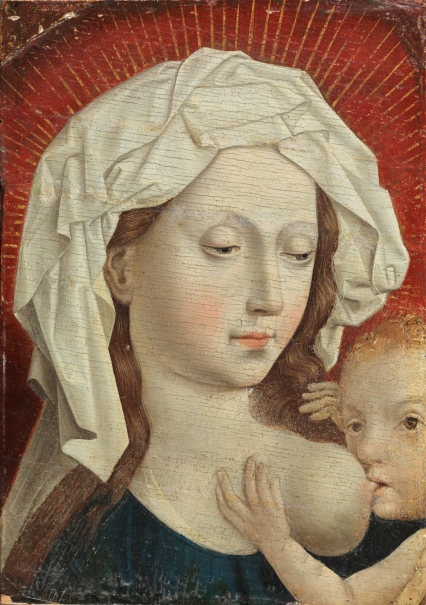
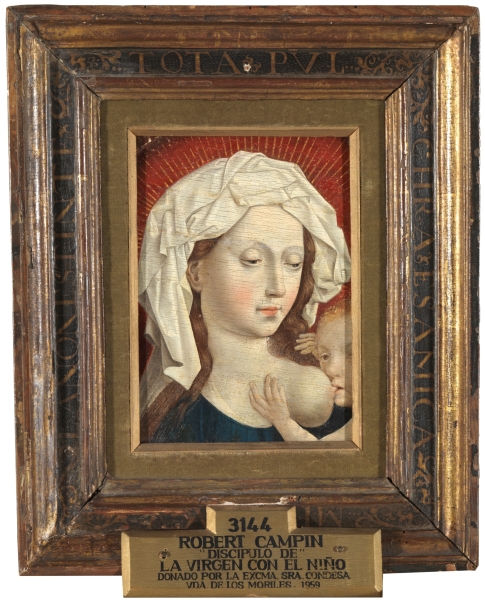
The Virgin nursing the Child
XV century. Oil on oak panel.Not on display
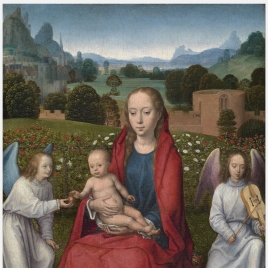
Mary, silhouetted against a red background with a halo of rays, wears a white veil and blue tunic. All that is visible of the Child, who is clutching his mother’s breast, are his head and hands. The panel reproduces a traditional iconography deriving from Byzantine icons of the Virgin Galaktotrophousa or Virgo lactans. Its precedents date back to classical Antiquity and even to certain Egyptian images of Isis suckling the god Horus, which became Christianised through the Coptic religion. This theme witnessed considerable development during the Middle Ages, spurred especially by the trend for more human portrayals of devotional piety in the thirteenth century and early Renaissance, and almost completely disappeared after the Council of Trent.
This work repeats a widespread iconographic model, the Virgin nursing the Child in roundel format, based on a prototype that was created by the Master of Flémalle but popularised and developed by Hans Memling’s workshop. It was originally painted on a circular panel with an engaged frame that was subsequently trimmed and converted into a rectangular format, as a result of which it suffered minor losses of paint and the figures are slightly askew. The impossibility of completing the dendrochronological analysis and the uncertain provenance of the work, of which there is no trace until 1969, do not allow us to rule out the possibility it is a copy dating from after the fifteenth century.
Pérez Preciado, José Juan, Fifteenth-century netherlandish painting at the Museo Nacional del Prado. Catalogue raisonné, Madrid, Museo Nacional del Prado, 2024, p.311-314 nº.40