Tomás Muñoz Lucena
Córdoba, 4.6.1860 - Madrid, 10.2.1942He was born on June 4, 1860.
He studied at the Provincial School of Fine Arts of Córdoba and was a pupil of the painter Rafael Romero Barros. In 1872, at just twelve years old, he earned high marks in Natural Drawing. He would later hold the position of Professor of Linear, Natural, and Topographic Drawing at the Provincial Institute of Secondary Education beginning in 1894.
In 1879, he received a scholarship from the Provincial Council to study at the Academy of Fine Arts of San Fernando, where he studied under Federico de Madrazo. As part of his academic progression, he submitted “Doña Juana la Loca” in 1880, “Doña Isabel la Católica dictando su testamento” in 1881, and “Ofelia” in 1883. The painter Eduardo Rosales was a major influence on his work.
That same year, he was granted a scholarship by the Academy to study in Rome, where he exhibited his work in several shows. After completing his stay, he settled in Granada, attending live model classes at the Artistic and Literary Center.
He made his debut at the National Exhibition of Fine Arts in 1881. While in Rome in 1887, he completed what would become his first major success: “El cadáver de Álvarez de Castro” (P005614), which earned him a second-class medal at that year’s National Exhibition. In 1888, he submitted “Un estudio de cabeza” to the National Exhibition. This work was later shown in Vienna as part of a group display of 40 Spanish works. He also participated in the Universal Exhibition of Barcelona.
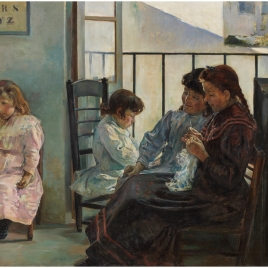
He served as a juror for the Artistic and Literary Competitions of the Ateneo of Córdoba in 1887 and 1888, the latter of which was held at the Friendship Circle. In 1889, he was awarded a diploma of merit for his painting “Flores”, and submitted “Cordobesa” to the Extraordinary Regional Exhibition of Fine Arts. In the 1890 National Exhibition, he participated with “Las lavanderas”, for which he received another second-class medal. He also exhibited “Una parada de coches de Granada”, a painting purchased by Queen Regent María Cristina of Habsburg.
He exhibited four oil paintings in the 1891 exhibition of the Circle de Bellas Artes at the Palacio de Cristal in Madrid's Retiro Park: “La fiesta de las palmas”, “Una acequia en Granada”, “Un día de agua”, and “Flores”. In 1892, he took part in shows at the Salón Mateu in Madrid and the Salón Parés in Barcelona. At the National Exhibition of Fine Arts, he was nominated for a decoration for his “Retrato”. In the International Exhibition of Fine Arts in Madrid, he exhibited eight works and two sketches of El Escorial. He also participated in the Annual Exhibition of the Circle de Bellas Artes and the International Fine Arts Exhibition in Vienna.
Several of his canvases were shown at the 1894 General Exhibition of Fine Arts in Barcelona, including “Maruja”, “Retrato”, “Por algo se empieza”, “El ángel caído”, “Recuerdo de Asturias”, and “Una merienda”. At the Fine Arts Exhibition in Bilbao, he was awarded second prize. In the 1895 National Exhibition, he presented “Un niño”, “Castigo”, “Están verdes”, “Maruja”, “Falda de Sierra Morena”, and “Canto religioso”, again being proposed for a decoration. The work “Castigo” (P006645) is from this year.
He was one of five recipients of first prizes in a 1900 competition organized by the magazine Blanco y Negro, to which he was a contributor. That same year, he won a bronze medal at the Paris Universal Exposition.
While residing in Granada, he was named vice-president of the Visual Arts section of the newly founded Asociación Cordobesa de Escritores y Artistas in Córdoba in 1900. Mateo Inurria served as director, and Julio Romero de Torres as secretary. He also participated in that year’s Granada Fine Arts Exhibition, winning an award for “Idilio”. At the 1900 National Exhibition of Fine Arts, he earned a first-class medal for “Plegaria en las ermitas de Córdoba”, which led critics to describe him as the "first Cordoban Impressionist." In November of that same year, he was appointed full professor at the Provincial Institute of Secondary Education in Granada. In 1924, he moved to Seville to work as a drawing teacher at the local institute. Later, back in Granada, he was named full member and board member of the Centro Artístico y Literario.
He presented four canvases at the 1904 National Exhibition. He also exhibited internationally—in Vienna and in Stockholm in 1932—and most notably in the annual exhibitions organized by José de Artal at the Witcomb Galleries in Buenos Aires, where he showed works in 1902, 1904, 1905, 1906, 1909, and 1913.
At the 1908 National Exhibition, he submitted six paintings, among which “Una cueva del Albaicín” and “Camino del Generalife” stood out. Two years later, “Una vaquera granadina” earned him a first-class medal. In 1914 and 1917, he participated in competitions organized by the Centro Artístico y Literario of Granada, and in 1918 he exhibited “Evocación” at the National Exhibition of Fine Arts.
He also took part in the 1924 and 1926 Fine Arts competitions organized by the Royal Cordoban Society of Archaeology and Excursions, held at the Friendship Circle, where he presented ten works, including “Las lavanderas”, which had been awarded years earlier. He also participated in the 1925 Seville Exhibition, organized by the Ateneo Sevillano, and in 1931 he exhibited at the Provincial Council of Córdoba.
Following his retirement in 1930, he moved to Madrid, where he died in 1942 at the age of 81.