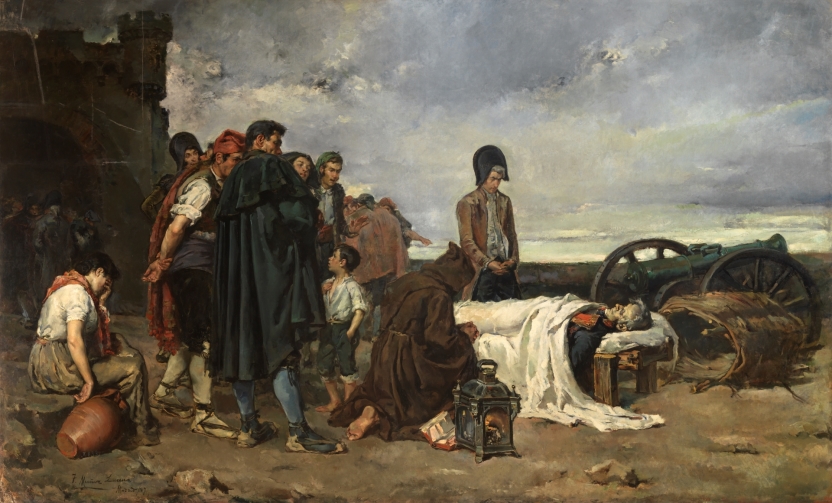
The Corpse of Álvarez de Castro
1887. Oil on canvas.On display elsewhere
The painting depicts a scene of intense melancholy surrounding the fate of Álvarez de Castro, the leading figure of the heroic defence of Girona who, having been taken prisoner by the French, was taken first to Perpignan and then to Figueras, where he died on 21 January 1810. According to the Count of Toreno, the French laid his corpse on a dolly. The deceased’s face appeared swollen and crimson, suggesting a man who has been strangled. A document implied the possibility that he had been murdered, although this hypothesis did not accord with the facts. Rather than opting for the diagonal framing common at the time for compositions around a corpse –as in the 1884 exhibition, with the success of The lovers of Teruel of (P004521) Muñoz Degraín and The Converstion of the Duke of Gandía (P006565) of Moreno Carbonero –the artist took his inspiration from frieze compositions. He introduces a sequence of figures to the background of the painting, the depth bringing a sense of natural verisimilitude. The work is further enriched by the variety of the figures´ attitudes, appropriate to their different conditions. In the foreground stands out the tallest figure of the group of peasants from Girona, bearing similarities to the noble attitude of Rosales´s classical heroes. The artist follows the stylistic model of The Death of Lucretia (P004613) of Rosales. Nevertheless, he makes occasional drawing mistakes in the resolution of the figures, the landscape being the most accomplished part of the painting and contributing to the expressiveness of the work. The serene character of the scene is produced by the horizontality of the format, which accentuates the elegiac tone of the presence of the weeping woman who is the perfect closure of the composition.
The painting was awarded the 2nd medal in the 1887 National Fine Arts Exhibition, and the following year, it was included in the Spanish consignment to the 1888 International Exhibition in Vienna.
Álvarez de Castro y su tiempo (1749-1810), Ministerio de Defensa, 2010, p.132-139 nº49