Luis Tristán
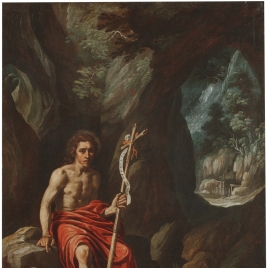
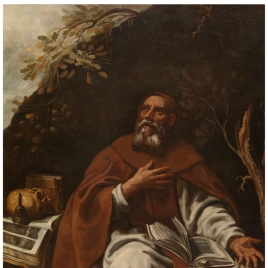
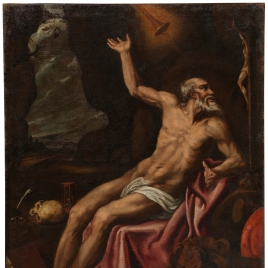
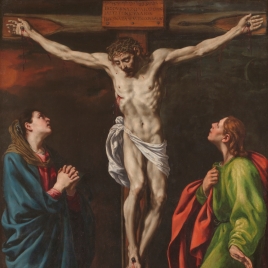
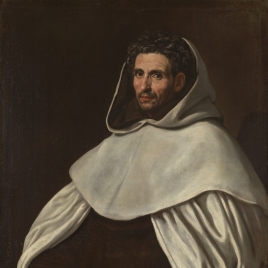
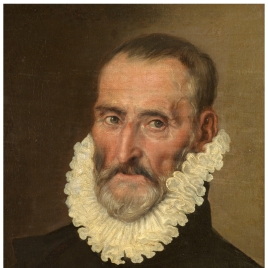
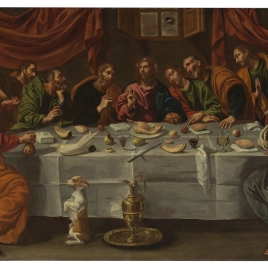
Toledo?, 1580/85 - Toledo (Spain), 1624One of the most outstanding representatives of painting from Toledo during the early 17th-century, an especially fertile period for that city. The earliest mention of Tristán links him to Toledo's most important painter, calling him an apprentice to El Greco in 1603. He was still there in 1606, but that was the year that he made his first trip to Italy. According to Jusepe Martínez, he was accompanied by Ribera. He must have been in Rome during the papacy of Paul V, and by 1613, he had returned to Toledo, where he worked for the rest of his life, taking commissions there and in the province. He was very close friends with El Greco's son, Jorge Manuel Theotocópuli, with whom he collaborated on some works, including the tumulus erected in 1621 when Philip III died. His style reflects his mixed training in its varied appearance, sometimes bordering on the contradictory. It always reflects El Greco's influence, especially in its elongated and unstable figures, but his direct contact with Caravaggism at the height of its development in Rome also links him to a naturalism that is patent in some of his works. Rather than a personal evolution between two apparently contradictory approaches, Tristán appears to have favored one or the other according to the project at hand, either by his own decision or at the request of his clients. His work also reflects his study of Venetian compositions, although the clearest influence is undoubtedly that left in Toledo by Juan Bautista Maíno, especially his great “Altarpiece of the Four Pascal Feasts” at the church of San Pedro Mártir, an innovative example of Roman naturalism enlivened by a sumptuous palette. All of this is reflected in works such as the group that Tristán painted in 1616 for the parish church of Yepes (Toledo), which is one of the most important in his career. Two of these images of saints are now at the Museo del Prado. His other works at that museum are six canvases associated with him (one is quite unlikely to be his), mostly from the Museo de la Trinidad; as well as an “Old Man” from the Royal Collection and a “Last Supper” acquired in 1993 thanks to the Villaescusa legacy (García López, D. in Enciclopedia M.N.P., 2006, vol. VI, p. 2112).