The Crucifixion
Ca. 1613. Oil on canvas.Room 010B
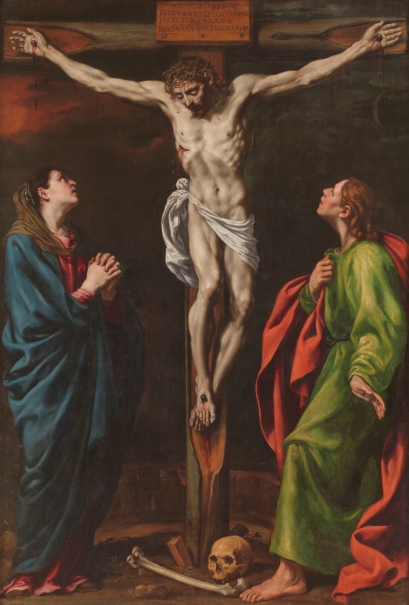
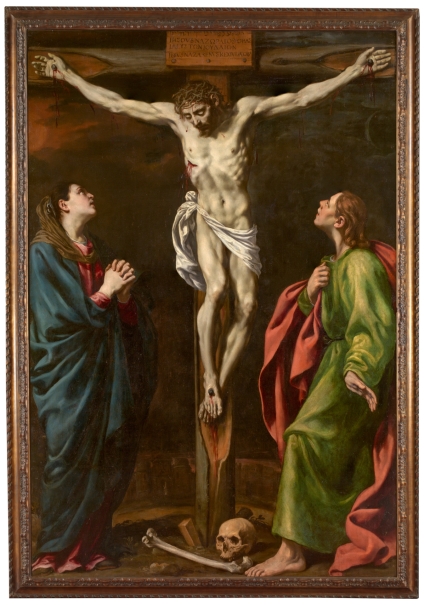
This depiction of Christ, lifeless on the cross and flanked by the Virgin Mary and Saint John, is considered one of the finest of many images of Calvary painted by this artist from Toledo. It is also a significant example of his painting, which owes much to the compositions and figurative models of his fundamental teacher in Toledo: El Greco. Finally, it reflects the Carravaggesque chiaroscuros shaped by Tristán’s second and definitive period of training in Rome, between approximately 1606 and 1612. After returning to Toledo, he painted mostly religious scenes based on many of El Greco’s compositions and models, as can be seen in this Calvary, whose elongated figures, expressive hands and small heads stand out against a somber background in which Tristán follows El Greco’s tendency to include urban elements of Toledo, such as the city walls and the Bisagra Gate. On the other hand, the compact modulation of the brushstrokes and the contrasted lighting reflect his Roman training. The representation of the cross as two rough-hewn beams with a wide cartouche in Hebrew, Greek and Latin is characteristic of this artist’s work. Dating is always problematical with Tristan, but this work has been linked to a commission from the monastery at Sisla (Toledo), where, in November 1613, he was contracted to make a Dead Crucifixion with the Virgin and Saint John. The subject, quality and dimensions of this Calvary make it a fundamental piece for the Museo del Prado’s collection. While there are half-a-dozen works by Tristán in its collection, and all of them are important, not one includes what was one of the most singular contributions to painting in Toledo from that period, much less of such notable quality and dimensions.