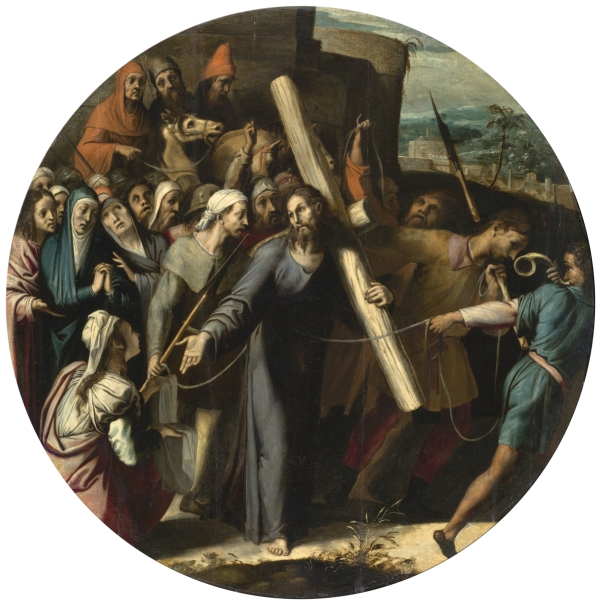
Until now, the Museo del Prado had no painting by Pieter van Kempeneer, a painter born in Brussels who is documented in Seville from 1537 onwards, having spent some time in Italy (Bologna, Venice and Rome). Kempeneer was active in Spain until 1563, when he returned to his native city. His production is characterised by a fair number of altarpieces and devotional works, some of which are in a small format, in which he reveals himself as an excellent draughtsman with an original narrative sense, the result of his profound knowledge of both Flemish painting and also of some of the principal figures of early Roman Mannerism, such as Perin del Vaga and Polidoro de Caravaggio.
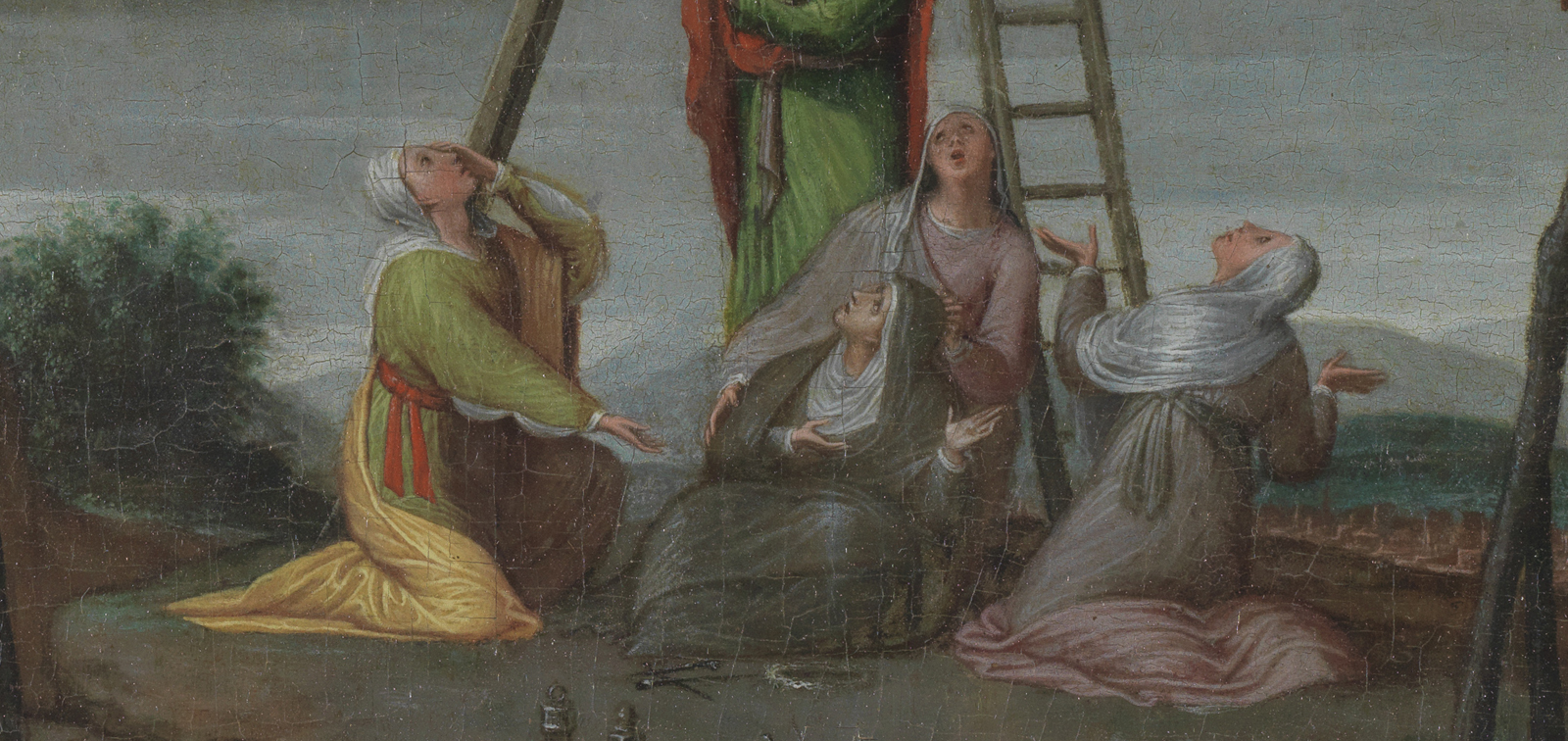
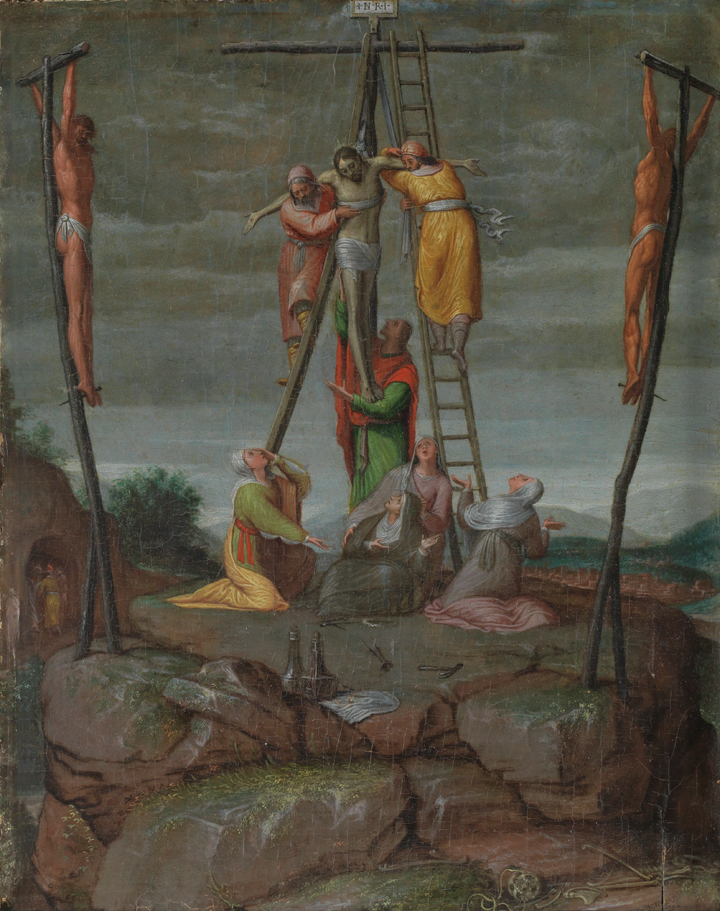
In his most complex compositions, like the one which concerns us here, Kempeneer designed his groups in the manner of a frieze. The arrangements of the figures, many of them with their heads raised and their hands performing rhetorical gestures, became expressive formulae which he repeated in many of his works.
Christ on the Way to Calvary was painted in about 1547 as part of a private altarpiece for the church of the convent of Santa María de Gracia in Seville. The central panel, The Descent from the Cross, is preserved at the Musée Fabre in Montpellier, and another tondo, The Resurrection, is in the Várez Fisa collection. The subject matter of the three works formed an appropriate iconographic grouping for a 16th century funerary chapel, and the commission for the altarpiece in fact came from Elvira de la Barrera, the widow of the Sevillian juror Luis Fernández, to whom the set was dedicated. The two tondos were cited in 1547 as pending completion, providing documentary evidence that allows the group to be dated.
Works designed in a circular format are rare in Kempeneer’s production and otherwise fairly infrequent in the Spanish art of the time. The Calvary which crowns the Altarpiece of the Purification at Seville Cathedral (1555) is also painted on a wooden tondo, as are the images of St Peter and St Paul on the St Nicholas Altarpiece in Córdoba Cathedral (1556).
Enrique Valdivieso has explained that such works were the production that could be assumed by an aging artist engaged in work that did not require a great physical effort. Besides drawing and providing compositions for the Tapestry Factory of his native city, Pieter van Kempeneer was also able to accept commissions for small-format works in which he transferred the monumentality of his earlier compositions to new expressive formulae, with a special emphasis on the representation of landscape and the details of the figures and objects accompanying the scene.
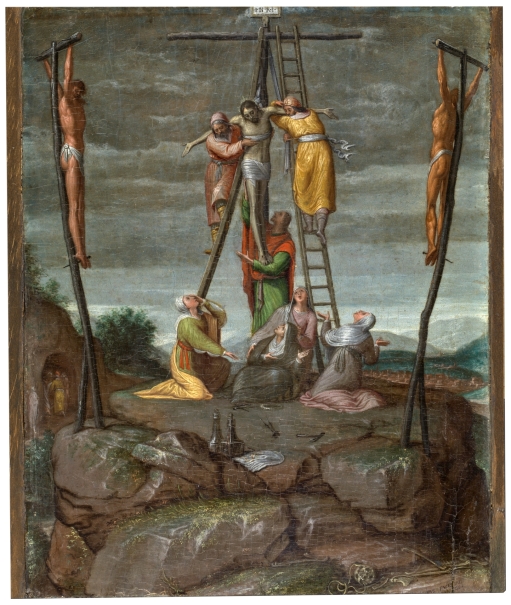
The panel from the Arango collection is one of the most emblematic and carefully executed creations of the 1570s. The central part of the composition resumes the central idea of the print by Marcantonio Raimondi, present in earlier versions of The Descent from the Cross. Here, however, the centre of the field of vision is opened up to create a complex representation of Mount Calvary, shown as a narrow promontory, stepped and rocky, outlined against a very open landscape beneath a broad sky. Rising precariously on the sides of this hill are the tall crosses bearing the two thieves. The minute and precise brushwork shows us another side of Kempeneer, that of a painstaking practitioner of piccola pittura.
The work is signed in Latin next to the bones which, contravening tradition, appear not at the foot of the cross but some distance away: Hoc opus faciebat / Petrus Campaniensis.