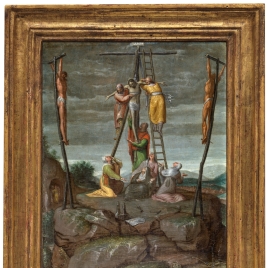
The Descent from the Cross
Ca. 1570. Oil on oak panel.Room 052C
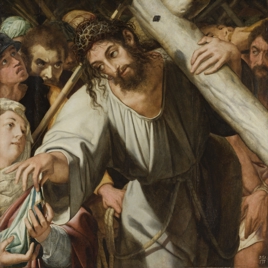
Calvary and The Descent from the Cross were two of the most frequent subjects in Pedro de Campaña’s oeuvre. Their content, as well as the painter’s Flemish training, explain his manner of emphasizing the markedly dramatic character of their compositions, stressing the figures’ expressive qualities in very contrived nocturnal settings. It is no surprise that these subjects continued to occupy Campaña towards the end of his career, after he returned to Brussels around 1563. The famous panels that he sent to Seville, as Francisco Pacheco put it, must have been small-format works for private prayer chapels, some of which would have been small portable diptychs or triptychs.
Enrique Valdivieso has explained these works as the sort of production that could still be undertaken by an artist whose age limited him to tasks requiring little physical strength. Besides drawing and supplying cartoons to the Tapestry Factory in his native city, Pedro de Campaña was able to accept small-format commissions, and there, he applied the monumentality of earlier compositions to new expressive formulas that particularly emphasized landscapes and the details of the figures and objects therein.
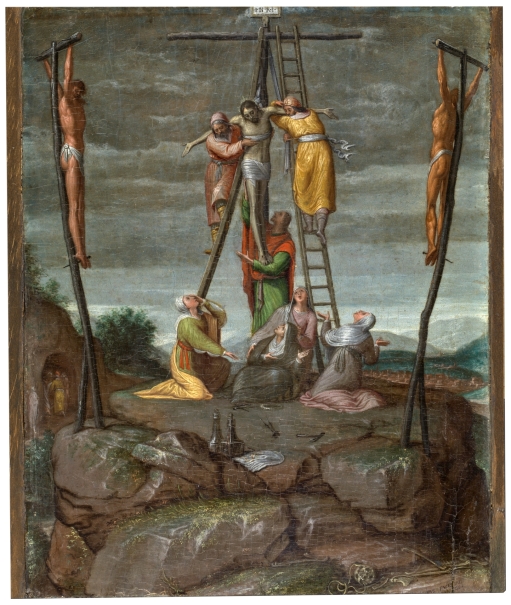
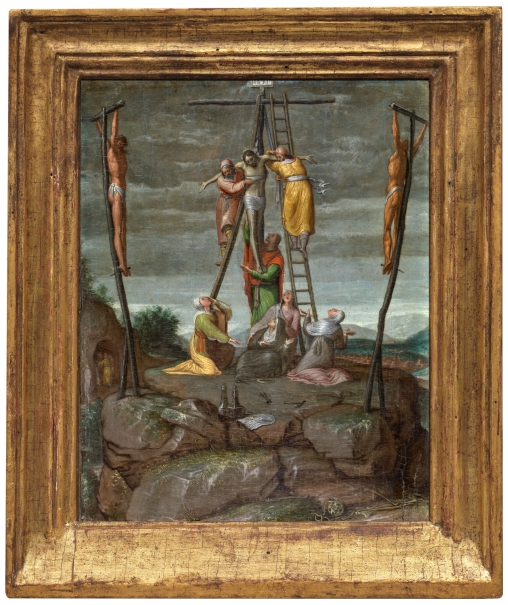
This panel from the Arango collection is one of the artist’s most refined and emblematic creations from the 1570s. The center of the composition is a reinterpretation of the central idea in Marcoantonio Raimondi’s print, which is also present in earlier Descents. Here, however, the field of vision is expanded to encompass a complex representation of Mount Calvary, which appears as a narrow, layered stone promontory that stands out against a very open landscape under a wide sky. The two tall crosses of the thieves stand precariously at the edges of this promontory. The tiny and precise brushstrokes present a different facet of Campaña: that of a careful maker of piccola pittura.
This work is signed in Latin alongside the skeletal remains that, defying tradition, do not appear at the foot of the cross, but instead, at a certain distance. The inscription reads: Hoc opus faciebat/ Petrus Campaniensis.