Crucifixion
Ca. 1550. Oil on oak panel.Room 052C
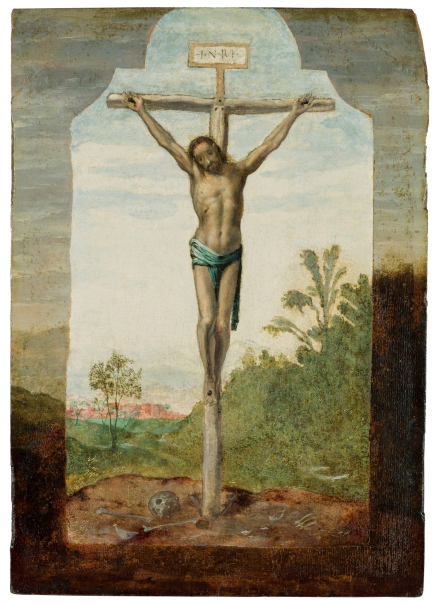
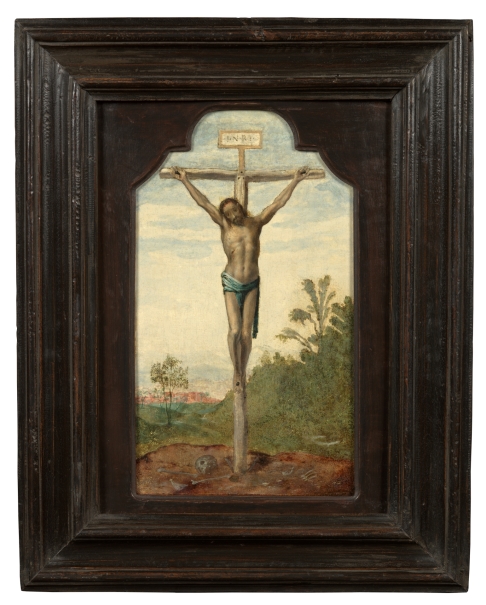
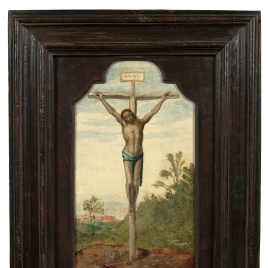
In this work, as in the rest of his creations, Pieter Kempeneer demonstrates a refined Flemish technique that allows him to portray all sorts of details with precision. This is especially remarkable in Christ’s figure, which was conceived using a strong anatomy that showcases the muscled torso and advancing leg. Both the leg and the torso are outlined with subtle shading and light chiaroscuro, which constitutes one of Kempeneer’s signature techniques. Likewise, the precision in design is evident in the fingers, the beard, and hair, despite deterioration. From a low point of view, the crucified figure is drawn with a clear sky background in which the blue intermingles with light whites in clouds. It is all imbued with a soft colour scheme, from the green of the vegetation to the blue of the perizoma.
Far from being a peaceful composition, the panel is rather unsettling, given its choice in palette and its marked contrast with the chosen theme. Despite the light that dominates the scene, Christ has just died. His eyes are closed, his head tilted, and Longinos has just speared him for the last time. Christ is dead, but he is alone. Moreover, he is in a particular Golgotha: a sort of a clearing amidst vegetation. Some trees are visible in the background, and the pinkish walls of Jerusalem are seen over yonder. At the base of the cross, many bones with Adam’s skull evoke an execution space, a place of death and desolation.
The theme, its iconographic treatment, and its size indicate that this is a painting conceived to be worshipped individually and intimately; more specifically, to stimulate Christ-centred religious practices. This supposition is supported by the presence of lateral marks that were most probably used to hold the hinges of small doors that allowed a ritual contemplation of the painting within the frame of a small house oratory. Furthermore, the existence of a repainted outline in the image – whose upper area is reminiscent of an architectural structure – hints at the former presence of an artisanal frame made of precious metal.
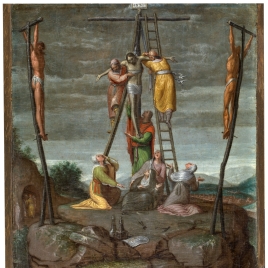
In the single published text on the panel to this day, Valdivieso suggested that it was painted in Brussels during Kempeneer’s last career stage (1563–around 1570). It would be one of the ‘famous panels he sent to Seville’ which made an impact on Pacheco in his biographical portrait of the Belgian artist. Allegedly, Kempeneer portrayed episodes of the Golgotha in a small format, but the truth is that most panels attributed to this period of time feature sharp and tiny figures, heavily dematerialized, in which the Calvary is always depicted as a gloomy, stark, nocturnal landscape – as happens to be the case in The Descent from the Cross (P008209). Those are some features that clearly contrast with this panel, dominated by a muscled anatomy of Christ – slightly too excessive – and by the outline of a clear day and luminous atmosphere. For that matter, the formal parallels appear to be closer to Kempeneer’s productions in Seville towards the middle of the century, in which he shows a strong taste for vigorous, energetic figures. This fact, knowing that his production of small devotional panels was usual during his Sevillian period, allows us to infer that the panel was completed later, around 1550.
Molina, Joan, 'Pedro de Campaña. Cristo crucificado'. Memoria de actividades del Museo Nacional del Prado 2020, Madrid, Ministerio de Cultura y Deporte,, 2021, p.84-86