Dirk Bouts
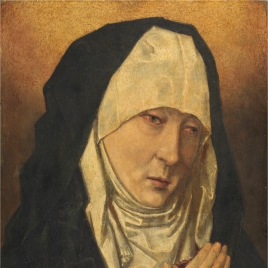
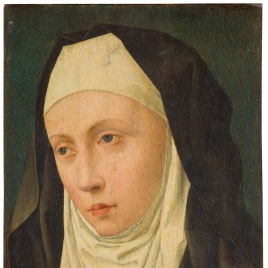
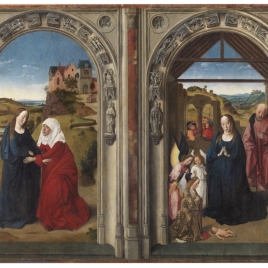
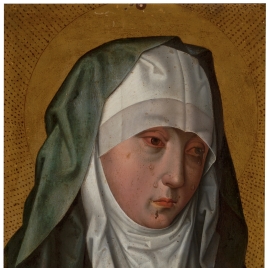
Haarlem (Netherlands), ca. 1420 - Leuven (Belgium), ca. 1475Little is known about the life of Dirk or Dierick Bouts and no works have been securely linked to his possible period of activity in his city of birth. During his mature years he established himself in Leuven. Although he is known to have married Catharina van der Brugge, called Metten Gelde, a wealthy citizen of Leuven, around 1448, there is no record of his presence in the city until September 1457. His only two fully documented works were local commissions: the “Polyptych of the Sacraments” in Leuven’s collegiate church of Saint Peter (Sint-Pieterskerk, inv. S/58/B), executed between 1464 and 1468, and the two panels of the “Justice of Emperor Otto III” painted for the city hall, now in Brussels (Koninklijke Musea voor Schone Kunsten, inv. 1448 and 1447). According to the commission of 1468, four paintings were originally planned, but only two were produced: the “Ordeal by Fire” (inv. 1448), completed in 1473, and the “Beheading of the Innocent Count” (inv. 1447), which the artist left unfinished when he died. The rest of the works that are attributed to Dirk have been linked to him on stylistic grounds.
The authors who have studied the painter do not agree on the stylistic and chronological development of his production, owing in part to the scant number of documented works attributed to him. One of the earliest dated paintings is the London “Portrait of a Man” (National Gallery, inv. NG943) which bears an inscription with the year 1462. His pictures denote an extensive use of models and compositions deriving from Rogier van der Weyden; as for technique, he is closer to Jan van Eyck in his attempts to lend depth and a translucent appearance to surfaces by means of enamel-like brushwork and glazes. His works are very colourful and luminous and his figures somewhat stiff and wooden. One of his main ontributions is the development of landscape in his historical works. Bouts ran a workshop in Leuven that was inherited by his son, also called Dirk or Dierick, about whom very little is known. Another son, Albrecht, followed in his father’s footsteps, especially in the production of devotional images based on prototypes made popular by the latter. Dirk is also thought to have been the master of the painter known as the Master of the Tiburtine Sibyl, who established himself in Haarlem after Dirk died (J.J. Pérez Preciado, "Fifteenth-century netherlandish painting at the Museo Nacional del Prado. Catalogue raisonné", Museo del Prado, 2024, p. 81).