Saint Monica
Early XVI century. Oil on panel.Not on display
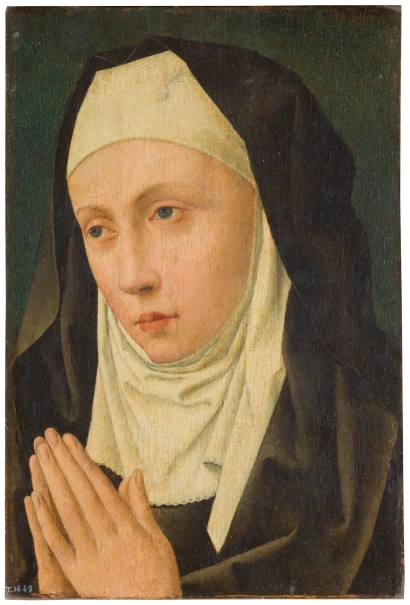
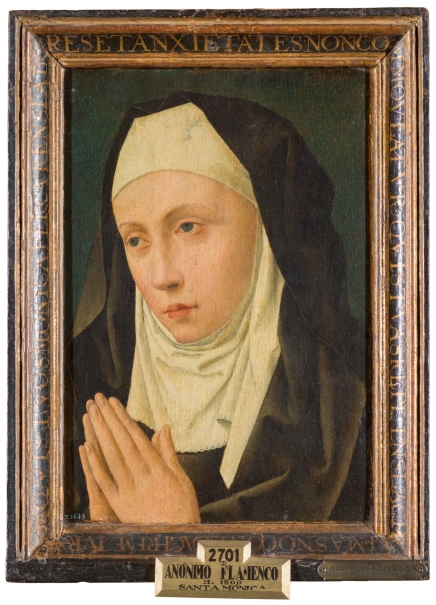
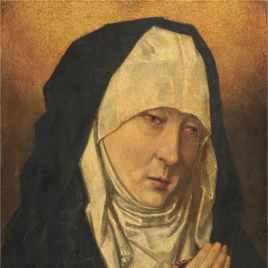
The figure is depicted bust length gazing to her right, with her hands clasped in prayer. The angle of view does not allow us to see her lower or upper arms and her hands are cut off by the lower edge of the painting. She wears a brownish-green hooded cloak, and beneath it a wimple that covers her hair leaving only her face visible. Her mouth is closed and several tears run down her face. The background is greenish-blue. There is no halo. As the original inscription on the panel explains, the figure is Saint Monica, the mother of Saint Augustine, albeit portrayed in the traditional guise of the Mater Dolorosa.
The diptych format for devotional pictures became enormously popular owing in particular to its widespread dissemination by Albrecht Bouts and his workshop. As many as seventeen examples of diptychs and twenty-seven versions of different quality featuring only the Mater Dolorosa are recorded. Of all the versions deriving from Dirk’s prototype, the Prado example is very unusual in that the figure is depicted in reverse and only one other such example is known: the copy auctioned in Cologne. The Prado panel is of fairly good quality, executed with great finesse, as evidenced by the light touches designating each of the eyebrow hairs. It is striking how the painter creates the folds of the headdress using very thick grey lines that in turn help mark the shadows.
It may be concluded that the present work was executed in the Netherlands after widespread iconographic models by Dirk Bouts that were also popularised by his son Albrecht. The maker, an unknown Flemish follower of these artists, would have used one of their models, which he transferred by means of tracing at an uncertain date – though judging by the imprecise execution not in the fifteenth century. The work subsequently found its way to Spain. As Henderiks analyses, those devotional models of sorrowful Virgins created by Bouts were abundant in this country and continued to be present until the mid-sixteenth century, as proven by the many copies that have been located.
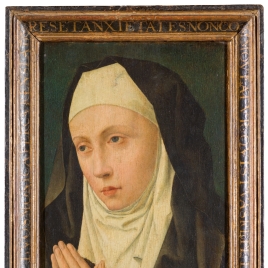
It is problematic to give an approximate date of execution owing to the impossibility of conducting a dendrochronological analysis of the support. Although the cult of Saint Monica became popular in the mid-fifteenth century, the pictorial language points to a production more characteristic of the early 1500s, when the Bouts’ models were being disseminated. The frame, however, must have been modified well into the century as it includes allusions to the Roman Breviary.
Pérez Preciado, José Juan, Fifteenth-century netherlandish painting at the Museo Nacional del Prado. Catalogue raisonné, Madrid, Museo Nacional del Prado, 2024, p.97-101 nº.9