Christ crowned with Thorns
1500 - 1525. Oil on panel.Not on display
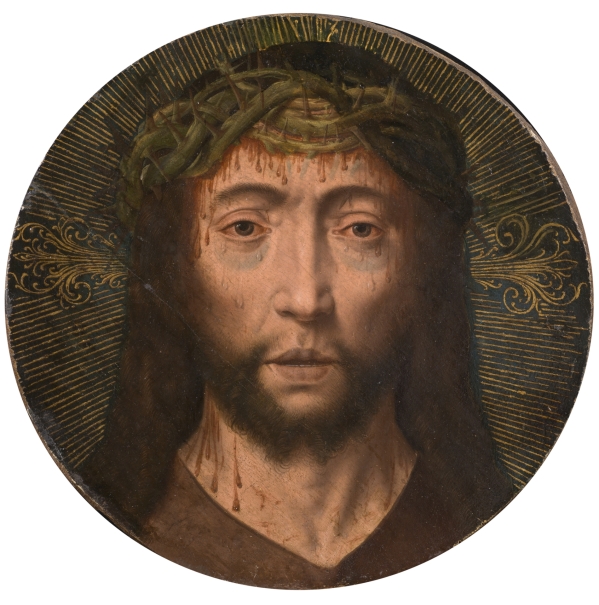
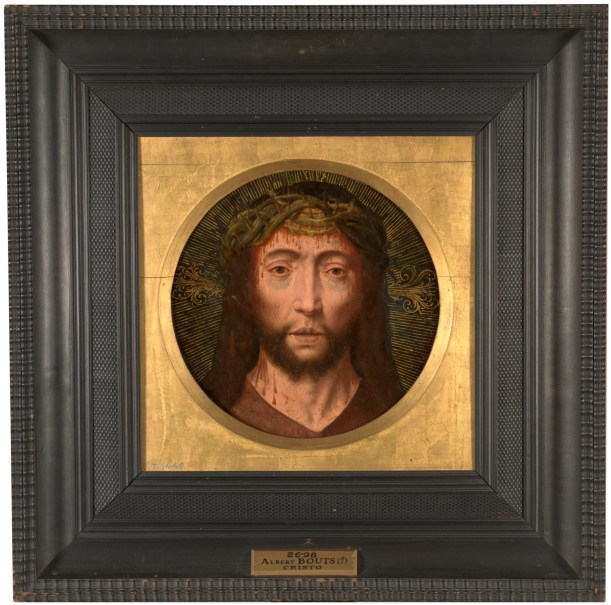
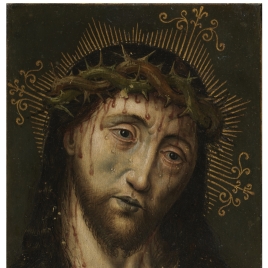
The face of the Christ crowned with thorns, depicted frontally and showing his neck and part of his tunic, almost completely fills the picture space. The greenish-blue background is barely distinguishable owing to the inclusion of the gold rays framing the head.
These belong to a halo with a cross, though the upper arm is barely distinguishable on account of the circular format and size of the support. The frontality and format heighten the drama of this depiction of Christ’s suffering. Blood from the wounds caused by the crown trickles from the forehead and down both sides of the head, mixing with the tears streaming down his cheeks, and reaches his neck. His bloodshot eyes convey great sadness, and the unusual detail of the tears welling in his eyes is striking. The sight of the thorns that pierce the flesh and show through the skin of the forehead causes unease in the spectator. The swollen, purplish eyelids and the parted mouth revealing the bottom teeth help create a powerfully human depiction of the torture of Christ. It should be stressed in this connection that not all the blood comes from the crown wounds: lacerations caused by lashes are visible on the neck.
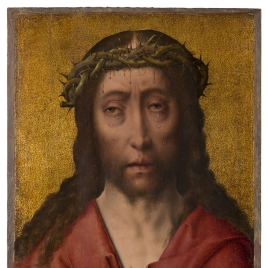
There are several known examples of the head of Christ crowned with thorns attributed with varying degrees of soundness to Albrecht Bouts. This one would have been based on the models made popular by his father Dirk Bouts, which in turn formally recall the image of the Holy Face by Jan van Eyck known only through copies made as part of the abovementioned devotional tradition. The one in the Nelson-Atkins Museum in Kansas City is generally thought to be the prime and the finest quality version created by Albrecht.
There are two unusual details in the Prado work. The first is the halo. As the technical study has shown, it was a later addition, as may also be inferred from its somewhat improvised appearance. It is quite possible that the halo was added in Spain, as it is not found in any of the models of Christ crowned with thorns by the circle of Albrecht Bouts. The second characteristic detail of this work is the presence of the lacerations on the neck as a result of the flagellation: a feature that is designed to convey Christ’s sorrow and suffering more eloquently.
Pérez Preciado, José Juan, Fifteenth-century netherlandish painting at the Museo Nacional del Prado. Catalogue raisonné, Madrid, Museo Nacional del Prado, 2024, p.77-80 nº.7