Albrecht Bouts
Leuven (Belgium), ca. 1452-60 - Leuven (Belgium), 1549Albrecht Bouts continued the artistic career begun by his father Dirk, in whose workshop he started out. When Dirk Bouts died in 1475, Albrecht left Leuven to travel and further his training, though in 1480 he is again documented in the city as an independent artist.
From 1492 at least he was sacristan of the chapel of Our Lady Outside the Walls, Onze Lieve Vrouw van Ginderbuiten, in Leuven, the same one that then housed Rogier van der Weyden’s “Descent from the Cross” now in the Museo del Prado (P2825). In the first decade of the 1500s he painted for that chapel the triptych of the “Assumption of the Virgin” now in Brussels (Koninklijke Musea voor Schone Kunsten, inv. 574). On one of its inner wings he portrayed his father-in-law Christianus de Nausnydere, a member of the city council, as a donor, and on the other he painted portraits of himself and his second wife Elisabeth de Nausnydere, a wealthy widow whom he had married before June 1490. A very striking feature of both scenes is the incorporation not only of his wife’s family’s coat of arms but also one of his own consisting of two gold crossbows on a red field with the letter A and beneath them three silver escutcheons on a blue field, traditionally associated with the painters Guild of Saint Luke. This self-indulgent display of a personal heraldic device clearly alluding to an artistic profession is very unusual for the time. Indeed, Albrecht attained a high social status in Leuven, acquiring several properties both there and in Brussels during his lifetime.
There are records of major commissions received by him from institutions in and outside Leuven. In 1504 he worked on an altarpiece, no longer extant, for the confraternity of the Holy Blood in Antwerp cathedral. Another documented work, which has not survived either, is a painting on an unknown subject executed for the confraternity of the Holy Sacrament in the church of Saint Peter, Sint-Pieterskerk, in Leuven in 1515.
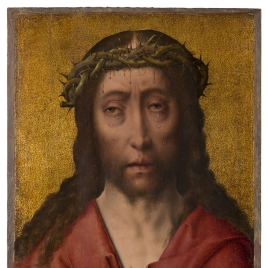
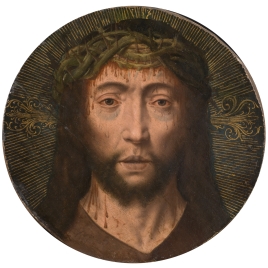
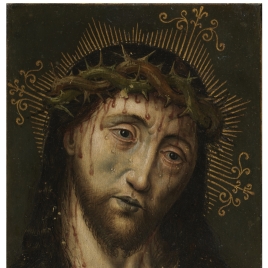
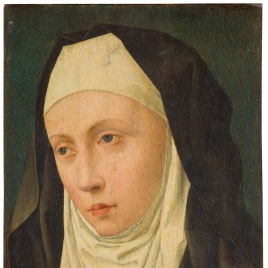
Albrecht’s style clearly derives from Dirk’s. Much of his output is based on continuing and reworking various devotional prototypes made popular by his father, especially images of the Mater Dolorosa and heads of Christ as Man of Sorrows. However, his paintings of events also denote the powerful influence of Hugo van der Goes, with whom he may have trained for a time during his youth (J. J. Péez Preciado,"Fifteenth-century netherlandish painting at the Museo Nacional del Prado. Catalogue raisonné", Museo del Prado, 2024, p. 70).