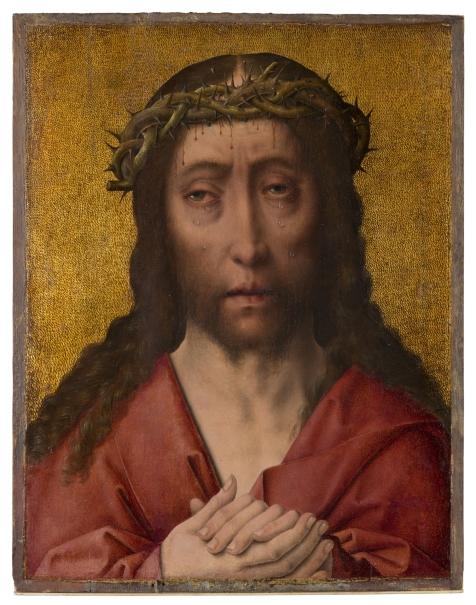
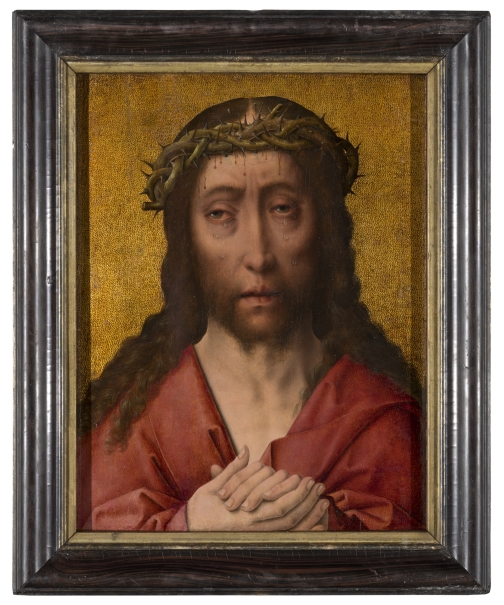
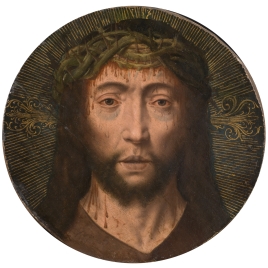
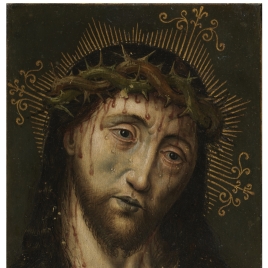
Christ crowned with Thorns
After 1488. Oil on baltic oak planks.Room 058A
Christ is depicted frontally, barely bust length, wearing a crown of thorns. The scarlet robe in which, according to the holy scriptures, he was mockingly dressed by the soldiers who tortured him is practically the only element of colour, along with the green of the crown. Panofsky defined this work decades ago as a representation of the Saviour crowned with thorns as opposed to an Ecce Homo, as images of this kind are sometimes labelled. Notable features are the hair with the centre parting and the addition of a gold background to lend the work the appearance of an icon or devotional image rather tan presenting it in a narrative context. It is very close in type to the vera icon or relic owned by John the Good that found its way into the Netherlands in the fifteenth century.
Historians have paid very little attention to the painting. It was first mentioned by Bermejo, who described it as one of the replicas in Spain of this composition by Dirk Bouts, albeit praising its quality and judging it comparable to other known versions such as those in London (National Gallery, inv. NG712) and Paris (Musée du Louvre, inv. 1994). For her part, Henderiks merely referred to the image in her study on Albrecht Bouts as one of various replicas of devotional Works. The circle of the Bouts family produced numerous known versions of this specific iconographic model. The Prado version, which was certainly painted after his death, as confirmed by the study of the age of the wood. It can therefore be attributed to the period when his son Albrecht was at the helm of the workshop.
The technical expertise with which the Prado work is executed makes it one of the most significant examples produced during the period Albrecht was in charge of the workshop. The brushwork is fine and concise, based on a delicate and confident drawing that is visible to the naked eye in places. A few details are notable for the finesse of their execution, especially facial features such as the nose and eyelid, the hair, and even the design of the crown of thorns. For all the above reasons this painting should be considered not just one of the various known versions attributed to this artist but one of the finest.
Pérez Preciado, José Juan, Fifteenth-century netherlandish painting at the Museo Nacional del Prado. Catalogue raisonné, Madrid, Museo Nacional del Prado, 2024, p.74-76 nº.6