Correggio (Antonio Allegri)
Correggio, Emilia-Romagna (Italy), 1489 - Correggio, Emilia-Romagna (Italy), 1534The Italian painter Antonio Allegri was probably born in Correggio, a small town in northern Italy not far from Reggio Emilia and Parma, from which he took his nickname. Although he had an uncle who was a painter, he seems to have received his artistic training in Mantua, perhaps under the guidance of Mantegna, who died there in 1506. Some of his earliest works are frescoes in Mantegna's funerary chapel at St. Andrew's in Mantua and in the atrium of the same church; predictably they show the influence of Mantegna, but also a novel smoothness of execution. Correggio's earliest documented works are a painting for the high altar of the church of San Francesco in his city (now in the Gemäldegalerie Dresden), dated 1514-1515, and an organ gate with the figure of King David (private collection, Turin), of similar date. They show a knowledge of Leonardo's sfumato and laughing faces, coupled with the intense, bright coloring of Bolognese artists such as Francia and Costa. In the late 1510s Correggio seems to have been in Rome and assimilated influences from Michelangelo and Raphael before settling in Parma, where he resided for the next decade and painted three remarkable fresco ceilings. The first was the vault of the Camera di San Paolo (ca. 1519), which he decorated with mythological figures in grisaille within lunettes, in imitation of sculptural reliefs and combined with a mock pergola; the second was the dome and apse of San Giovanni Evangelista (1520-1524), where the style of the figures is much more monumental and heroic; and the third was the dome of the cathedral (commissioned in 1523 but not completed until 1530), in which he displayed an illusionism of unprecedented ambition, which perhaps his commissioners considered too daring. In the same decade of 1520 he also executed no less than five large altar paintings - two for Parma, two for Modena and one for Reggio Emilia - in which the intention is to involve the viewer in the action in an unprecedented way and at the same time convey an unparalleled sense of religious joy. "The Adoration of the Shepherds" for Reggio, known as "The Night" (Gemäldegalerie, Dresden), is perhaps the most famous, and possesses the added interest of being an exceptionally influential night scene.
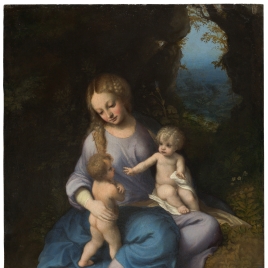
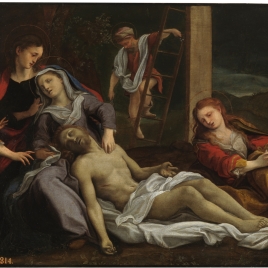
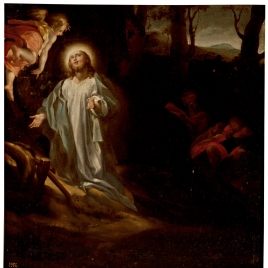
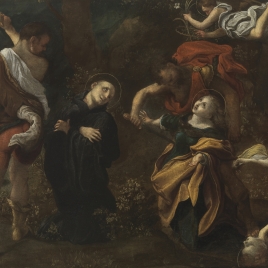
At the same time, Correggio continued to paint smaller, highly innovative religious compositions, almost always virgins or Passion scenes, but he also began to explore mythological painting. He painted "School of Love" (National Gallery, London) and "Venus and Cupid with a Satyr" (Louvre, Paris) around 1523-1525 for a Mantuan nobleman named Maffei. Around 1530 he executed the allegories of Virtue and Vice for the studiolo of Isabella d'Este, also in Mantua (now in the Louvre), and the commission of her son, Federico Gonzaga, for four canvases with "Jupiter's Loves" (1532-1534) to be sent to Emperor Charles V (now divided between Vienna, Berlin and Rome). Just as it is often said that the frescoes and altar paintings of Correggio's maturity anticipated the Baroque, and it is true that they exerted a profound influence on many aspects of 17th century painting, it could be said that these last mythologies almost prefigure the Rococo (Ekserdjian, D. in Enciclopedia M. N. P., Madrid, 2006, pp. 852-853).