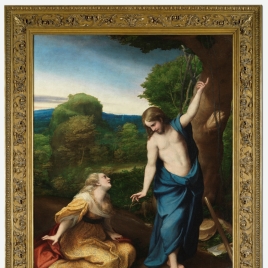
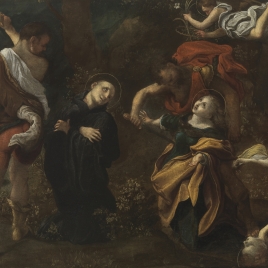
Noli me tangere
Ca. 1525. Oil on panel transferred to canvas.Room 049
Antonio Correggio’s stay in Rome between 1518 and 1519 powerfully affected his late work, which reflects that of late Raphael and the Michelangelo of the Sistine Chapel. Without ever abandoning Andrea Mantegna, and especially Leonardo, Correggio drew on those influences to shape his personal and decisive contribution to the classical style. After returning to his native Parma in 1520 he focused on frescoes and large altarpieces, painting few religious works for private use.
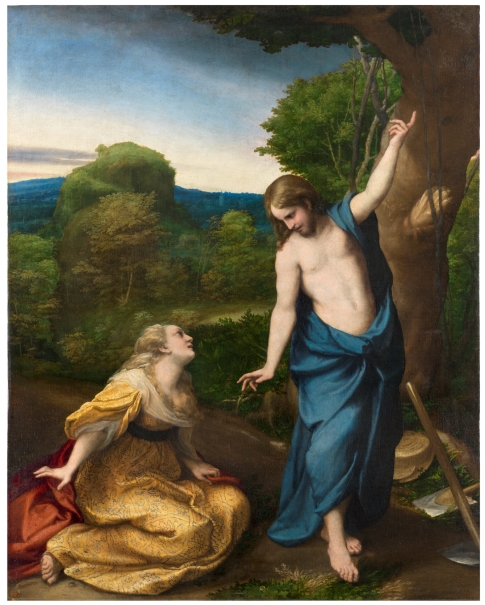
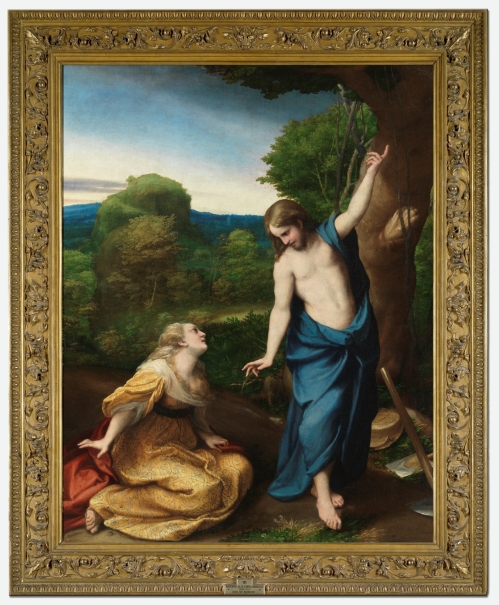
Noli me tangere, c.1525, constitutes one of Correggio’s first mature paintings. It was first mentioned in print in Pietro Lamo’s Graticola di Bologna, c.1560, after the author saw it at the Hercolani house in Bologna, and the painting was still there in 1568 when Giorgio Vasari admiringly mentioned it in the second edition of his Le Vite de’ più eccellenti pittori, scultori, ed architettori (Lives of the Most Eminent Painters, Sculptors, and Architects): The work is painted with such delicacy that it defies belief. There is no documentation of the painting having been commissioned by a member of the Hercolani family, but it is most likely that it was Vincenzo Hercolani (1500-57). The identity of the painting’s first owner is important, as it provides evidence that it was made for a private chapel, which its formal characteristics seem to indicate.
Correggio was very aware of where his works were to be hung, so the refined landscape and careful rendering of the farm implements -a magnificent fragment of still life avant la lettre- imply that he knew viewers would be close enough to see them. Vincenzo Hercolani was a member of the Brotherhood of Buon Gesù, whose bylaws urged its members to hang religious images in their homes. It also encouraged meditation exercises focused on Christ’s Passion. The apparently straightforward composition is extraordinarily balanced. Along a vertical axis running from Mary Magdalene’s right foot to Christ’s left hand, the characters stand out against a beautiful landscape tenuously lit by the dawn. Mary Magdalene wears the yellow garb characteristic of prostitutes and appears deeply moved by the meeting. Her emotional instability contrasts with Christ’s serene, tranquil figure, which Correggio depicts with a few iconographic peculiarities, including a blue robe in contrast with the white or pink robes traditionally employed in illustrations of this passage from the Bible (John 20:1-19). Correggio’s colour choice alludes to the sky or to the absence of stigmata from Christ’s Passion, symbolising his perfect state after the Resurrection.
The admirable balance attained here was not effortless; X-rays show that Correggio tried two different positions for Mary Magdalene before choosing the third and final, highest position of all. Her dress is practically identical to the one worn by Saint Cecilia in Raphael’s homonymous depiction in Bologna, indicating that Correggio must have studied the latter. He may have done so at the suggestion of Vincenzo Ercolani, who also owned the Vision of Ezekiel, c.1518, by Raphael now at the Galleria Palatina di Palazzo Pitti, Florence, as well as works by Francesco Francia and Lorenzo Costa. Vicenzo must have contacted Correggio through Costa’s close ties to Veronica Gambara, a lady from the painter’s home town and one of his important patrons.
From the Hercolani family, Noli me tangere passed to Cardinal Pietro Aldobrandini in 1598, before entering the collection of Cardinal Ludovico Ludovisi in 1621. In 1632 it was inherited by Prince Lodovico Ludovisi, who gave it to King Philip IV as payment for the Piombino Estate, as traditionally stated. However, Morán Turina (2024) has pointed to hitherto unnoticed historical evidence of great importance that would substantially alter the collecting history of the work. This is the presence on the reverse of the panel on which the painting was originally painted - transferred to canvas in 1934 - of the fire-engraved seal of King Charles I of England (AMNP, C. 1380, book 2, fol. 45r). This change of support was not included in the Museum´s 1942 guide (145-146), which still noted that the Noli me tangere had on its reverse ‘two seals: one a link of A and R: the second the known one of Charles I of England’. The 1945 edition did update its new status as an oil on canvas, and the memory of the English sovereign´s seal has since been lost.
In 1635 King Charles I was interested in purchasing important works from the Ludovisi collection in Rome and Count Arundel wrote to his agent in the papal capital, William Petty, urging him ‘to buy some of the principal paintings of the Ludovisios for the King our Master’ (Hervey 1921: 384). Although there is no specific record of acquisitions for the British monarch from that collection, it is certain that the documentation relating to the sale of his assets includes a ‘Christ in ye Garden at by Correggio’, a painting that was sold to Remigius van Leemput on 22 March 1649 for 34 pounds and from there bought in 1650 by Philip IV´s agent, Alonso de Cárdenas, for the Spanish sovereign (Loomie 1989: 262- 263). This raises a new circumstance: that Niccolò Ludovisi´s gift to Philip IV, sent by the Duke of Medina de las Torres, was a copy, and that the original entered the Spanish royal collection through the purchase in London in 1650. Both were destined for El Escorial, but the original would displace the copy once it became known. The painting finally entered the Museo del Prado in 1839. (Information updated by the Department of Italian and French Painting up to 1800 on 5/12/2024).
Falomir Faus, Miguel, 'Antonio Correggio. Noli me tangere'. Italian masterpieces from Spain's royal court, Museo del Prado, National Gallery of Victoria Thames & Hudson, 2014, p.52