formularioRDF
The itinerary <em>TITULORECORRIDO</em> has been successfully created. Now you can add in works from the Collection browser
<em>TITULOOBRA</em> added to <em>TITULORECORRIDO</em> itinerary

Metabuscador

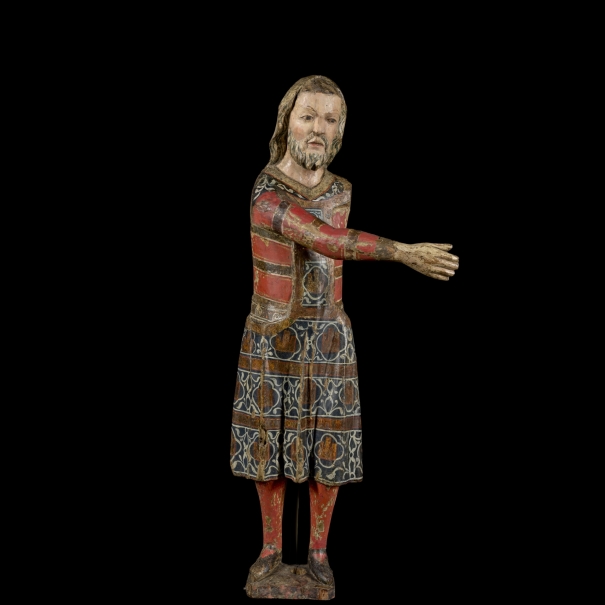
Nicodemus, part of a Descent from the Cross
Polychromed, Carved on taco de madera. Last quarter of the XIII century
Theatrical representations of the Descent from the Cross have been part of the iconography and literature of the Passion since ancient times. Sculptural groups in which the holy men Nicodemus and Joseph of Arimathea were prominent made it possible to reenact the story inside the church. Here they can be distinguished by the pellote they both wear, a typical 13th-century garment decorated with heraldic motifs, in which colour plays an important role.
ARTWORK
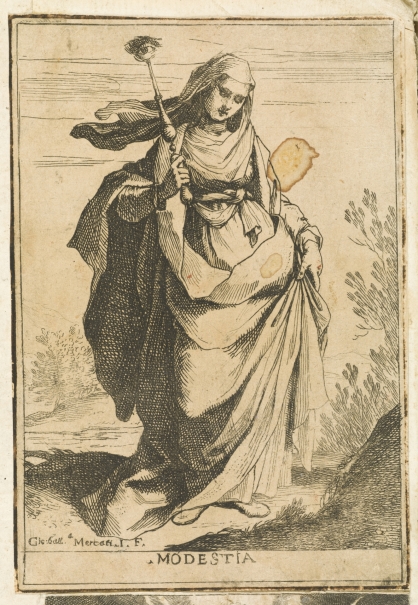
Alegoría de la modestia
Etching on laid paper. 1620 - 1637
Representación de la Modestia de pie, con velo por encima de la cabeza, por detrás paisaje. En su mano derecha lleva el atributo que la identifica: un cetro terminado en un ojo alusivo a que la modestia debe estar vigilante con ella misma para no caer en la vanidad.
ARTWORK
Anonymous – Engraver
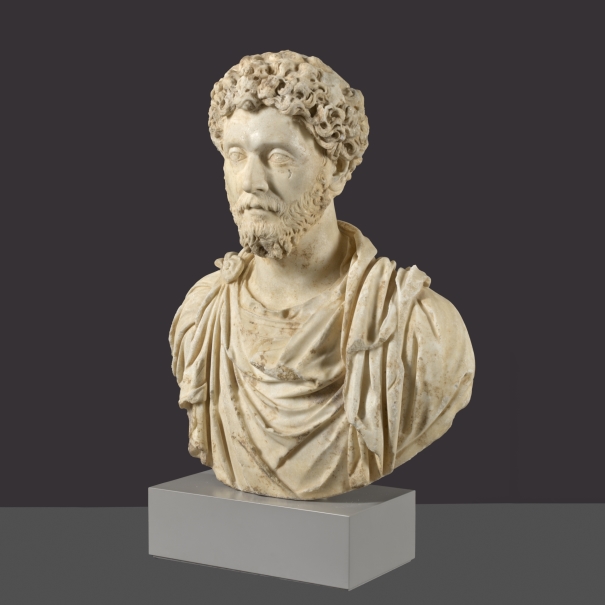
The Emperor Marcus Aurelius
Sculpted . 161 - 169
La iconografía de Marco Aurelio se divide en cuatro tipos de retratos sucesivos. De ellos, los dos primeros lo representan joven, como príncipe heredero bajo Antonino Pío (138-161 d. C.), y el tercero, al que corresponde el presente busto, conmemora su coronación junto a Lucio Vero (161 d. C.). El cuarto tipo, que muestra al monarca con barba y melena más largas, sustituye al anterior en 169 d. C., cuando muere Lucio Vero y Marco Aurelio queda como único emperador hasta su muerte (180 d. C.). De
ARTWORK
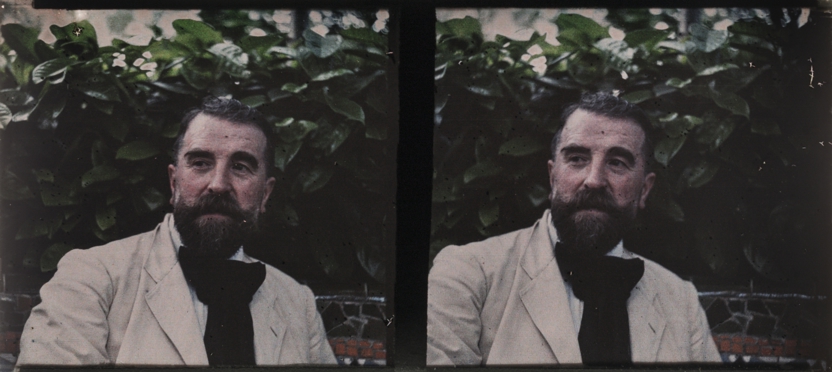
The sculptor Miguel Blay
Autochrome on glass plaque. Ca. 1918
Este retrato de Miguel Blay (1866-1936) es un autocromo estereoscópico. Patentado por los hermanos Lumière, el autocromo fue el primer procedimiento fotográfico a color, que gozó de gran éxito entre profesionales y aficionados, pese a su elevado coste. La obra confirma el interes de Blay por ser retratado con uno de los procedimientos fotográficos más singulares del momento.
ARTWORK
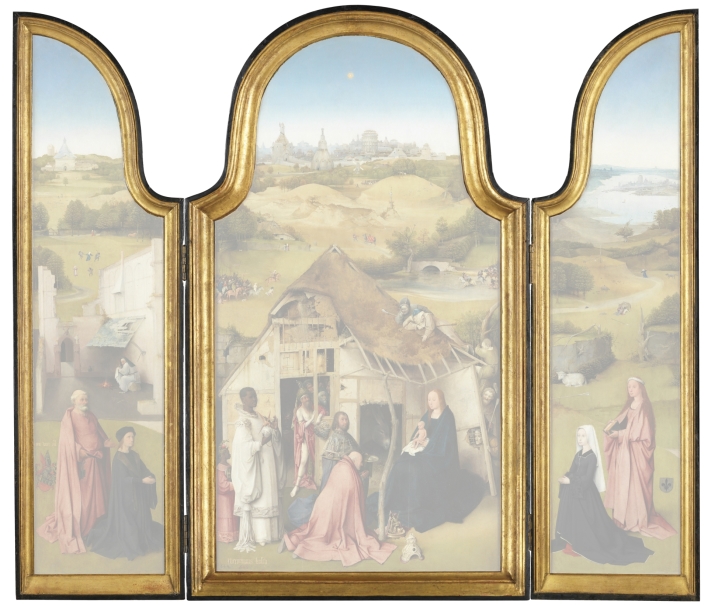
Frame of Triptych of the Adoration of the Magi
Polychromed, Water gilding, Joined / assembled . Ca. 1494
This frame, representative of 15th-century Flemish art, was generally used for diptychs and triptychs. It is remarkable for its simplicity: narrow carved mouldings, gilded and polychromed in black. The lower moulding, with its rainsill, draws the viewer into the painting, as though to join the group of figures. This device serves to enhance the overall illusion of depth.
ARTWORK
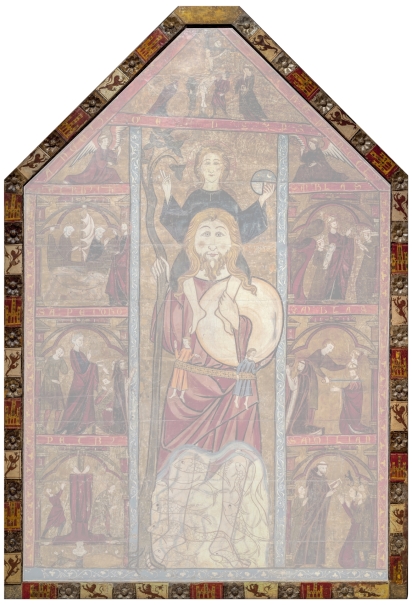
Frame of Altarpiece of Saint Christopher
Joined / assembled, Policromado al temple . Late XIII century
El Retablo de san Cristóbal es un ejemplo destacado de la tipología de retablo en forma de pentágono que se manifestó en la corona castellana durante los siglos XIII y XIV, de la que apenas quedan ejemplares. Presenta una superficie lisa, sin elementos estructurales que la articulen. Es la propia pintura la que define un encasamento central flanqueado por dos calles que se dividen en tres registros superpuestos y se coronan por otro en forma de trapecio. La parte superior se remata por un compar
ARTWORK
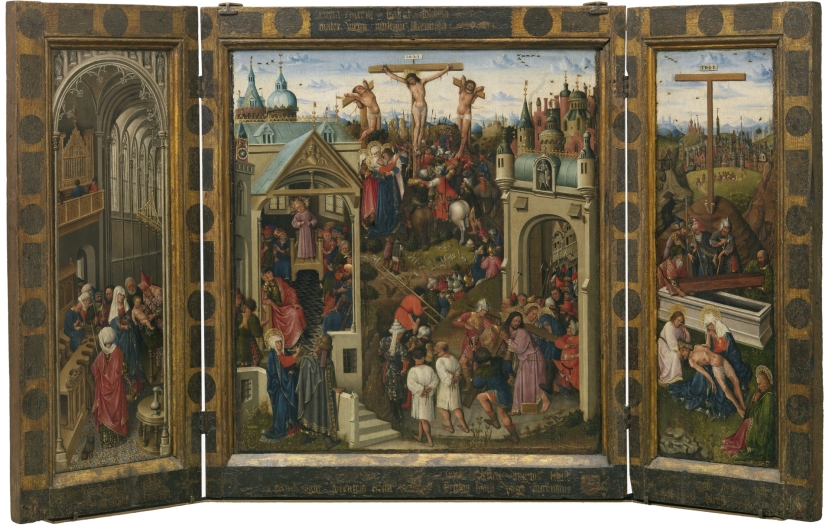
Frame of Triptych with Scenes from the Life of Christ and Mary
Gilded, Polychromed, Carved, Mortise-and-tenon joint . Ca. 1440
This triptych was painted on a panel of Baltic oak, a wood typical of Netherlandish paintings and therefore of their frames. The boards are inserted into a grooved frame decorated with fictive dark stones on a gilt background. The particular iconography of the triptych suggests that it was specially commissioned, a view borne out by the five escutcheons on the lower mouldings, which may be linked to Eximén Pérez de Corella.
ARTWORK
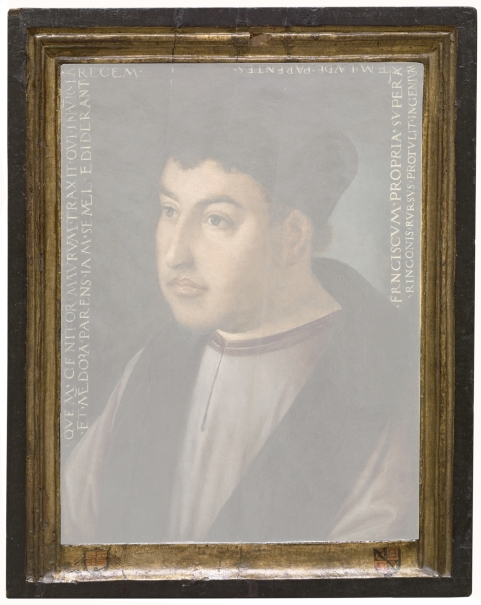
Frame of Francisco Fernández de Córdoba y Mendoza
Polychromed, Carved, Water gilding . 1520 - 1521
The original integral frame is formed from the same piece of wood as the panel itself, and is therefore inseparable from it. The use of gilt and black polychrome suggests it was made in Castile, though strongly influenced by Flemish models. The lower moulding boasts a rainsill, highly characteristic of contemporary Flemish frames, as well as two coats of arms which, taken in conjunction with the inscription on the painting itself, enabled the sitter to be identified.
ARTWORK
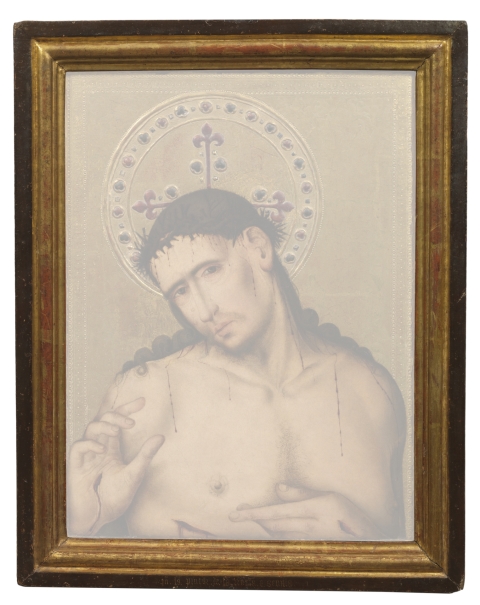
Frame of Man of Sorrows
Water gilding, Policromado al temple . Ca. 1500
Marco formado por molduras sencillas con una técnica muy delicada. Tallado con cavetos y boceles dorados al agua o policromados en negro, su sistema constructivo sigue el patrón de ranura o engargolado, donde la tabla queda inserta en un hueco en el marco, de manera fija como una pieza única. Una vez conformado, se pasaba a su decoración, por medio de estuco, oro y pigmentos. En el cabio aparece una inscripción: Juo S. pintor de Sa. Roma d. Sevilla, que ha permitido identificar a su autor, Juan
ARTWORK
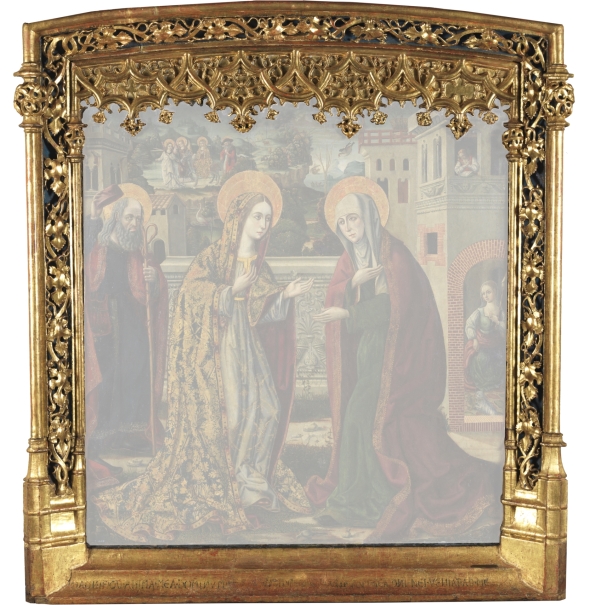
Frame of The Visitation
Polychromed, Trepanado / calado, Water gilding, Joined / assembled . Ca. 1500
This frame, in a style midway between Gothic and Renaissance, was strongly influenced by Flemish art. In structural terms it follows the fixed-frame pattern, with its characteristic rainsill and an inscription in Gothic script alluding to the subject depicted. Interestingly, the tracery arches typical of Gothic architectural decoration are interspersed with more naturalistic elements associated with the Renaissance, such as the carved openwork vine leaves running around much of the perimeter.
ARTWORK
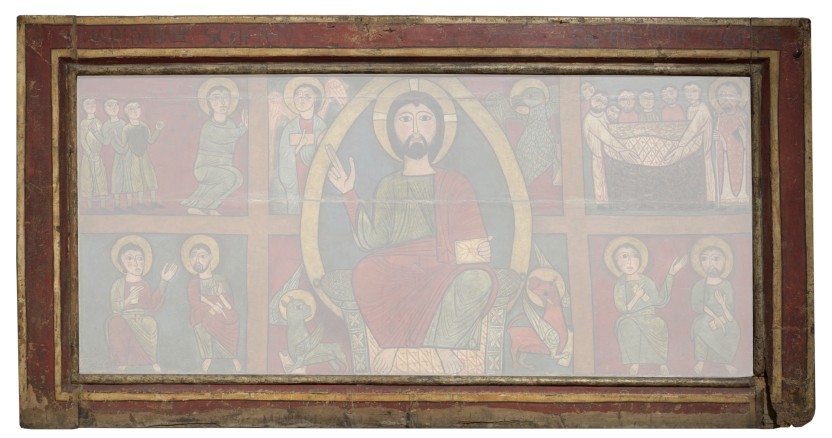
Frame of The Guils Frontal
Mortise-and-tenon joint, Policromado al temple . Late XIII century
The Romanesque frame of this altarpiece frontal consists of simple mouldings attached to the painting by means of wooden pegs to create a fixed whole. Like the painting, the frame is polychromed in tempera using plain colours. Latin inscriptions on the upper moulding allude to the scenes depicted: on the left, “lapidabant Stefanu” (stoning of Stephen), and on the right, “sepelierunt Stefanu” (burial of Stephen).
ARTWORK
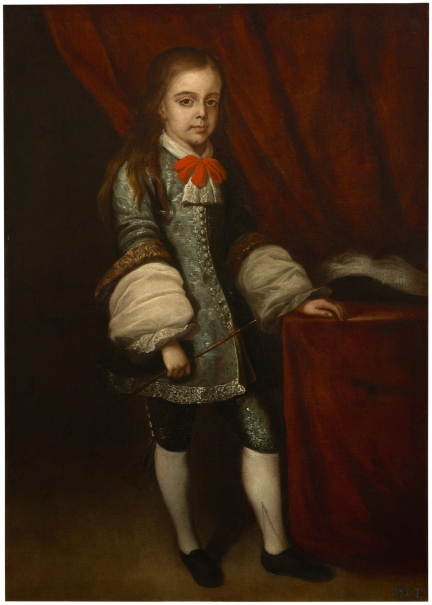
Portrait of a child
Oil on canvas. Late XVII century
The wealthy clothing of the child and the setting in which he stands suggest the social status of this unknown and sad model. The costume and accessories allow us to date this painting to the last years of the 17th century, making it an interesting graphic record of the nobility during the unfortunate Charles II´s reign. The painting depicts the delicate and fragile figure of an anonymous long-haired child with a melancholic look. The artist of this painting, which recalls the child portraits of
ARTWORK
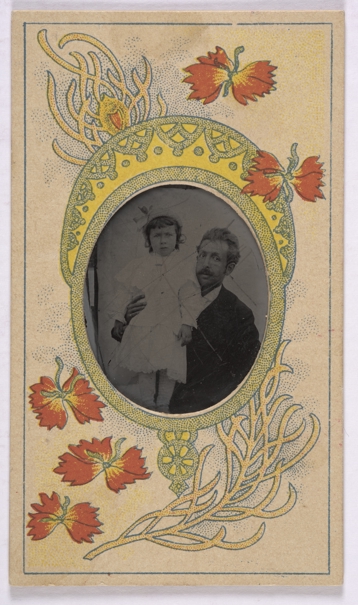
The painter Manuel González Santos holding his daughter Adela
Tintype on card. Ca. 1912
Además de sus retratos profesionales, en los que aparecen con las herramientas del oficio o en sus los estudios, los artistas también conservaban en sus archivos otras fotografías de carácter familiar, como este ferrotipo en el que el pintor Manuel González Santos posa orgulloso con su hija Adela en brazos.
ARTWORK
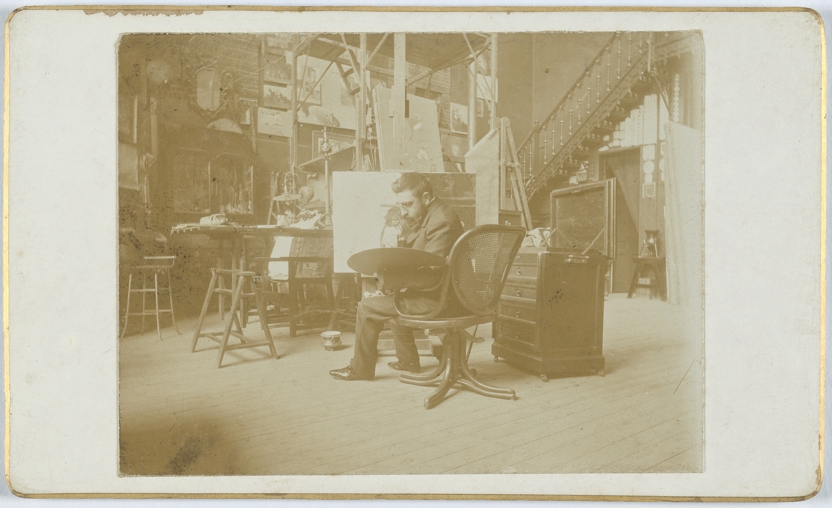
Eduardo Sánchez Solá in his studio
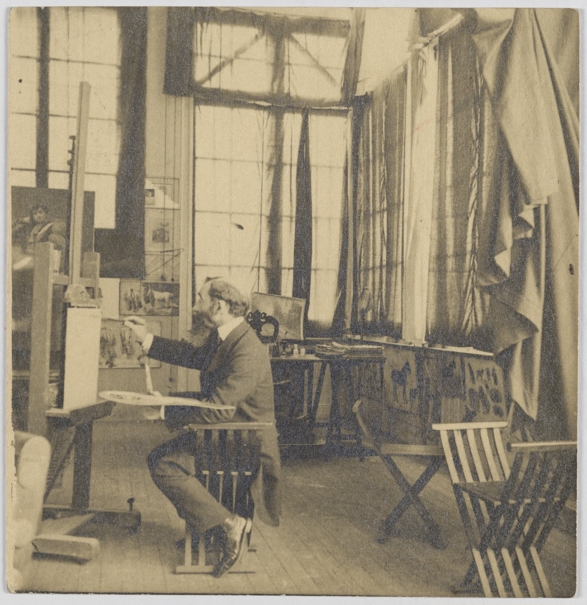
Albumen on paper. Ca. 1895
La temática de los monaguillos alcanzó una especial fortuna en la obra de Eduardo Sánchez Solá (1869-1949), y uno de esos cuadros se adivina en el caballete que aparece junto al artista.
ARTWORK
Anonymous – Photographer
Luis Sainz in his workshop at the Casa de los Estudios, in Madrid
Photography techniques on paper. Ca. 1900
El pintor Luis Sainz aparece en el interior de la Casa de los estudios, que estaba situada en Madrid, concretamente en la calle Lista, 24, y de la que él fue promotor. Así describía la revista "La Esfera" este espacio de creación: Hay en la amplia y clara calle de Lista una casa de simpática tradición artística. La nombran «la casa de los estudios», porque en ella, con sus puertas á un anchuroso patio ajardinado, hay hasta cinco ó seis estudios de pintores y escultores.
ARTWORK
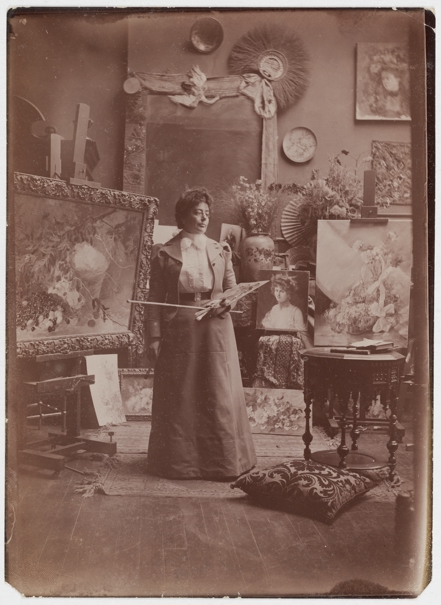
María Luisa de la Riva in her Paris studio
Gelatin / collodion on paper. Ca. 1900
Rather than “a distinguished amateur painter”, as she was described by the writer Manuel Ossorio y Bernard in 1883, María Luisa de la Riva was - as she herself stated in some of her letters - a “professional painter who works for a living”, with a long and successful career. She is pictured here, at the age of 41, in her studio, surrounded by her works and the props used in some of her compositions.
ARTWORK
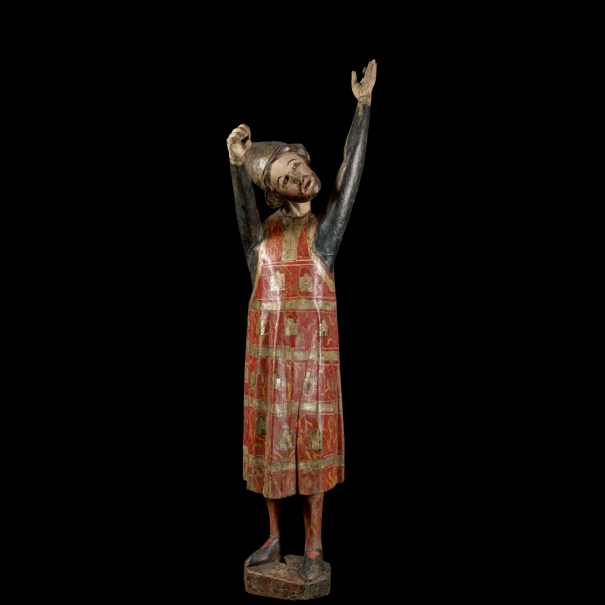
Joseph of Arimathea, part of a Descent from the Cross
Polychromed, Carved on taco de madera. Last quarter of the XIII century
Theatrical representations of the Descent from the Cross have been part of the iconography and literature of the Passion since ancient times. Sculptural groups in which the holy men Nicodemus and Joseph of Arimathea were prominent made it possible to reenact the story inside the church. Here they can be distinguished by the pellote they both wear, a typical 13th-century garment decorated with heraldic motifs, in which colour plays an important role.
ARTWORK
Loading...

Loading...

Up