formularioRDF
The itinerary <em>TITULORECORRIDO</em> has been successfully created. Now you can add in works from the Collection browser
<em>TITULOOBRA</em> added to <em>TITULORECORRIDO</em> itinerary

Metabuscador

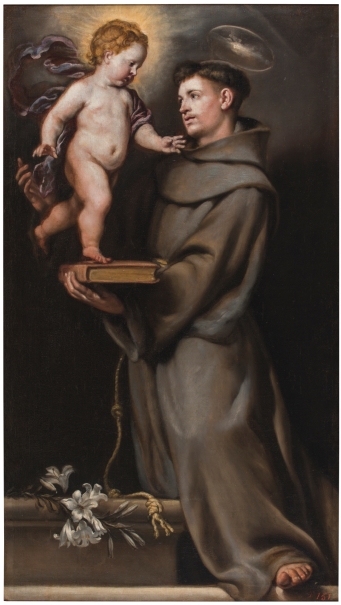
Saint Anthony of Padua
Oil on canvas. Second half of the XVII century
He is dressed in the typical Franciscan robe, fastened by the rustic cord with the three knots symbolising the vows of poverty, chastity and obedience. The writings of Saint Bernardine of Siena described Saint Anthony as corpulent and short, but the usual iconography preferred to soften his physiognomy and insist on the amiability or gallantry of his person. For this reason, the most frequently depicted scene, is of vision which occurred during a trip to France, when the Virgin appeared to him i
ARTWORK
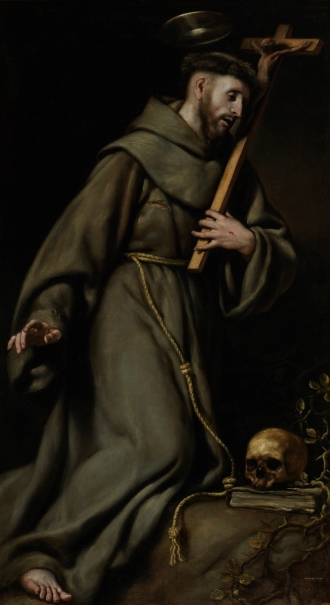
Saint Francis of Assisi
Oil on canvas. Second half of the XVII century
The portrait depicts Saint Francis of Assisi dressed in the typical Franciscan sackcloth fastened with a rustic cord with the three knots. Each of the knots represents the vows of poverty, chastity, and obedience. He holds a crucifix in his hand and the wounds on his own body are clearly visible. On this occasion, the depiction of the saint does not attempt to come close to the description given by his biographer Thomas of Celano. He describes Francis of Assisi as a puny-looking short figure wit
ARTWORK
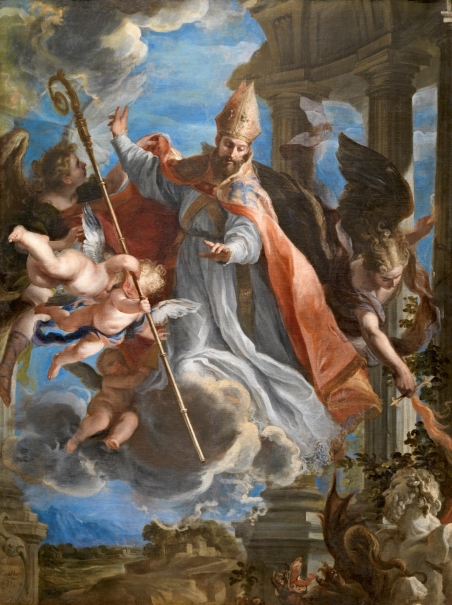
The Triumph of Saint Augustine
Oil on canvas. 1664
Raised on a cloud, Saint Augustine (354-430) triumphantly combats Hell and Paganism, symbolised by the dragon and classical sculpture below. The compositional dynamism is emphasised by the sinuous form of the saint’s body, its sense of movement and the group of angels clustered around him, including one on the right that directs its sword against the enemies of religion. The canvas was painted for the monastery of the Augustinian Recollects in Alcalá de Henares.
ARTWORK
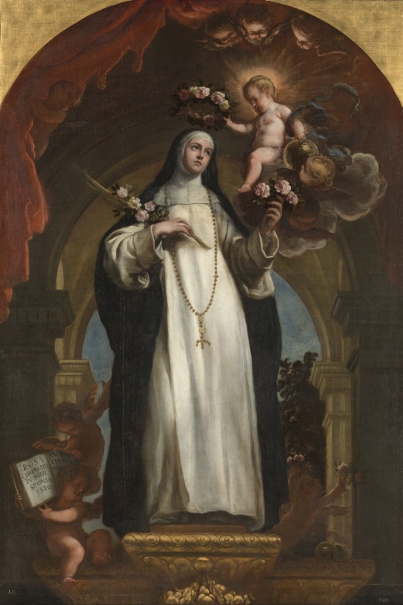
Saint Rose of Lima
Oil on canvas. Ca. 1685
This painting and Saint Dominic of Guzmán (P000662) is a pair of canvases painted around 1685 by Claudio Coello for the church of the Dominican friary of Nuestra Señora del Rosario in Madrid, now in the Prado, depicting Saint Dominic of Guzmán and Saint Rose of Lima, two doctrinal pillars of the Order of Preachers. The two genders and geographical regions, represented by the order’s founding father and the brand-new Spanish American saint, are positioned at the same level in
ARTWORK
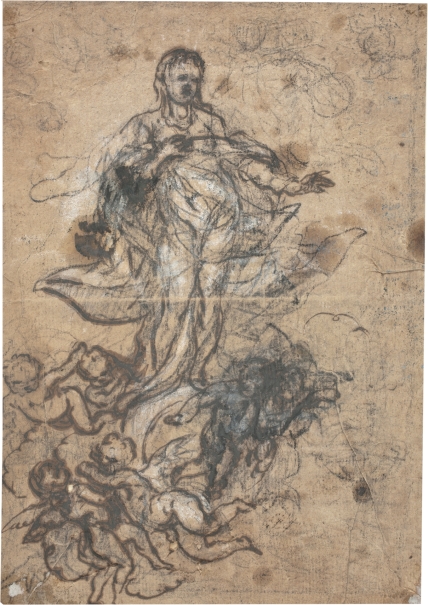
The Immaculate Conception / Sketch for an Immaculate Virgin and a Saint Ignatius of Loyola
Charcoal, Pencil, White chalk on dark toned paper. Second half of the XVII century
This drawing depicts the Immaculate Conception standing on the crescent of the moon. Her left arm appears outstretched and her right arm across her chest. A group of little angels flutter at her feet. On the reverse side is a light sketch for the Immaculate Virgin herself and another of Saint Ignatius of Loyola that corresponds to the one in the church of Valdemoro. These sketches allow for the attribution to Claudio Coello, to whom Ceán Bermúdez had already attributed that paintin
ARTWORK
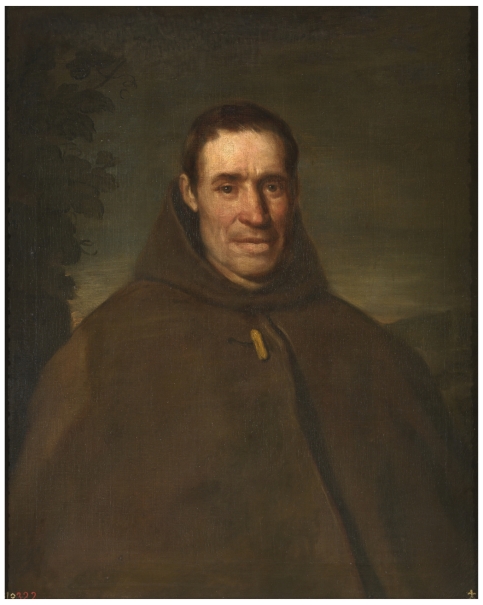
Father Cabanillas
Oil on canvas. 1689 - 1693
This likeness of the Franciscan clergyman is a significant example of elongated bust portraits that are quiet customary in the Western figurative tradition. Such works allow a closer approach to the model’s essential features, reducing but not eliminating accessory elements such as his clothing and a summary depiction of the surrounding space. Rather than overly limiting information on the protagonist’s social condition, this economy of means favors the viewer’s concentration on his face. His fe
ARTWORK
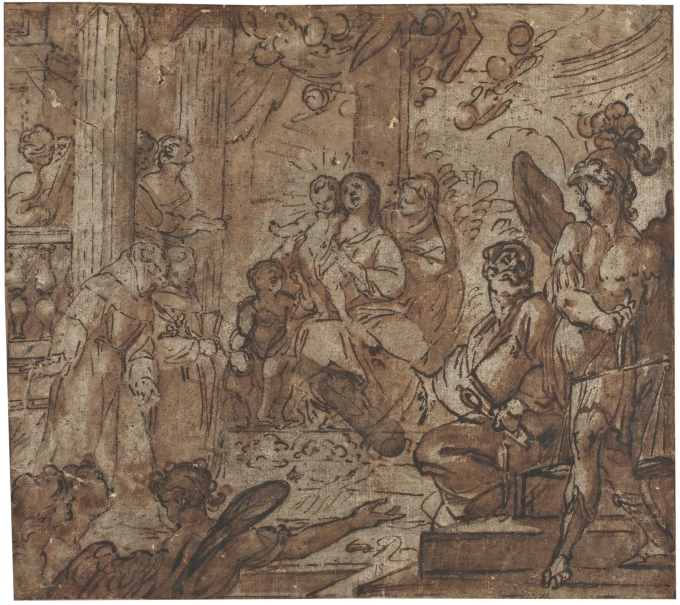
The Virgin and Child with Saints
Grey-brown wash, Pencil on laid paper. 1669
In an apse-shaped interior on a pedestal, the Virgin is depicted seated with the Christ Child standing on her lap. Saint Anne appears behind her, and to her right the Infant Saint John is drawn with the lamb. To the observer’s right, in the foreground of the composition, Saint Peter and Saint Michael are depicted, and to the left, Saint Francis and Saint Anthony. Behind them, on a platform with balustrade and columns, some figures are included. They seem to carry musical instruments (although th
ARTWORK
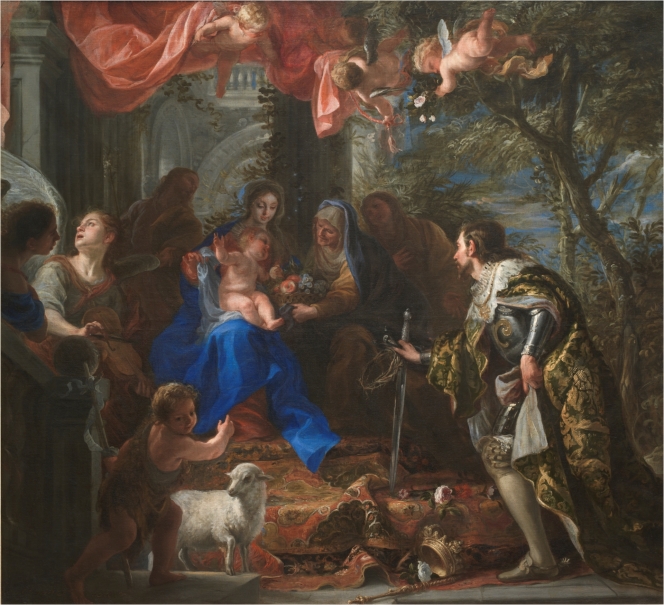
The Virgin and Child adored by Saint Louis, King of France
Oil on canvas. Ca. 1665
Surrounded by angels, the Holy Family, with Saint Elizabeth and the infant Saint John, receive Saint Louis, King of France. The background combines architecture and curtains. This work is organized like a large stage set, using the infant Saint John and an adjacent lamb to invite the viewer to participate. The dynamic and complex composition with its brilliant and expansive colors recalls models from the Flemish Baroque. The subject is a spectacular Baroque reply to the “sacred conversations” of
ARTWORK
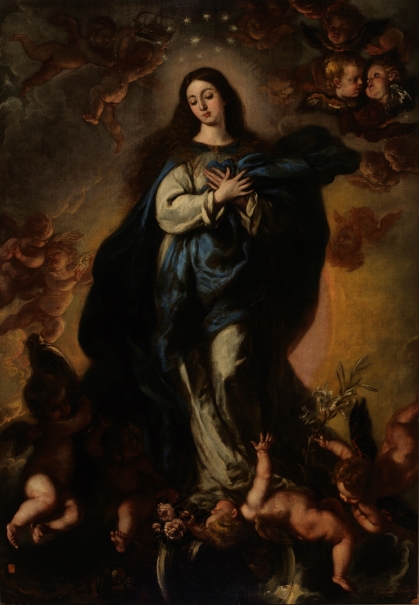
The Immaculate Conception
Oil on canvas. Second half of the XVII century
This is a significant example of Claudio Coello’s style and one of his finest representations of the Immaculate Conception. It admirably associates grace and delicate modesty with the triumphal emphasis that characterizes depictions of this subject from Madrid in the second half of the century. Its rich, refined and predominately warm color scheme corresponds to Coello’s most powerful period, free of the earlier dependence on Rizi still visible in the large San Plácido Annunciation from 1
ARTWORK
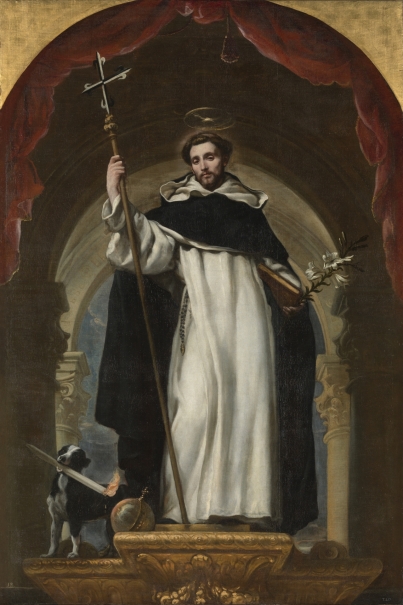
Saint Dominic of Guzmán
Oil on canvas. Ca. 1685
Spanish saint Dominic de Guzmán (1170-1221) founded the Dominican Order, which became one of the most powerful and influential religious groups in Catholic Europe, partially as a result of its defense of orthodoxy through the Inquisition, which was led by Dominican prelates. Claudio Coello made five paintings for their convent of El Rosario in Madrid, one of which is presented here. They were probably painted in the mid 1670s, when the painter was relatively young but had already made a p
ARTWORK
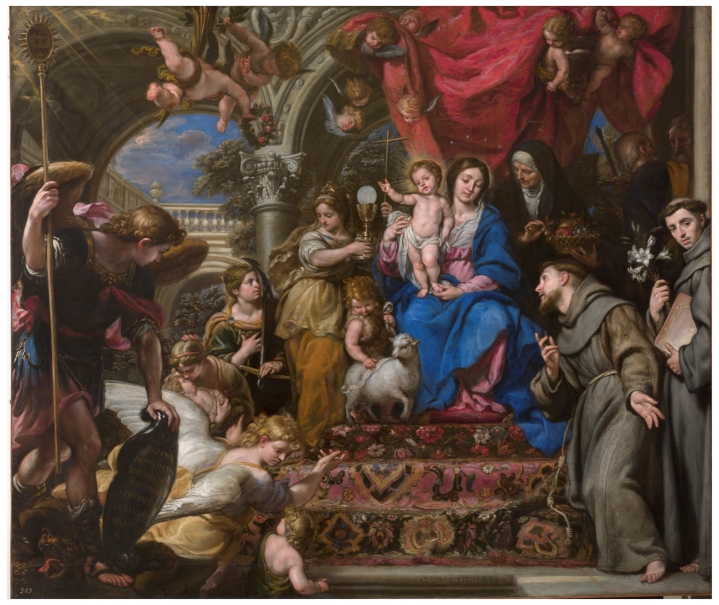
The Virgin and Child between the Theological Virtues and Saints
Oil on canvas. 1669
Various figures of Virtues and saints are grouped around the Virgin and Child, forming an extensive “sacra conversazione”. The infant Saint John the Baptist is easily recognisable, as are Saint Elizabeth of Hungary, Saint Paul, Saint Peter, Saint Francis and Saint Anthony of Padua, all of whom were among the most popular saints in Baroque Spain.
ARTWORK
Loading...

Loading...

Up