formularioRDF
The itinerary <em>TITULORECORRIDO</em> has been successfully created. Now you can add in works from the Collection browser
<em>TITULOOBRA</em> added to <em>TITULORECORRIDO</em> itinerary

Metabuscador

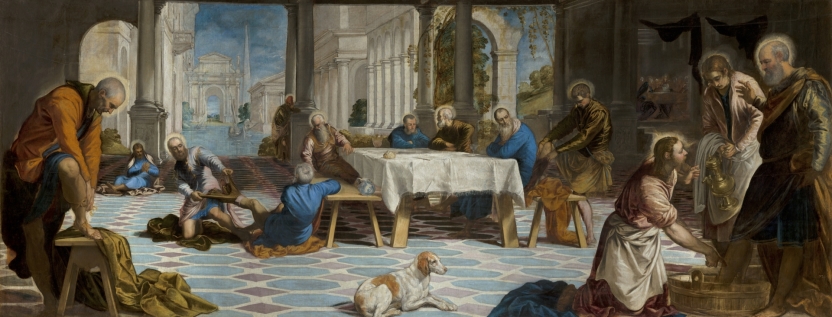
The Washing of the Feet
Oil on canvas. 1548 - 1549
This scene from the New Testament (John 13, 1-20) shows the moment just before the Last Supper, when Jesus washed Saint Peter´s feet as an example of humility and service to others. The displacement of the main characters, Christ and Saint Peter, to one end of the composition is due to the original location of this work on the right wall of the presbytery of San Marcuola, where the image of Christ washing Saint Peter´s feet was on the part of the canvas closest to the congregation. When seen fro
ARTWORK
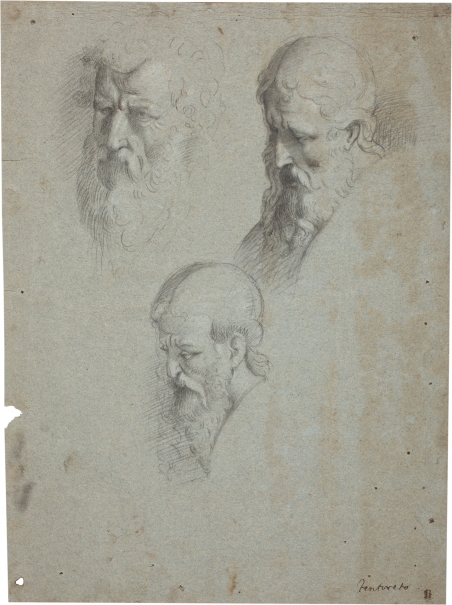
Heads of Three Bearded Men
White chalk, Pencil on grey paper. XVI century
From their style, it is possible that these feeble studies may date from the beginning of the nineteenth century. The heads may derive from a painting or paintings by Tintoretto, but the prototype could also be Lombard, perhaps the work of one of the Campi, or their followers.
ARTWORK
Jacopo Robusti Tintoretto – (Attributed to)
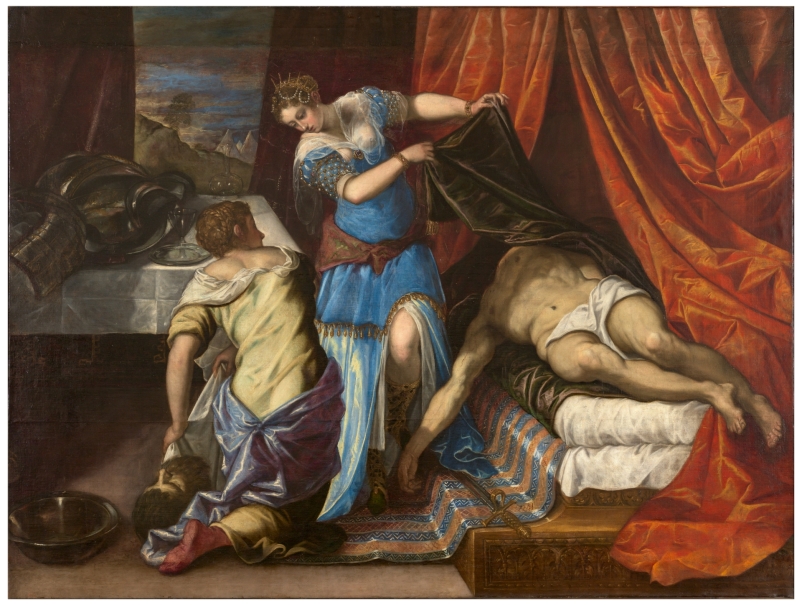
Judith and Holofernes
Oil on canvas. Ca. 1577
Traditionally catalogued as a work from Tintoretto´s youth, the dating of this painting has been moved to the late fifteen-seventies by recent studies. The artist draws on the Bible story (Judith 13, 9-11) but his reading of the subject is not erotic. Here, Judith wears her finest clothing to seduce Holofernes, rather than appearing nude, as was habitual in Italian Renaissance art. The action takes place in the tent of an Assyrian general and the painter has meticulously recreated its interior,
ARTWORK
Jacopo Robusti Tintoretto – (Workshop of)
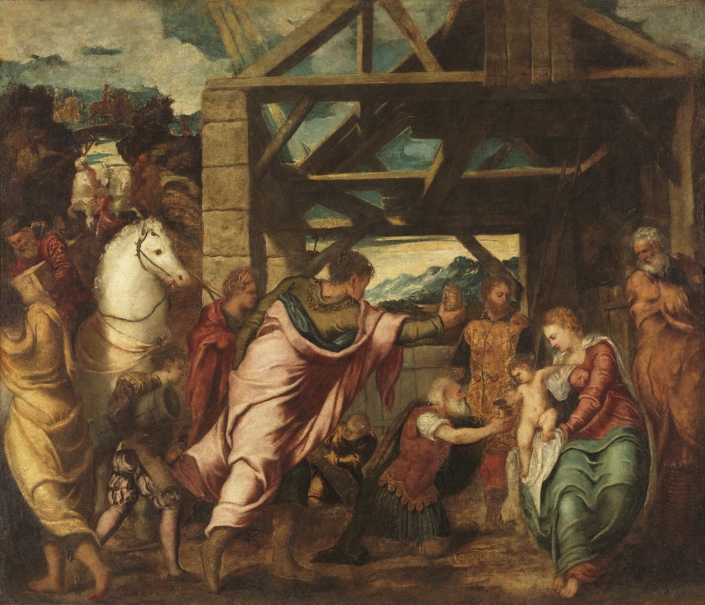
The Adoration of the Magi
Oil on canvas. XVI century
La obra fue comprada en Venecia por el almirante de Castilla, que la donó al convento madrileño de San Pascual. Con la Desamortización pasó al Museo de la Trinidad y más tarde al Museo del Prado, donde haa figurado como "obra de Tiziano" y como "Copia de Tiziano".
ARTWORK
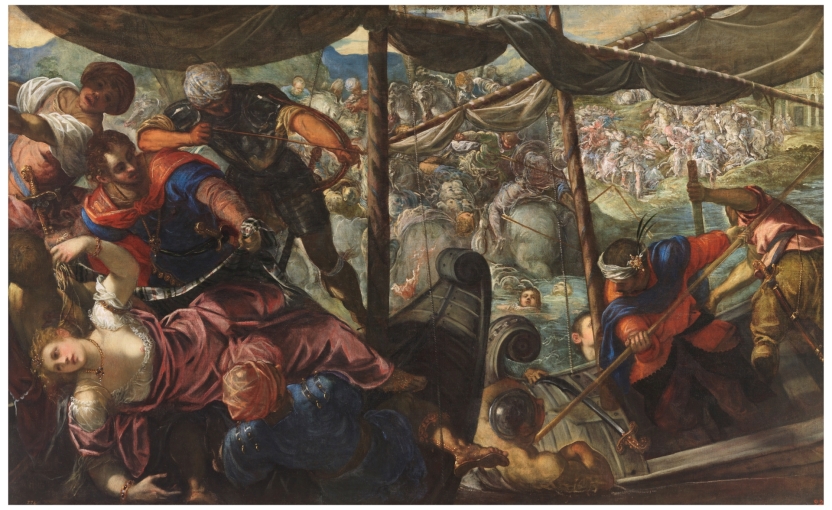
The Abduction of Helen
Oil on canvas. 1578 - 1579
Helen’s move from Sparta to Troy is described very differently in the two oldest narratives. In the Iliad, Homer describes Helen’s reticence to abandon Menelaeus, suggesting she was kidnapped by Paris. However, in his Ephemeris Belli Troiani (fourth century BC), Dictys Cretensis describes her departure as the willing flight of a woman in love. Both versions are represented in sixteenthcentury Italian painting. Helen’s voluntary flight was depicted by Giulio Romano at the Sala di Troia in the Pal
ARTWORK
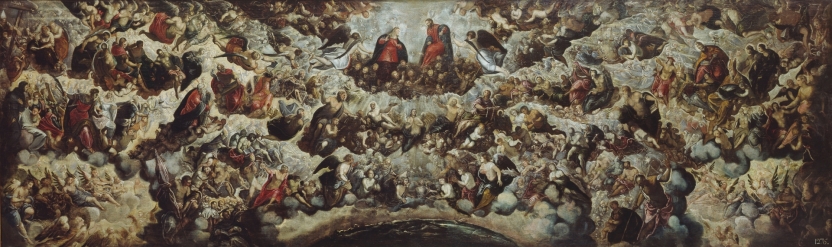
Paradise
Oil on canvas. Early Finales del siglo XVI - XVII century
La obra coincide con la enorme pintura del mismo tema en el Palacio Ducal de Venecia en casi todos los grupos de figuras, y con ella se relaciona en su composición general. El Paraíso, que ocupa la casi totalidad del lienzo, permite ver en la parte inferior el mundo, que tratándose de Venecia es sobre todo el mar.Preside la gran composición en el centro de la parte superior el grupo de la Virgen arrodillada a los pies del Salvador hacia el que desciende el Padre Eterno con los brazos extendidos.
ARTWORK
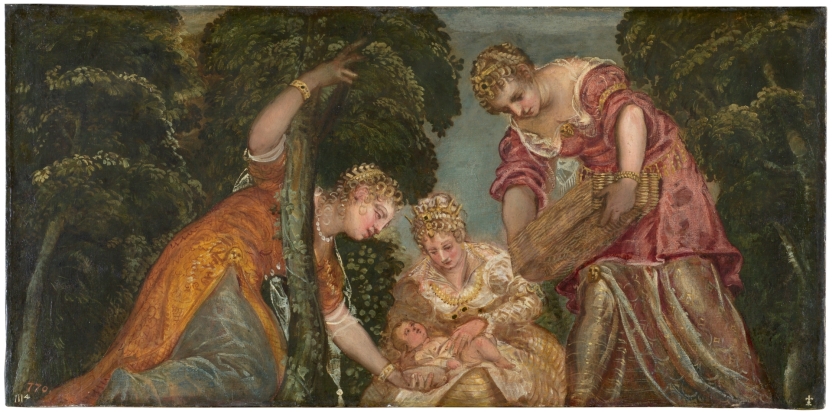
Moses rescued from the Nile
Oil on canvas. Ca. 1555
This is one of seven canvases (P00386, P00388, P00389, P00393, P00394, P00395, P00396) in a group linked by the same color scheme, a general accentuation of surface drawing and a rhythm of curved forms that link on painting to another. The scenes were designed to be seen together, at a certain height and laid out on canvases conceived as inclined planes that converged on a central painting. Clearly, this group was intended for a profane setting. The biblical themes have lost their dramatic chara
ARTWORK
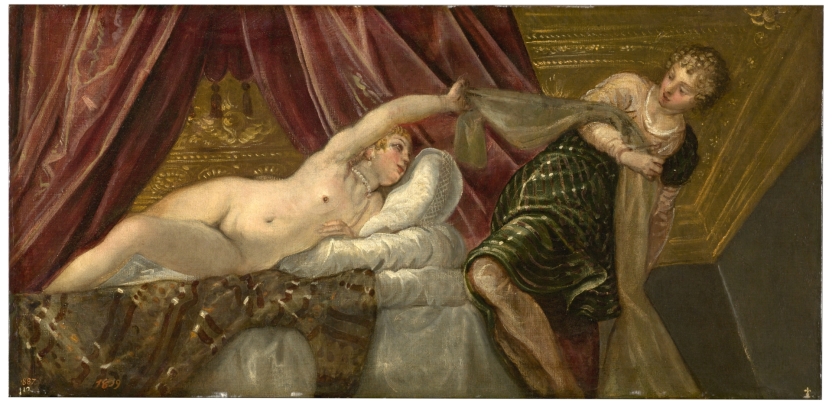
Joseph and the Wife of Putiphar
Oil on canvas. Ca. 1555
Joseph is a handsome and virtuous slave falsely accused of rape by his master´s wife, whose advances he has rejected. He is imprisoned, but eventually raised to the highest office by Pharaoh (Exodus: 39). Joseph and the Wife of Putiphar and Susannah and the Elders (P386) can be understood as parables of righteousness threatened and preserved, but here -as was usual for artists of the Renaissance and Baroque- they are presented in terms of sensuous appeal and erotic charge rather than as moral le
ARTWORK
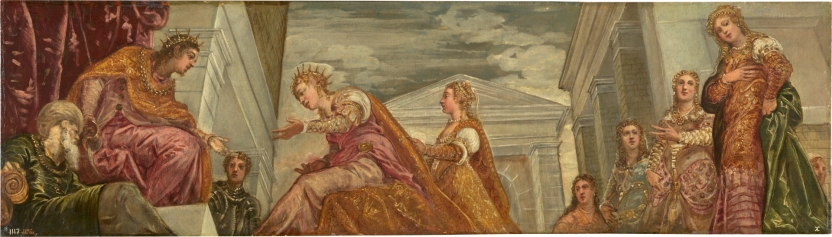
The Queen of Sheba and Salomon
Oil on canvas. Ca. 1555
This is one of seven canvases (P00386, P00388, P00389, P00393, P00394, P00395, P00396) in a group linked by the same color scheme, a general accentuation of surface drawing and a rhythm of curved forms that link on painting to another. The scenes were designed to be seen together, at a certain height and laid out on canvases conceived as inclined planes that converged on a central painting. Clearly, this group was intended for a profane setting. The biblical themes have lost their dramatic chara
ARTWORK
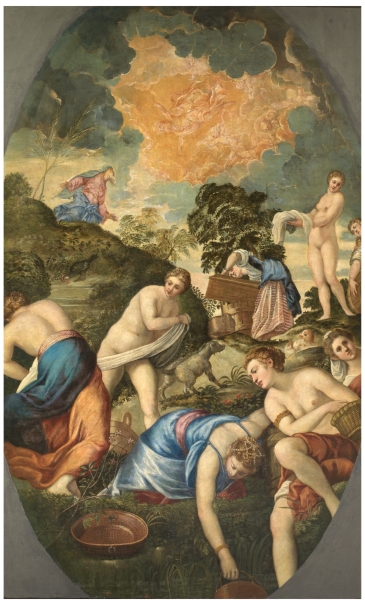
The Purification of the Midianite Virgins
Oil on canvas. Last quarter of the XVI century
This is one of seven canvases (P00386, P00388, P00389, P00393, P00394, P00395, P00396) in a group linked by the same color scheme, a general accentuation of surface drawing and a rhythm of curved forms that link on painting to another. The scenes were designed to be seen together, at a certain height and laid out on canvases conceived as inclined planes that converged on a central painting. Clearly, this group was intended for a profane setting. The biblical themes have lost their dramatic chara
ARTWORK
Jacopo Robusti Tintoretto – (and workshop)
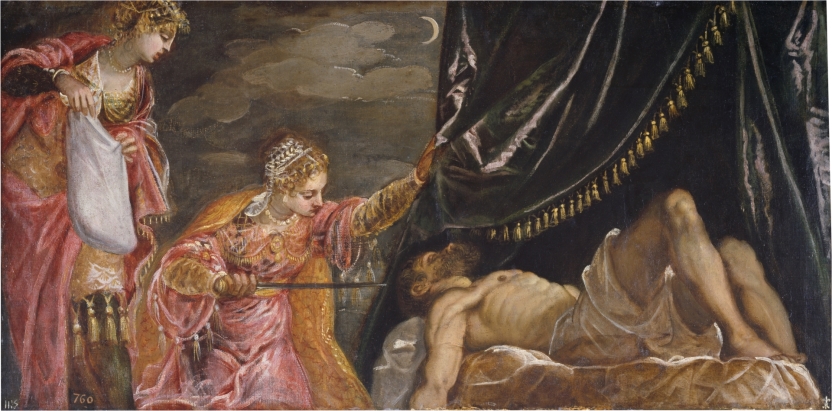
Judith and Holofernes
Oil on canvas. 1552 - 1555
This is one of seven canvases (P00386, P00388, P00389, P00393, P00394, P00395, P00396) in a group linked by the same color scheme, a general accentuation of surface drawing and a rhythm of curved forms that link on painting to another. The scenes were designed to be seen together, at a certain height and laid out on canvases conceived as inclined planes that converged on a central painting. Clearly, this group was intended for a profane setting. The biblical themes have lost their dramatic chara
ARTWORK
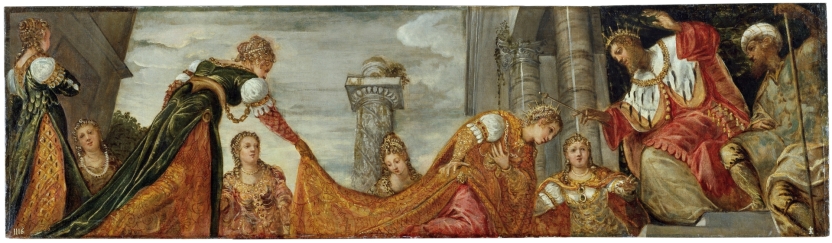
Esther and Ahasuerus
Oil on canvas. 1552 - 1555
This is one of seven canvases (P00386, P00388, P00389, P00393, P00394, P00395, P00396) in a group linked by the same color scheme, a general accentuation of surface drawing and a rhythm of curved forms that link on painting to another. The scenes were designed to be seen together, at a certain height and laid out on canvases conceived as inclined planes that converged on a central painting. Clearly, this group was intended for a profane setting. The biblical themes have lost their dramatic chara
ARTWORK
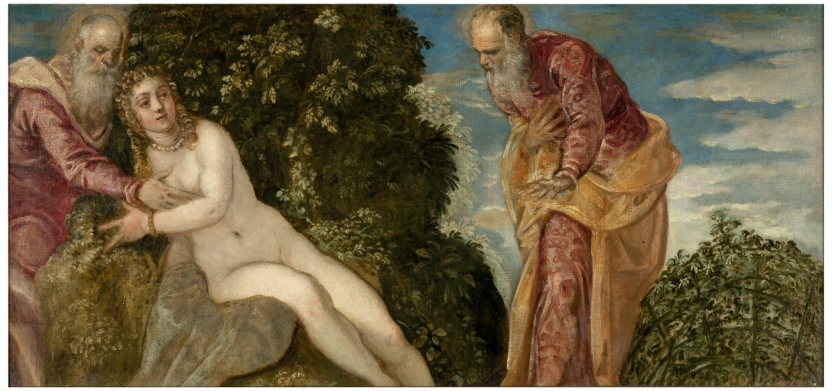
Susannah and the Elders
Oil on canvas. 1552 - 1555
This canvas is part of a group of six paintings: Susannah and the Elders (P386), Esther and Ahasuerus (P388) Judith and Holofernes (P391), The Visit of the Queen of Sheba to Solomon (P394), Joseph and the Wife of Putiphar (P395) and Moses Rescued from the Nile (P396). All have horizontal formats and the same palette, a general accentuation of surface drawing and a rhythm of curved forms that link the paintings to each other. They are accompanied by a central work with an oval format (The Purific
ARTWORK
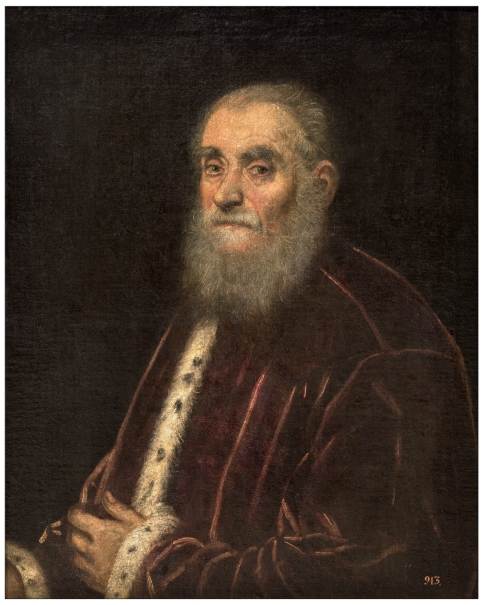
Marco Grimani
Oil on canvas. 1576 - 1583
A portrait of Marco Grimani (d. 1583), a Venetian senator and contemporary of Tintoretto. In keeping with the artist´s customary portrait compositions, the sitter appears slightly turned, over a black background, and gazing fixedly at the viewer. The placement of his left arm opens the work´s perspective into a third dimension. This realistic representation of the model is characteristic of Tintoretto, who differed from his contemporaries in his faithful depiction of his sitters. The attributes
ARTWORK
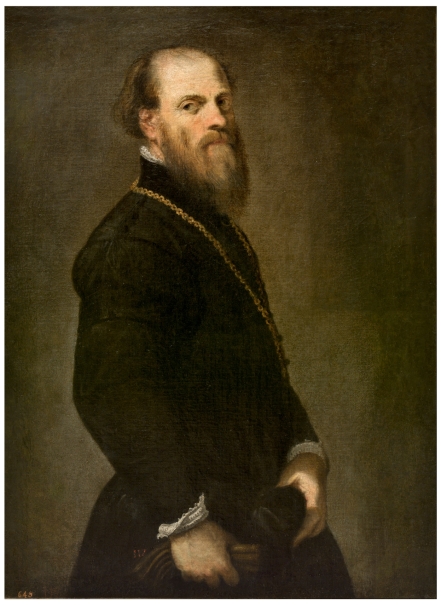
Gentleman with a Gold Chain
Oil on canvas. Ca. 1555
The Nobleman with the Golden Chain is the finest portrait by Jacopo Tintoretto at the Museo del Prado and one of that painter’s most outstanding, overall. While historians disagree about its chronology, the artist’s mastery of both the model’s anatomy and his relation to the surrounding space link it to his so-called portraits in motion from the 1550s. In fact, it is even more sophisticated and efficient than the latter works, as there are no excessive gestures and the twisting body and face are
ARTWORK
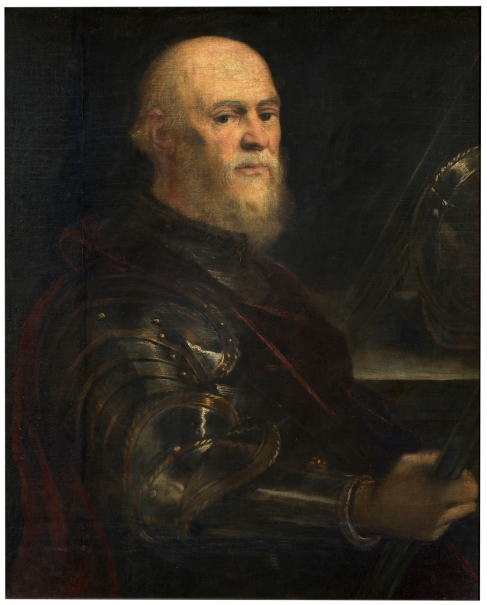
A Venetian General
Oil on canvas. 1570 - 1575
A portrait of a Venetian soldier wearing armor. He holds a baton in his right hand and his weapons in his left. Turned, he extends his arm toward the viewer, thus opening a third dimension in this composition strengthened by the force of his gaze. It has not been possible to confirm the identity of the sitter, but we must point out the similarity of this work's general composition to that of the portrait of Sebastiano Veniero at the Kunsthistorisches Museum of Vienna. Tintoretto made numerous po
ARTWORK
Loading...

Loading...

Up