formularioRDF
The itinerary <em>TITULORECORRIDO</em> has been successfully created. Now you can add in works from the Collection browser
<em>TITULOOBRA</em> added to <em>TITULORECORRIDO</em> itinerary

Close Continuar a ficha de la obra Continuar a ficha de la obra
17-02-2026
Jacopo Robusti Tintoretto

Venice (Italy), 1518 - Venice, 1594

See author's file

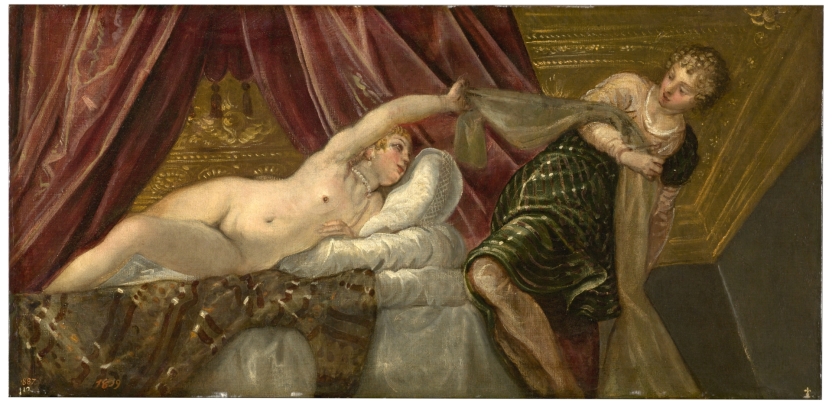
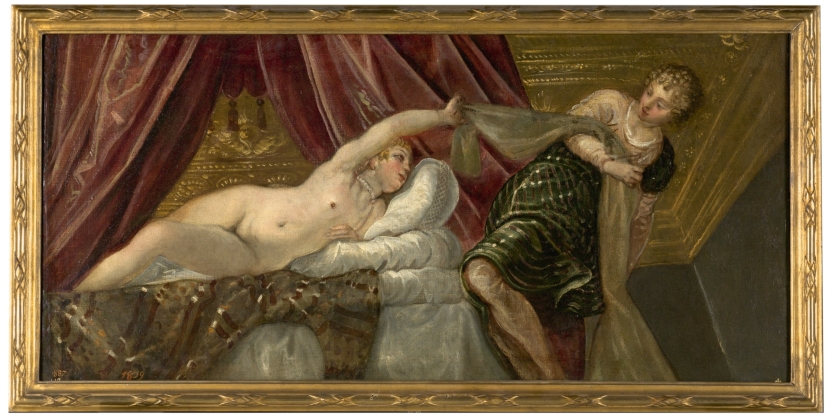
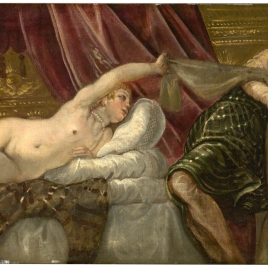
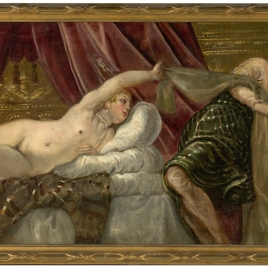
Joseph and the Wife of Putiphar

Ca. 1555. Oil on canvas.
Room 044

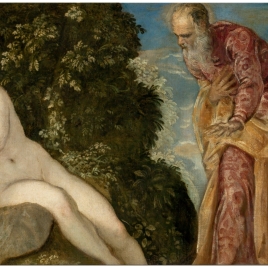
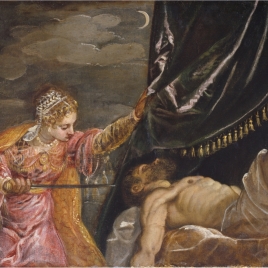
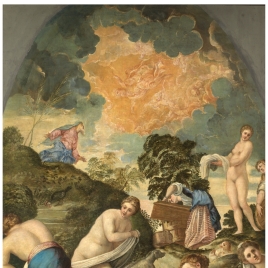
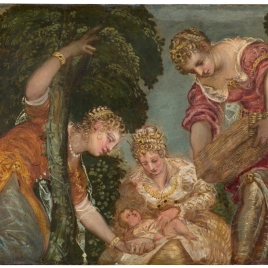
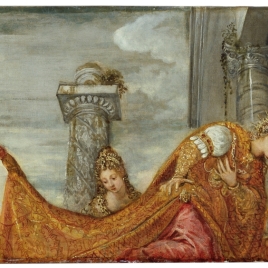
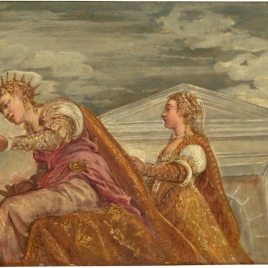
Joseph is a handsome and virtuous slave falsely accused of rape by his master´s wife, whose advances he has rejected. He is imprisoned, but eventually raised to the highest office by Pharaoh (Exodus: 39). Joseph and the Wife of Putiphar and Susannah and the Elders (P386) can be understood as parables of righteousness threatened and preserved, but here -as was usual for artists of the Renaissance and Baroque- they are presented in terms of sensuous appeal and erotic charge rather than as moral lessons. Potiphar´s wife, lushly nude except for her jewelry, appears extremely sexually aggressive. Grasping the cloth that exposes the body of Potiphar´s wife, Joseph´s backward motion only serves to exaggerate her advances. The two pictures were part of a decorative cycle that also includes representations, in a similar format, of four other Old Testament subjects: Esther before Ahasuerus (P388), Judith and Holofernes (P389), Solomon and the Queen of Sheba (P394), and the Finding of Moses (P396). The six pictures are united by a shared color scheme; an unusually long, rectangular format; and a rhythm of curving, undulating forms that runs from painting to painting. With their doll-like figures and emphasis on surface pattern, these works are far from typical of Jacopo Tintoretto´s usual style, which is characterized by intense chiaroscuro and high drama, based on heroically idealized depictions of the human body in action. These pictures are in a very different mode, one that is related to their function as furniture painting, intended primarily as decoration. Their long, narrow format; oblique perspective; decorative approach; and multiple panels indicate that they were painted as a set to adorn the upper portion of a room. Nothing is known of the original commission or location, although the ensemble was clearly intended for a secular context. The biblical subject matter provides little more than an occasion for the depiction of exotic costumes, courtly ceremony, and naked flesh. The decorative appeal of the ensemble was not lost on Diego Velazquez, who acquired it for Philip IV (r.1621-65) on his second trip to Venice. Upon its arrival in Spain, the cycle was placed on a ceiling in the so-called Bóvedas de Tiziano (Titian Vaults) in the Alcazar Palace in Madrid, which housed the other nudes in the Spanish Royal Collections. Later, the paintings became part of the collection of Queen Isabel Farnese (r. 1714-46), second wife of Philip V (r. 1700-46), at the Royal Palace of La Granja de San Ildefonso, near Segovia. Tintoretto was not widely collected in Spain during his lifetime or in the decades that followed. While he obtained several important commissions from Philip II, his style seems not to have appealed to the royal tastes, and his efforts to take the place of Titian in the king´s favor after the older artist´s death were unsuccessful. Nor were his paintings widely collected by members of the Spanish nobility during this period. The situation changed dramatically in the middle third of the seventeenth century. These were the years in which Velazquez exerted his greatest influence on Spanish collecting, and, as Miguel Falomir has suggested, the change can be attributed primarily to the Spanish painter´s appreciation for his Venetian predecessor (Tintoretto, 159-162). By 1686, the number of paintings by Tintoretto hanging in the Alcazar Palace alone (forty-three) was exceeded only by those of Titian (seventy-six) and Rubens (sixty-two), and was equivalent to that of Velazquez himself (Text drawn from Echols, R.: Splendor, Myth, and Vision. Nudes from the Prado, 2016, pp. 78-79).

Multimedia

Technical data

Imagen del carrusel
Imagen del carrusel
Inventory number
P000395
Author
Jacopo Robusti Tintoretto
Title
Joseph and the Wife of Putiphar
Date
Ca. 1555
Technique
Oil
Support
Canvas
Dimension
Height: 54 cm; Width: 117 cm
Series
Serie de las historias bíblicas
Provenance
Royal Collection (acquired by Velázquez, Venice, 1651; Alcázar Palace, Madrid, Titian Vaults, Alcove of the First Room, 1686; Alcázar Palace, Titian Vaults, Nile Room, 1700, n. 508; Isabella Farnese Collection, Royal Palace of La Granja de San Ildefonso, Segovia, 1746, n. 1112; La Granja Palace, Casa de Alhajas-otra pieza-pinturas con marco, 1766, n. 1112; La Granja Palace, Casa de Alhajas, 1774, n. 1112; La Granja Palace, 1794, n. 1112; La Granja Palace, 1814-1818, n. 1112).

Bibliography +

Palacio del Real Sitio de San Ildefonso. La Granja. 1746, Inventario general Pinturas, Muebles y otras alhajas de la Reina Nuestra Señora que tiene en el Palacio del Real Sitio de San Ildefonso, VII, Madrid, 1746, pp. 102.

Inventario: Pinturas del Real Sitio de San Ildefonso. Inventari hecho a la muerte del Señor Carlos III. 1794., Madrid, 1794, pp. 62.

Inventario La Granja 1814., Madrid, 1814, pp. 45.

Inventario de las Pinturas del Museo Hecho a la Muerte del Rey, Madrid, 1834, pp. 72.

Thode, Henry, Tintoretto, Delhagen and Klafling, 1901, pp. 72.

Osmaston, F.P.B., The art and genius of Tintoret, II, G.Bell and Sons Ltd., 1915, pp. 212.

Bercken, Erich von der, Jacopo Tintoretto, I, R.Piper, Munich, 1923, pp. 175,182,185,194 lám. 37.

Pittaluga, M., Il Tintoretto, Bologna, 1925, pp. 274-275.

Fosca, François, Tintoret, Albin Michel, Paris, 1929, pp. lám. 75.

Venturi, Adolfo, Storia dell' arte italiana, U. Hoepli, 1929, pp. 544-547.

Berenson, Bernard, Italian pictures of the Renaissance. A list of principal artists and their Works with and index of places. Venetian school, Oxford, 1932, pp. 561.

Coletti, L, Il Tintoretto, Bergamo, 1940, pp. 14-15.

Bercken, Erich von der, Die Gemälde des Jacopo Tintoretto, R. Piper & co., 1942, pp. 114, n 192 - 197.

Museo Nacional del Prado, Museo del Prado: catálogo de los cuadros, Museo del Prado, Madrid, 1942, pp. 636.

Palomino de Castro y Velasco, Acisclo Antonio (1653-1726), El museo pictórico y escala óptica, M. Aguilar, 1947, pp. 911.

Tietze, Hans, Tintoretto. The Paintings and Drawings, Phaidon, London, 1948, pp. 353-354.

Museo Nacional del Prado, Museo del Prado. Catálogo de los cuadros, Museo del Prado, Madrid, 1949, pp. 640-643.

Pallucchini, Rodolfo, La giovinezza di Tintoretto, Milano, 1950, pp. 90-91,156-157, note 49-51.

Pearce, S. M., Dating on the evidence of costume and hairdressing, Tintoretto, Greenwood Press, 1952, pp. 228-231.

Museo Nacional del Prado, Museo del Prado: catálogo de los cuadros, Museo del Prado, Madrid, 1952, pp. 655.

Welsford, R., Jacopo Tintoretto, The Burlington Magazine, XCV (600), 1953, pp. 102-104.

Berenson, Bernard, Italian pictures of the renaissance. List of the principal artists and their works with and index of places :Venetian school, I, Phaidon, London, 1957, pp. 175.

Maxon, J., The master of The Corsina 'Adulteress', The Connoisseur, 148 (Nov), 1961, pp. 254.

Pallucchini, R., Jacopo Tintoretto, Istituto di Storia dell' arte, Padova, 1962-1963, pp. 67-68.

Sánchez Cantón, Francisco Javier, Museo del Prado. Catálogo de las pinturas, Museo del Prado, Madrid, 1963, pp. 685.

Tüngel, Richard, 400 Jahre Kunst, Kultur, und Geschichte im Prado, Schweizer Verlagshaus, Zurich, 1964, pp. 190/lám. 102.

Pallucchini, R., Tintoretto, in, XIII, Venezia-Roma, 1965, pp. col. 944.

Pallucchini, A, Madrid. Prado, Milano, 1968, pp. 47.

Schulz, Juergen, Venetian Painted Ceilings of the Renaissance, University of California Press, 1968, pp. 125-126.

Pallucchini, A, Tintoretto, Firenze, 1969, pp. 12-13, 32-33.

De Vecchi, P.L, L' opera completa di Tintoretto, Rizzoli, Milano, 1970, pp. 98-99.

Aguilera, Emiliano M., El Desnudo en las Artes, Giner, Madrid, 1972, pp. 152-153.

Sánchez Cantón, Francisco Javier, Museo del Prado. Catálogo de las pinturas, Museo del Prado, Madrid, 1972.

Angulo Iñiguez, Diego, Museo del Prado: pintura italiana anterior a 1600, Gredos, Madrid, 1979, pp. 209-210.

Pignatti, Terisio, The Golden Century of Venetian Painting, County Museum of Art, Los Angeles, 1979, pp. 102.

Lassaigne, Jacques, La Grande Histoire de la Peinture. Vol. I. L'Europe Gothique, Skira, Ginebra, 1979, pp. 32.

Rescigno, E., Grande Storia Della Musica. N. 72. Joseph Haydn, Fabbri Editori, Milan, 1979, pp. 188.

Sérullaz, Maurice, Velázquez, Harry N. Abrams, Nueva York, 1981, pp. 20.

Da Tiziano a El Greco: per la storia del Manierismo a Venezi, Electa, Milan, 1981.

Martineau, J., The genius of Venice: 1500-1600, Catálogo de la exposción, Royal Academy of Arts, London, 1983, pp. 215.

Rossi, P., Il Tintoretto manierista, Cultura e Societa Nel Rinascimento Tra Riforme e Manierismi, Leo S. Olschki, Firenze, 1984, pp. 240-241.

Valcanover, Francesco, Tintoretto, Harry N.Abrams, Nueva York, 1985, pp. 94/lám. 15.

Museo Nacional del Prado, Catálogo de las pinturas, Museo del Prado, Madrid, 1985, pp. 691.

Lawner, Lynne, Lives of the Courtesans. Portraits of the Renaissance, Rizzoli, Nueva York, 1987, pp. 173.

Museo Nacional del Prado, Museo del Prado: inventario general de pinturas (I) La Colección Real, Museo del Prado, Espasa Calpe, Madrid, 1990.

Pallucchini, Rodolfo, Tintoretto: le opere sacre e profane, Electa, 1990, pp. 171-172 il.245-246.

Pilo, Giuseppe Maria, Postilla a Jacopo Tintoretto, Arte documento, 5, 1991, pp. 108-147 [123].

Checa Cremades, Fernando, Tiziano y la monarquía hispánica: usos y funciones de la pintura veneciana en España (siglos XVI y XVII), Nerea, Madrid, 1994, pp. 278, n. 67.

Jacopo Tintoretto. Ritrati, Catálogo de la exposición, Electa, Venezia, Viena, 1994, pp. 18, 20, 23.

Freedberg, S.J, Prolusione, Jacopo Tintoretto Nel Quarto Centenario Della Morte. Convegno Internazionale Di Studi.(1994.Venezia), 1996, pp. 11-16 [12].

Portús Pérez, Javier, La Sala Reservada del Museo del Prado y el coleccionismo de pintura al desnudo en la corte española, 1554-1838, Museo del Prado, Madrid, 1998, pp. 94.

Dunkerton, J. Foister, S. Penny, N, Dürer to Veronese. Sixteenth-century painting in the National Gallery, New Haven, London, 1999, pp. 129-130.

Museo Nacional del Prado, Pintura italiana del Renacimiento: guía, Museo del PradoAldeasa, Madrid, 1999, pp. 228.

Weddigen, E., Jacomo Tentor F. Myzelien, Tintoretto forschung, peripherie, interpretation, und rekunstruktion, München, 2000, pp. 221,255.

Garrido, Carmen, El Lavatorio de Tintoretto: La creación de un original, en: Una obra maestra restaurada: El Lavatorio de Jacopo Tintoretto, Museo Nacional del Prado, Madrid, 2000, pp. 36-37.

Salort Pons, Salvador, Velázquez en Italia, Fundación de Apoyo a la Historia del Arte Hispánico, Madrid, 2002, pp. 129.

Aterido Fernández, Ángel; Martínez Cuesta, Juan; Pérez Preciado, José Juan, Colecciones de pinturas de Felipe V e Isabel Farnesio. Inventarios Reales, II, Fundación de Apoyo de la Historia del Arte Hispánico, Madrid, 2004, pp. 480.

Falomir, Miguel (editor), Tintoretto, Museo Nacional del Prado, Madrid, 2007, pp. 147, 258-265.

Dunkerton, J, Tintoretto's underdrawing for Saint George and the dragon, National Gallery Technical Bulletin, 28, 2007, pp. 26-35 [35 note 9].

Hans Rottenhammer begehrt - vergessen - neu entdeckt, Hirmer, 2008, pp. 19-22.

Echols, R. Ilchman, F, 'Toward a new Tintoretto catalogue, with a checklist of revised attributions and a new chronology' En:, Jacopo Tintoretto Actas del Congreso internacional Jacopo Tintoretto (2007.Museo Nacional del Prado Madrid), Madrid, 2009, pp. 91-150 [138].

Gentili, A., Il corpo femminili e lo sguardo maschile nella pittura veneziana del Cinquecento: Tiziano, Tintoretto, Veronese, L' arte erotica del rinascimento. Atti del Colloquio internazionale (2008, Tokyo), 2009, pp. 49-56.

Venezia e l'Egitto, Skira, 2011, pp. V5, 306-7 / 155.

Binotto, M, 'José e la moglie di Putifar' Il Tintoretto In: Tintoretto, Skira, 2012, pp. 92-93.

Azanza, José Javier, 'Cargado el cuerpo de vicios...catequesis, iconografía y emblemática en torno al sexto mandamiento' En: Valor discursivo del cuerpo en el barroco hispánico, Universitat de València,, 2015, pp. 155-172 [167 f.6].

Martínez Leiva, Gloria; Rodríguez Rebollo, Ángel, El inventario del Alcázar de Madrid de 1666. Felipe IV y su colección artística, Consejo Superior de Investigaciones Científicas, Madrid, 2015, pp. 622 nº 915.

Portús Pérez, Javier, Displaying the Nude in Spain 1550-1834. The Sala Reservada, en: Splendor, Myth, and Vision: Nudes from the Prado, Clark Art Institute; Museo Nacional del Prado, 2016, pp. 50-66 [59].

Echols, R, 'Jacopo Tintoretto. Joseph and Potiphar's wife" En:, Splendor, Myth, and Vision : Nudes from the Prado, Clark Art Institute ; Museo Nacional del Prado,, 2016, pp. 78-84 n.4.

Burke, Jill, The European Nude 1400-1650, en: Splendor, Myth, and Vision: Nudes from the Prado, Clark Art Institute ; Museo Nacional del Prado, 2016, pp. 16-49 [34,41].

Tintoretto: A Star was born, Wallraf, das Museum, Wallraff-Richartz-Museum, Munich, 2017, pp. 197 e n.61.

Tintoretto 1519-1594, Marsilio,, 2018, pp. 252 f.181.

Tintoret: Naíssance d'un génie, Éditions de la Reunión des musées nationaux,, Paris, 2018, pp. 199-200 n.61.

Other inventories +

Inv. Felipe IV, Alcázar de Madrid, 1686. Núm. s. n..
Bóvedas del Tiziano [...] Bóvedas (que llaman) del Tiziano [...] {888} Y en la Alcoua de la primera pieza de estas Bobedas ay en el techo vna Pintura aobada de vnas nimfas y vn Baño de mano de Tintoreto, y en su circunferençia ay seis adornos de Pintura de diferentes fabulas puestas a la gracia y adorno de la Pintura Prinçipal.

Inv. Testamentaría Carlos II, Alcázar de Madrid, 1701-1703. Núm. [508].
Bobedas del tiçiano [...] 508 / Yttem en el techo del aposentto donde estta el Nilo Ottra Pinttura aobada de Unas ninfas y Vn Vaño de mano de Tinttoretto y en Su Circunferenzia Seis adornos de pintturas de diferenttes fabulas puesttas a la Grazia y adorno de la pinttura prinzipal Con marco negro tasada en Seiscienttos doblones ... 600

Inv. Isabel Farnesio, La Granja, 1746. Núm. 1112.
1112-1113-1114-1115 / Quatro, Pinturas en Lienzo, de mano del Ticiano; que representan la 1ª. Jph. que huye de la Muger de Putifano. La 2ª. la Sussana. La 3ª. quando la Hija de Faraon sacò à Moyses del Rio; Y la 4ª. Sisara. Tienen à dos pies, y un dedo de alto; quatro y tres de ancho. Sin Marco ... 4

Inv. Testamentaría Isabel Farnesio, La Granja, 1766. Núm. 1112.
Casa de Alajas donde estan depositadas algunas cosas [...] Ôtra Pieza siguen las Pinturas [...] Pinturas con marco [...] 1112 / Una pintura con marco liso de quatro pies de largo, y dos y medio de ancho, representa la Muger de Putifar agarrada de la capa de Josèf vale ciento y cincuenta rrs

Inv. Carlos III, La Granja, 1774. Núm. 1112.
{17959} 1112 - Quatro pies de largo dos y medio de alto la mujer de Putifar agarrada a la capa de Josef misma pieza [casa de alajas] ... 150

Inv. Testamentaría Carlos III, La Granja, 1794. Núm. 1112.
Otra en lienzo de 4 pies de largo por 2 1/2 de alto, marco dorado liso, representa á Josef el cast y la muger de Putifar: en ciento y cincuenta reales. Tintoreto ... 150

Inv. Fernando VII, La Granja, 1814-1818. Núm. 1112.
{20527} 1112 / Quatro pies de largo dos y medio de alto Jose el Casto y la muger de Putifar = Tintoreto

Inv. Testamentaría Fernando VII, Real Museo, Sala Reservada, 1834. Núm. 2.
DOS. La muger de Putifar. Está asiendo de la capa a José que procura escapar / Tintoretto. Escla Venecna / L. / 2160

Museo Real de Pinturas a la muerte de Fernando VII, 1834. Núm. 2.
SALA RESERVADA / Dos. La muger de Putifar. Está asiendo de la capa a José que procura escapar / Tintorello Escuela Veneciana / Lº / 2.160

Catálogo Museo del Prado, 1854-1858. Núm. 1839.

Inv. Real Museo, 1857. Núm. 1887.
Tintoretto. / 1887. El Casto José. / Alto 2 pies, 1 pulg; ancho 1 pie, 7 pulg.

Catálogo Museo del Prado, 1872-1907. Núm. 422.

Catálogo Museo del Prado, 1910. Núm. 395.

Catálogo Museo del Prado, 1942-1996. Núm. 395.

Inscriptions +

N.395
Scrap of paper. Stretcher

1839
Inscribed in red color. Front, lower left corner

887.
Inscribed in orange. Front, lower left corner

Tirinnanzi Restauró Fevrero 1856
Inscribed. Front

Los Angeles County Museum Exp. 79913
Scrap of paper. Stretcher

B77 (2 veces)
Inscribed with chalk. Stretcher


Fleur-de-lys , used as a collection’s mark belonged to Queen Isabella Farnese. Front, lower right corner

M.N.PRADO / 000395
On metallic tablet. Stretcher

110
Inscribed in white. Front, lower left corner

capa
Inscribed with chalk. Frame, front, right side bar

167
Scrap of paper. Frame, back

Exhibitions +

Tintoretto 500th Anniversary
Venecia
07.09.2018 - 06.01.2019

Tintoretto. A Star is born
Colonia
06.10.2017 - 28.01.2018

Splendor, Myth and Vision: Nudes from the Prado
Williamstown MA
12.06.2016 - 10.10.2016

Jacopo Robusti Tintoretto
Roma
24.02.2012 - 10.06.2012

Venezia e l'Egitto
Venecia
30.09.2011 - 22.01.2012

Tintoretto
Madrid
30.01.2007 - 13.05.2007

Location +

Room 044 (On Display)

Expuesto
Update date: 17-02-2026 | Registry created on 28-04-2015

Visor 360

Drag with the cursor to rotate the piece

Other works by Jacopo Robusti Tintoretto

Print on demand

Print artworks available in our catalogue in high quality and your preferred size and finish.

Image archive

Request artworks available in our catalogue in digital format.

Up