formularioRDF
The itinerary <em>TITULORECORRIDO</em> has been successfully created. Now you can add in works from the Collection browser
<em>TITULOOBRA</em> added to <em>TITULORECORRIDO</em> itinerary

Metabuscador

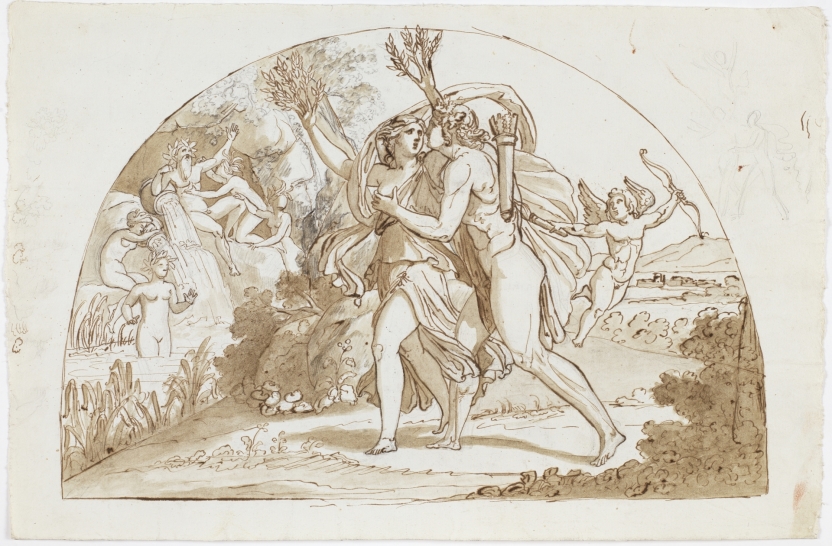
Apollo and Daphne
Pencil, Grey-brown wash, Pencil on laid paper. 1812 - 1813
This drawing, based on the account in Ovid’s Metamorphoses, shows Apollo attempting to catch Daphne, who begs to be turned into a laurel in order to escape her pursuer. Peneus, her father, is visible in the background surrounded by nymphs, while Cupid – in full flight – points down at the scene. Madrazo set down the outlines in pen and wash, then reworked them in charcoal; the resulting pictorial effect suggests that this may have been a preparatory drawing for a painting.
ARTWORK
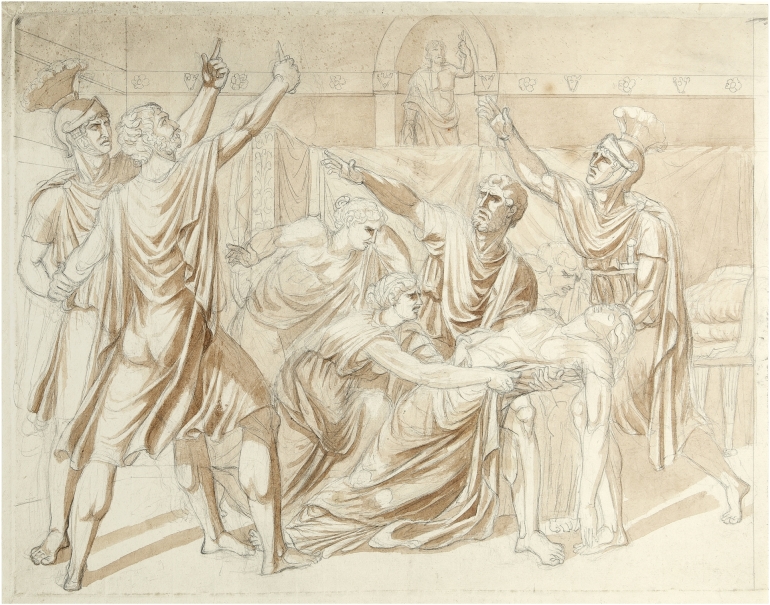
Modellino for The Death of Lucretia and the Oath of Brutus
Wash, Pencil on paper. Ca. 1804
Regarded as the supreme example of feminine virtue for the classical world, Lucretia’s suicide after being raped by the son of the last king of Rome led the men of her family –her father Lucretius, her husband Collatinus, Publius Valerius and Brutus – to swear vengeance against the rapist. This story, traditionally hailed as the origin of the Roman Republic, was turned into a political allegory in the context of the French Revolution. For his adaptation of the episode, Madrazo adopted a declamat
ARTWORK
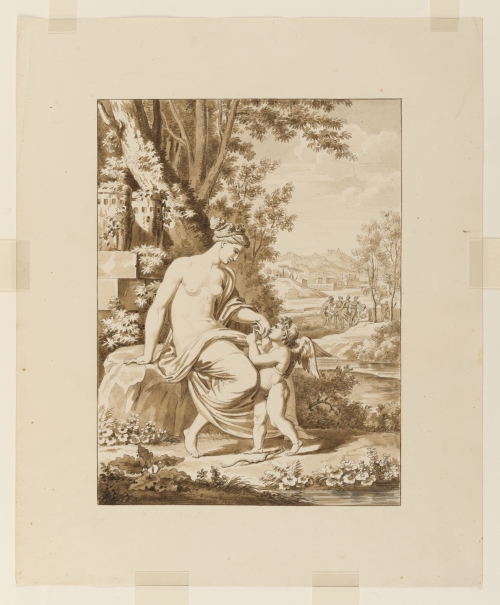
Eros Scolded by Aphrodite
Black ink, Grey-brown wash, Pencil, Pencil ground on wove paper. Ca. 1812
This definitive drawing for an etching on the same theme, produced by Madrazo in Rome, shows the gods resting – amidst a dizzying play of chiaroscuro – in a broad, detailed landscape. It is remarkable both for the delicate treatment of the female body and for the inclusion of the three Graces dancing with shepherds, a scene recalling Raphael’s painting at Chantilly, in a tribute to the vagaries of love as narrated by Lucian of Samosata.
ARTWORK
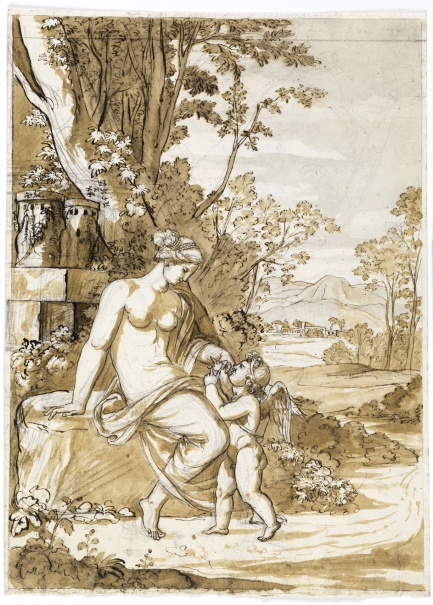
Eros Scolded by Aphrodite
Pencil, Grey-brown wash, Pencil ground, Grey-brown ink on wove paper. 1812
This preliminary drawing sheds light on Madrazo’s creative approach. On the verso, a pencil sketch suggests a horizontal setting in which the landscape plays a more prominent role. On the recto, after experimenting with denser vegetation, he completed the scene with ink and wash, removing unwanted lines and achieving a pictorial effect that foreshadows the final composition.
ARTWORK
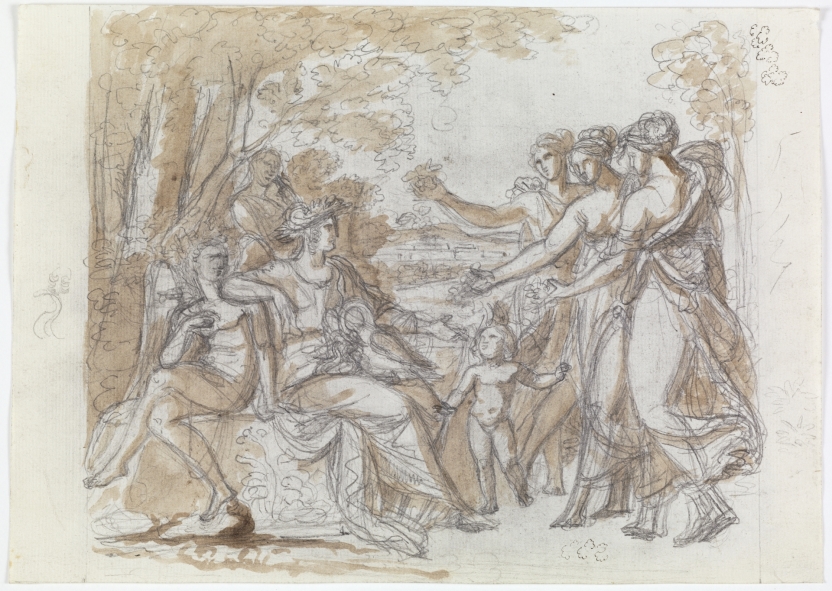
Leda and the Swan
Indian ink wash, Pencil, Grey-brown wash, Pencil on laid paper. Ca. 1812
This drawing, remarkable for its sharp outlines and precise shading, reworks the myth of Leda and the swan, using allegorical elements taken from Apollodorus’ account. Leda holds the bird – according to Ovid, “the adulterer [Zeus] had covered himself in feathers”– while the Three Graces pour gifts into her lap; they are accompanied by a winged figure, perhaps Divine Love, in a scene of great symbolic complexity.
ARTWORK
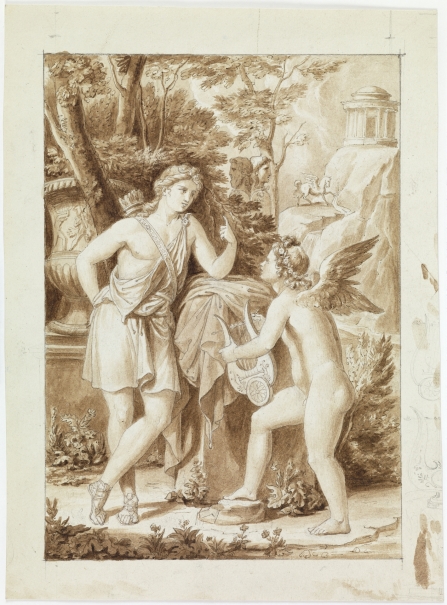
The Dispute between Apollo and Cupid
Grey-brown wash, Pencil, Pencil on wove paper. Ca. 1812
The drawing brings together three mythological tales: the dispute between Apollo and Cupid, which gave rise to the myth of Apollo and Daphne; in the background, Pegasus is creating the Hippocrene spring on Mount Helicon; finally, in the scene featured in the highly-decorated urn, the cunning Hercules, having secured the golden apples, leaves Atlas burdened with the celestial vault.
ARTWORK
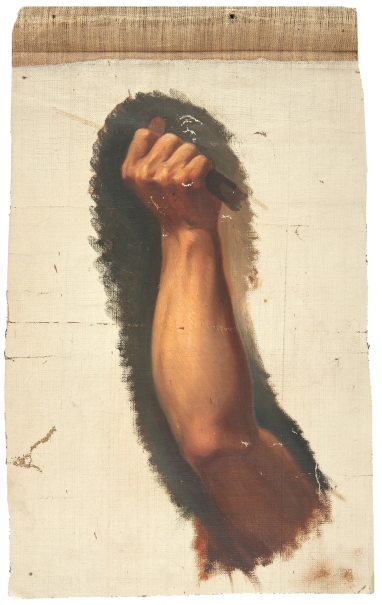
Study of a raised arm
Oil on canvas. Ca. 1812
This is the only oil study related to what is considered the most ambitious painting performed by José de Madrazo during his sojourn in Italy: The Greeks and the Trojans Fighting over the Body of Patroclus. It was executed in 1812 to decorate one of the rooms in the Palazzo del Quirinale as part of the redecoration programme of its rooms to serve as a residence for Napoleon Bonaparte during his visit to the Eternal City.This missing painting by José de Madrazo is known through wate
ARTWORK
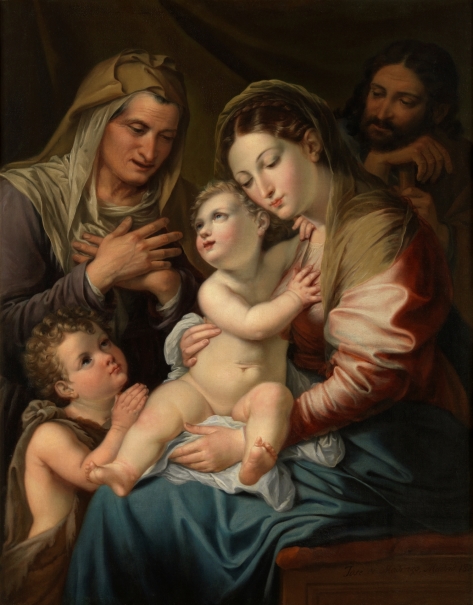
Holy Family
Oil on canvas. 1839
In a very tight foreground enhanced by the studied use of lighting devices, the Virgin Mary appears sitting and holding in her lap the Christ Child, who sweetly rests his hands on her body while gazing at Saint Elizabeth. Saint Elizabeth leans over little Saint John, who is kneeling and delicately laying his clasped hands on the Christ Child. Together as a group they establish an almost sculptural cohesion, magnified by the excessive size of the depicted figures. In the background, the absent fi
ARTWORK
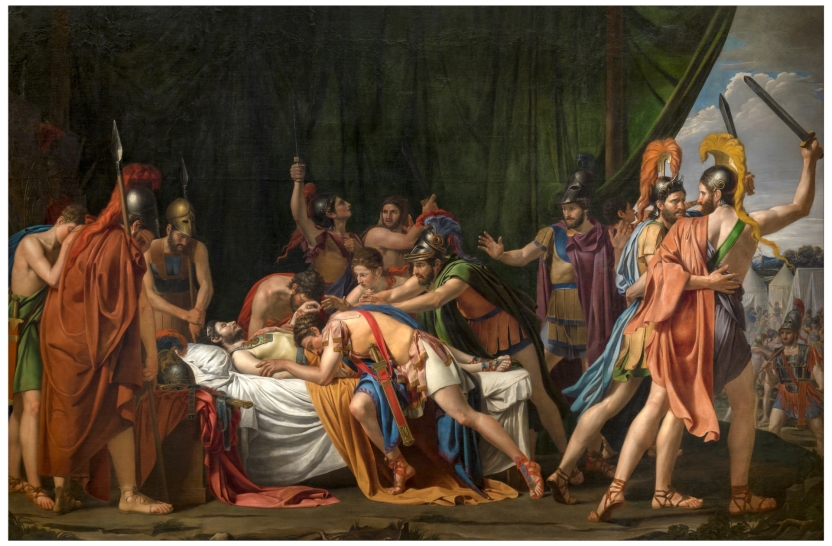
The Death of Viriatus, Chief of the Lusitanians
Oil on canvas. 1807
This massive canvas has traditionally been considered José de Madrazo’s masterpiece as well as the most emblematic painting of Spanish Neoclassicism. It has been exhibited in the Museo del Prado since it opened in 1819 in the Galería de Artistas Contemporáneos. As a result, it has since acquired enormous fame and recognition within the 19th century official milieu, as well as in Spanish art historiography up to the present day.This work was painted in Rome thanks to the allo
ARTWORK
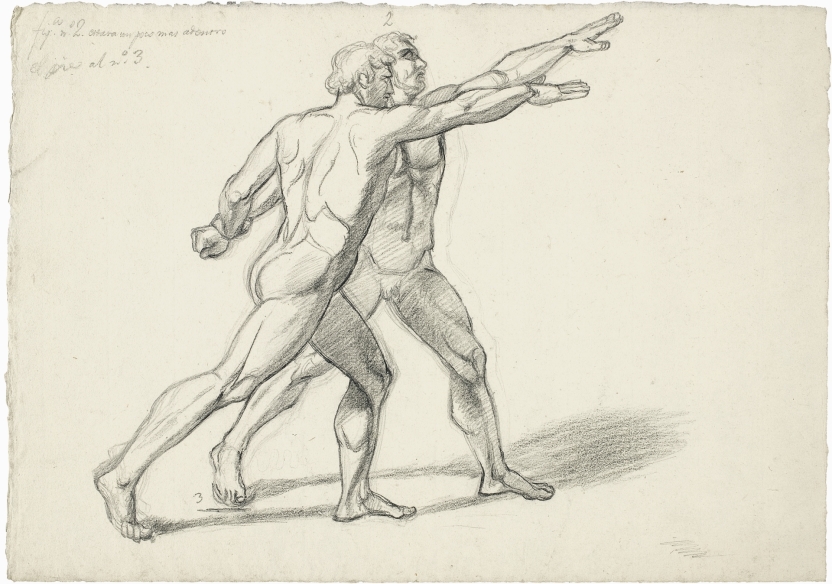
Study of two nude men for The Death of Lucretia and the Oath of Brutus
Charcoal, Pencil on laid wrapping paper. Ca. 1804
Stressing its political significance, Madrazo placed the main focus of The Death of Lucretia on the oath, for which he drew inspiration from the classical statuary he had studied in Paris and Rome. Although he finally lightened the monumental treatment of the group, the preparatory anatomical drawings show that such studies were uppermost in his mind from the outset; they also testify to the various ideas he considered and discarded before deciding on the final appearance of the work.
ARTWORK
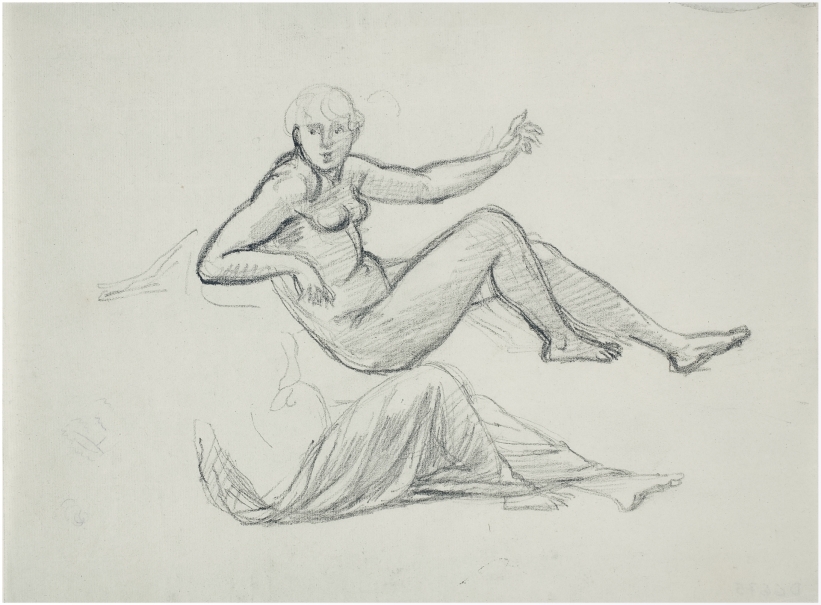
Reclining female figure. Study of Drapery
Pencil on laid paper. 1812 - 1813
This was a preparatory drawing for one of the figures in the Apollo and Hyacinthus lunette, possibly a nymph or a personification of Lacedaemonia. Madrazo first focused on the nude figure, meticulously revising outlines and volumes, before adding the drapery over her legs. The depiction of the woman, leaning against a plinth, her head turned towards the viewer, testifies to Madrazo’s rigorous compositional approach and his attention to detail.
ARTWORK
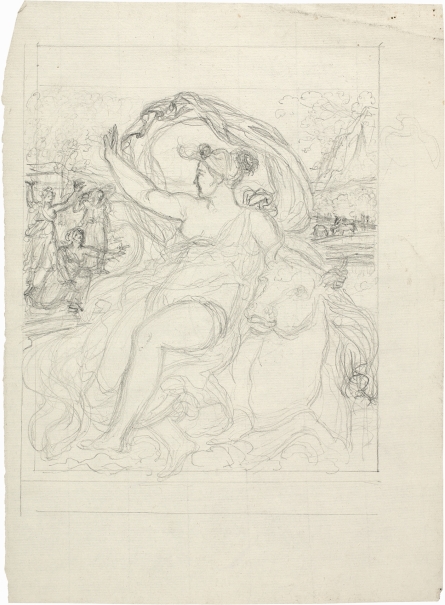
The Rape of Europa
Pencil on laid paper. Ca. 1812
For this recreation of the abduction of Europa, Madrazo drew on Ovid’s Metamorphoses and on earlier depictions including the frescoes at the Palazzo Farnese in Rome and engravings made by Giovanni Battista Palumba (active 1500-15). Europa, borne away by Zeus in the form of a white bull, clings to his horns while her companions wave frantically from the shore. The drawing, gridded for transfer, is notable for its detailed landscape and elegant composition.
ARTWORK
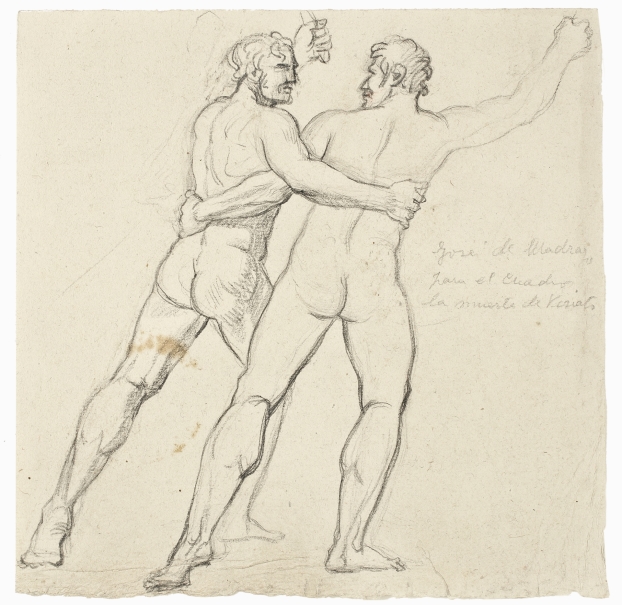
Study of two men embracing for The Death of Viriatus
Charcoal on paper. Ca. 1807
Madrazo’s drawings are conceived with a practical sense which subverts the ideas espoused by Anton Rafael Mengs and inculcated in Madrid painters; rather, they embrace the notions of expressive utility, synthesis and brevity that David urged on his students, especially when dealing with ancient statues. His anatomical studies often replicate or counteract poses adopted by the famous statues then kept in the collections and museums that he was able to study at first hand, whose influence can be t
ARTWORK
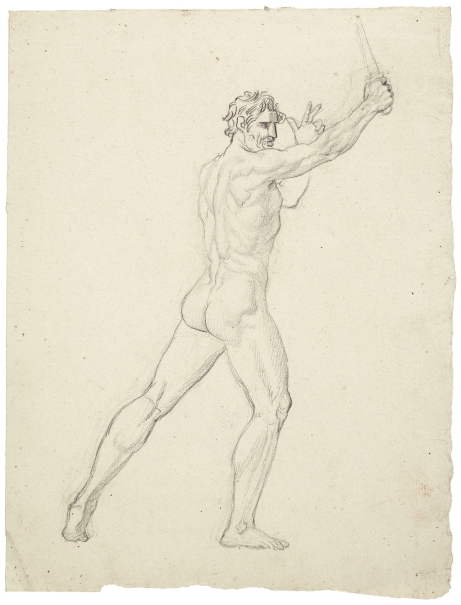
Study of a male nude in profile brandishing a dagger, for The Death of Viriatus
Conté crayon on grey paper. Ca. 1807
The artist carefully studied each figure in the composition, undressing them and analysing the shifting position of their muscles in every gesture he devised, in order to find in each case the most persuasive and distinctive formula. The group comprising the two armed figures swearing vengeance for the death of Viriatus is far more meticulously worked than the rest; Madrazo experimented with several alternative positions for the arms and legs, and even with different numbers of men swearing the
ARTWORK
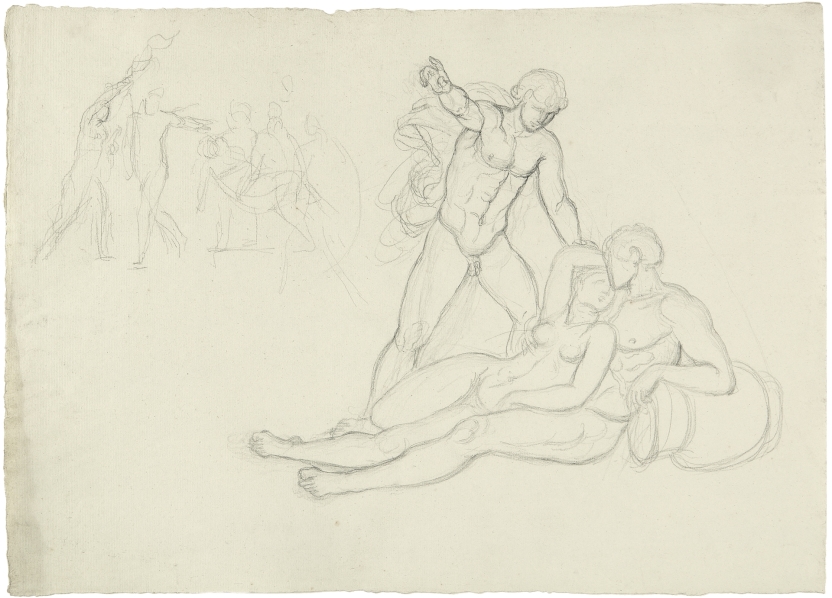
Nude Couple Alerted by a Man. Studies
Pencil on laid paper. 1812 - 1813
This drawing, linked to Apollo and Hyacinthus, shows the river-god Eurotas reclining beside a nymph who embraces him, while a man – a dynamically foreshortened figure in dishevelled attire – alerts them. Madrazo captures the anatomies with considerable narrative economy. Smaller studies in the upper corner may allude to Zephyrus throwing the discus which brought about Hyacinthus’s death, and to his burial near the temple of Apollo at Amyclae.
ARTWORK
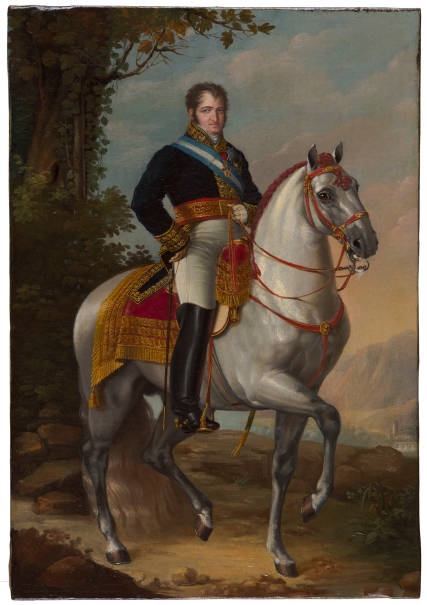
Ferdinand VII on horseback (preliminary study)
Oil on canvas. 1821
Madrazo would have presented this preliminary study to the king for approval before painting the final version, which is also in the Prado (P3295). For many years the large-scale definitive version was the only painting of Ferdinand displayed to the public in the museum he had founded. He is shown as commander-in-chief of the Spanish armed forces beside an oak tree that refers to the virtues of the good ruler.
ARTWORK
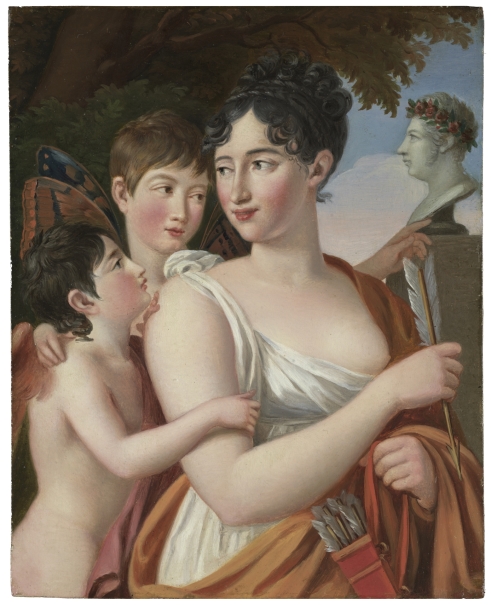
Josefa Tudó with her sons Manuel and Luis Godoy, in a garden
Oil on panel. Ca. 1812
This group portrait depicts Josefa Tudó (1779–1869), first countess of Castillo Fiel, with her two sons, Manuel and Luis, around a portrait bust of their father, Manuel Godoy (1767–1851). It is the artistic expression of an atypical family reality through allegorical code. Produced during the Roman exile of King Charles IV’s favourite, this painting synthesises the predilection for classical culture that both Godoy and Madrazo shared. This picture first introduced into the Museo del Prado
ARTWORK
Loading...

Loading...

Up